Navy celebrates 100th delivery of AESA radar
NAVAL AIR SYSTEMS COMMAND, Patuxent River, Md. -- The Navy and its industry partners, Raytheon and Boeing, marked the 100th delivery of the APG-79 Active Electronically Scanned Array (AESA) Radar at a celebration in Forest, Miss., July 1.
Two F/A-18 Super Hornets present at the event showcased the radar used by the Navy’s F/A-18 Hornet, Super Hornet and the EA-18G Growler.
The technology will support the Navy’s mission and define its combat capability and the viability of the warfighter in the future.
“This milestone proves the importance not only of developing a revolutionary and viable solution but of teaming closely with our customers to ensure they receive exactly what they need to keep our aviators safe,” said Dr. Tom Kennedy, vice president for the Tactical Airborne Systems group at Raytheon Space and Airborne Systems.
The APG-79 AESA synthetic aperture radar (SAR) has a higher success rate than previous radar technologies. AESA’s open systems architecture incorporates commercial off-the-shelf components and is anticipated to be more affordable and require maintenance only every 10 to 20 years.
“The incorporation of the AESA radar has revolutionized the F/A-18 and EA-18G fleet. The advanced capabilities encompassed in the radar ensure the Super Hornet and Growler’s dominance in the radar technology arena. It provides the platforms with increased range and resolution, allows the tracking of more targets than current systems in use and features high-resolution SAR maps at long standoff ranges,” said Cmdr. Andrew McFarland, F/A-18 & EA-18G Radar Integrated Product Team military lead for the Navy, regarding the capabilities of the AESA radar. “It is truly a great time to be a Navy aviator.”
Tracking twice as many targets as the radar it replaces, the AESA features active electronic beam steering, which allows the radar beam to be repositioned nearly instantaneously. In addition, the radar allows more time for persistent target observation and information sharing before critical decisions are made. This results in increased aircraft effectiveness and aircrew survivability.
Five Navy squadrons have already transitioned to the radar. The first AESA-equipped squadron, Strike Fighter Squadron 22, also known as the “Fighting Redcocks,” is currently deployed and has noted the enhanced operational capabilities, hardware reliability levels and reduced maintenance.
-- 30 –
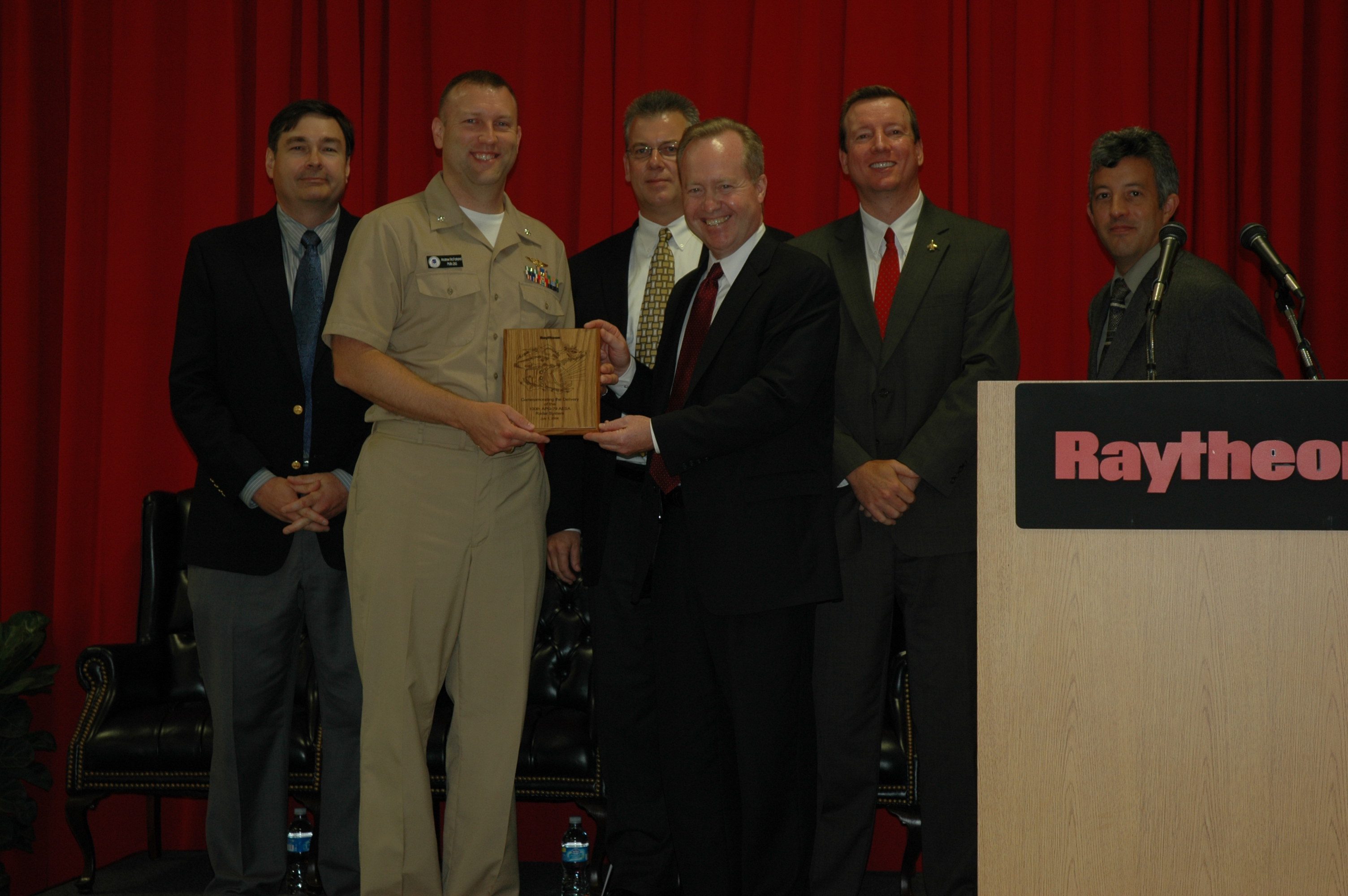
Steve Collins, Raytheon F/A-18 program director, presents Cdmr. Andrew McFarland with a plaque in commemoration of the 100th AESA delivery milestone. Also pictured is Bob Hildebrand, Forest site director, Tom Kennedy, vice president, Raytheon Tactical Airborne Systems, Mike Gibbons, Boeing EA-18G and acting F/A-18 program manager, and Eric Ditmars, Raytheon APG-79 AESA program manager. Photo By Wynona Moore