

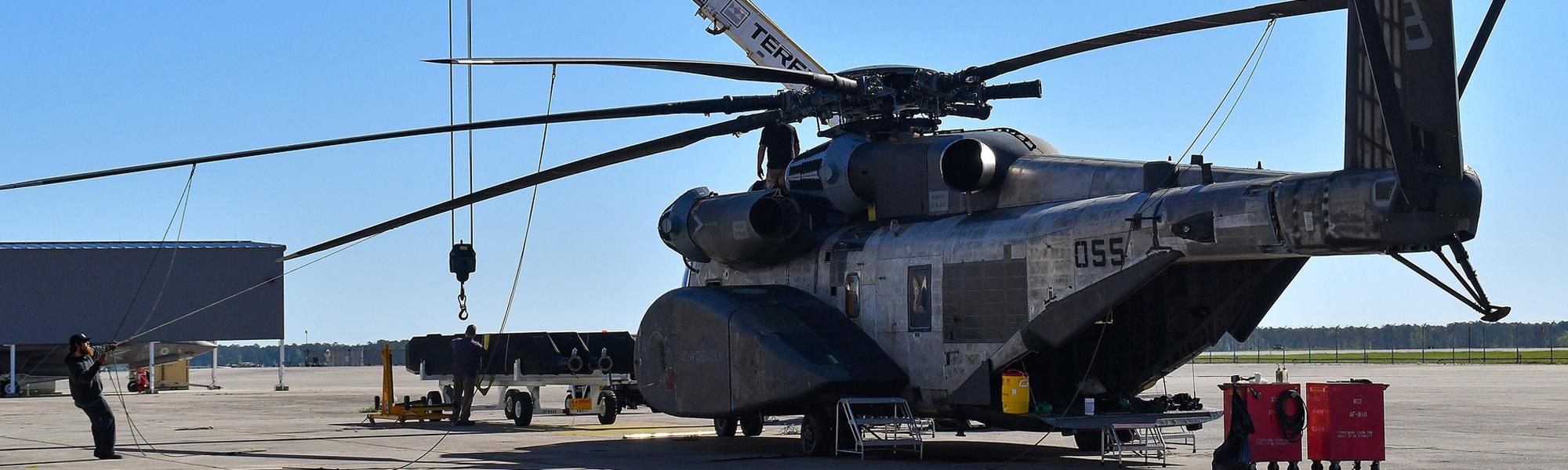

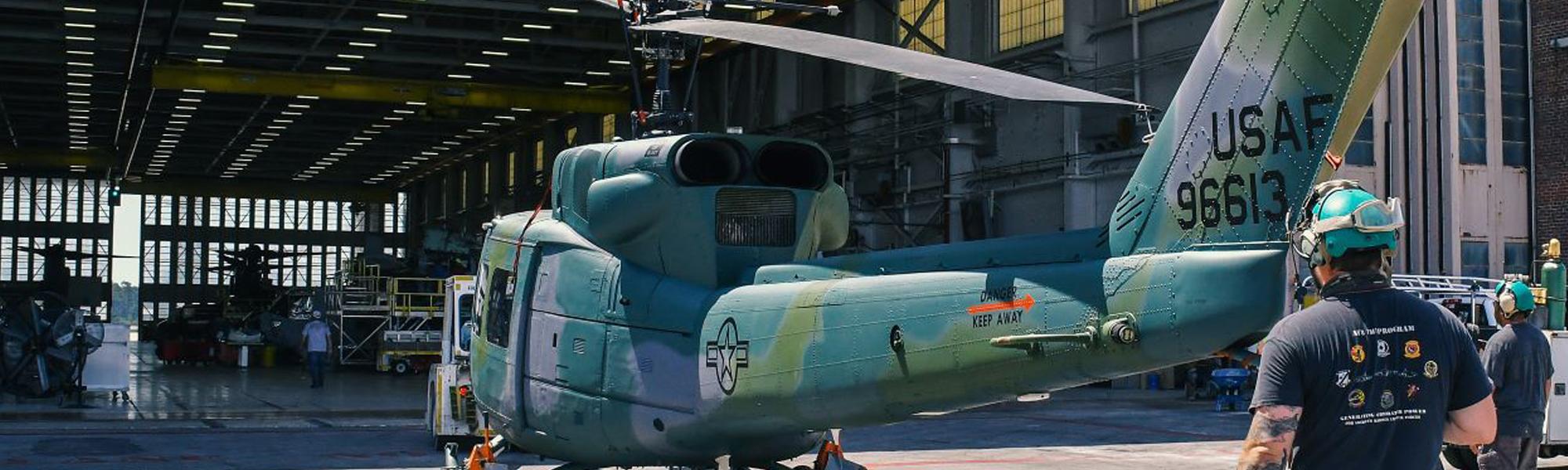


FLEET READINESS CENTER EAST~ Service to the Fleet ~Since 1943, Fleet Readiness Center East aboard Marine Corps Air Station Cherry Point, North Carolina, has played an important part in national defense. Our workforce has earned a reputation of excellence in providing world-class maintenance, engineering and logistics support for Navy and Marine Corps aviation, as well as other armed services, federal agencies and foreign governments. Our skilled workforce uses state-of-the-art technology to ensure that FRCE is without equal in providing quality, cost-effective support. Our employees take great pride in their work, and this professional spirit is evident in the high-quality products they produce. |
|---|
Our mission is to maintain and operate facilities and perform a complete range of depot level rework operations on designated weapon systems, accessories, and equipment; manufacture parts and assemblies as required; provide engineering services in the development of changes of hardware design; furnish technical services on aircraft maintenance and logistic problems; and perform, upon specific request or assignment, other levels of aircraft maintenance. |
FLEET READINESS CENTER EAST~ Service to the Fleet ~Since 1943, Fleet Readiness Center East aboard Marine Corps Air Station Cherry Point, North Carolina, has played an important part in national defense. Our workforce has earned a reputation of excellence in providing world-class maintenance, engineering and logistics support for Navy and Marine Corps aviation, as well as other armed services, federal agencies and foreign governments. Our skilled workforce uses state-of-the-art technology to ensure that FRCE is without equal in providing quality, cost-effective support. Our employees take great pride in their work, and this professional spirit is evident in the high-quality products they produce. |
|---|
Our mission is to maintain and operate facilities and perform a complete range of depot level rework operations on designated weapon systems, accessories, and equipment; manufacture parts and assemblies as required; provide engineering services in the development of changes of hardware design; furnish technical services on aircraft maintenance and logistic problems; and perform, upon specific request or assignment, other levels of aircraft maintenance. |
Sep 25, 2026
McDonald assumes command at FRCE
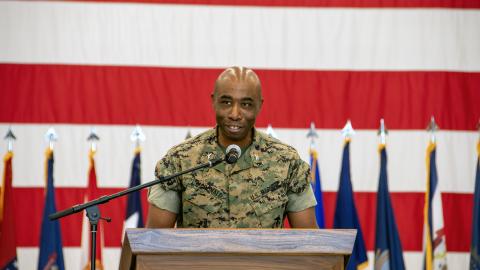
Marine Corps Col. Christopher McDonald II assumed command of Fleet Readiness Center East (FRCE) from Navy Capt. Randy Berti during a change of command ceremony Sept. 25.
During the ceremony, Berti formally transferred authority and responsibility of the depot to McDonald in front of an audience of hundreds of FRCE employees, distinguished visitors and special guests.
Berti assumed command Sept. 12, 2024, after serving as FRCE’s executive officer, the depot’s second-in-command, for two years. Berti said the four years he spent at FRCE gave him a front-row seat to the most service-focused team he has ever worked with.
“It has been an absolute honor to lead this command and witness firsthand the incredible talent and dedication of the great Americans of FRC East,” said Berti. “Beyond the services we provide, what truly defines FRC East is a culture of dedication to the mission. Every member of this world-class workforce is united by a clear, common purpose: keeping our warfighters safe and ready, every day. As I hand over the watch, I leave confident that this command's unique spirit and commitment will carry it forward to accomplish even greater things well into the future.'
Under Berti’s leadership, FRCE significantly expanded its operational footprint and secured additional future workload, ensuring the depot’s role in supporting the warfighter for decades to come. This success was defined by a first-of-its-kind partnership between the Navy and the state of North Carolina to construct a new, state-of-the-art aviation maintenance, repair and overhaul complex at the North Carolina Global TransPark in Kinston.
FRCE celebrated the project with a ribbon cutting ceremony Sept. 17. The facility will support the depot’s incoming workload for the Navy and Marine Corps C/KC-130 Hercules/Super Hercules transport aircraft and Air Force HH-60W Jolly Green II search and rescue helicopters and is scheduled to induct its first aircraft in 2026.
While the Kinston facility was the largest new addition during Berti’s command, FRCE also completed a major F-35 Lightning II expansion project in January 2025, which provided the command additional space and aircraft bays to support the increasing F-35 modification workload. Combined, these two infrastructure upgrades represent the opportunity to significantly increase the depot’s workload.
Berti also advanced the depot's capabilities for next-generation platforms. In early 2025, FRCE inducted the fleet's first CH-53K King Stallion for the Age Exploration Program, Depot, marking the first time the platform had ever undergone depot-level maintenance. This was followed by the induction of the platform’s first T408-GE-400 turboshaft engine, which powers the King Stallion. Additionally, the depot inducted its first CMV-22B Osprey, making FRCE the sole maintenance provider with the capability to overhaul all three V-22 variants.
These operational milestones were further bolstered by FRCE’s designation as the Commander, Fleet Readiness Centers Additive Manufacturing Center of Excellence in October of 2024, positioning the depot as the enterprise’s leading site for polymer and metallic 3D-printed solutions.
Beyond operational achievements, Berti reinforced a command-wide culture of fiscal responsibility that achieved a $56 million positive impact to the depot’s net operating result in 2025. The command also successfully streamlined its billing process to close out over $330 million in sales orders and slashed financial adjustment turnaround times from weeks to just three days. These efforts earned the Comptroller Department recognition from the Assistant Secretary of the Navy for exceptional financial management.
FRCE also received numerous Department of the Navy-level safety and occupational health accolades with Berti in command. These include the depot’s second consecutive Chief of Naval Operations Shore Safety Award in the Large Industrial category, the Chief of Naval Operations Aviation Safety Award, and the Admiral Verk Clark Safety Award. The command was also recognized by the North Carolina Department of Labor with its eighth consecutive Gold Award and two Million-Hour Awards.
Berti was presented with the Legion of Merit during the ceremony for his service while in command. The Legion of Merit is awarded to individuals who distinguish themselves by exceptionally meritorious service in a duty of great responsibility.
McDonald, who has served as the depot’s executive officer since 2024 and previously served as the depot’s logistics and industrial operations military deputy group head from 2016 to 2018, said it is an incredible honor to return to the command in this new leadership capacity.
“It is an honor and privilege to take command of this outstanding organization,” McDonald said. “What this 3,900-plus workforce of Marines, Sailors and civilians brings to the fight each day is remarkable – directly contributing to the six warfighting functions of Marine aviation, the Navy and the Joint Force. Under Captain Berti’s command, FRC East consistently delivered critical world-class aviation maintenance and technical support to the fleet, having a direct positive impact on readiness.”
McDonald is a native of Poplar Bluff, Missouri, and brings over 25 years of distinguished military service to his new role as FRCE commanding officer. McDonald’s military career began in 1998 upon enlisting in the Marine Corps. After earning his commission as an officer in December 1999, he built a distinguished career in aviation logistics, highlighted by his successful command of Marine Aviation Logistics Squadron 14 from 2018 to 2020.
Throughout his career, he has served in premier staff assignments, including serving as the aviation supply officer at Headquarters Marine Corps in Washington, D.C., and as a defense resource portfolio manager for the Chairman of the Joint Chiefs of Staff at the Pentagon. McDonald also deployed in support of Operation Iraqi Freedom and Operation Enduring Freedom in Afghanistan. His personal decorations include the Defense Meritorious Service Medal, four Meritorious Service Medals, three Navy and Marine Corps Commendation Medals, and a Navy and Marine Corps Achievement Medal.
The incoming executive officer, Capt. Charles Fisher Jr., reports to FRCE after serving as the maintenance officer for Commander, Strike Fighter Wing Atlantic at Naval Air Station Oceana, Virginia Beach.
FRCE is North Carolina's largest maintenance, repair, overhaul and technical services provider, with more than 3,900 civilian, military and contract workers. Its annual revenue exceeds $886 million. The depot provides service to the fleet while functioning as an integral part of the greater U.S. Navy; Naval Air Systems Command; and Commander, Fleet Readiness Centers.
Sep 23, 2026
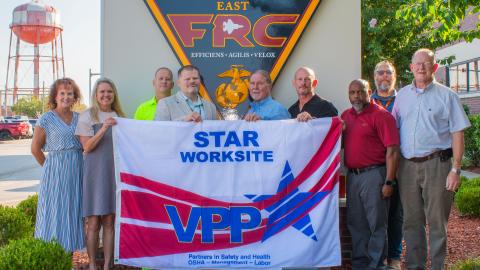
Fleet Readiness Center East Earns Landmark Third OSHA VPP Star Designation
Fleet Readiness Center East (FRCE) has earned Voluntary Protection Program (VPP) Star recognition from the Occupational Safety and Health Administration (OSHA) in a third application area, becoming the only Naval Air Systems Command (NAVAIR) facility to achieve VPP Star recognition in three areas, reinforcing its position as a national leader in defense industrial safety.
VPP Star recognition represents OSHA’s highest level of achievement for workplace safety and health, awarded only to organizations that maintain rigorous injury-prevention standards and demonstrate exemplary safety cultures.
“Achieving VPP Star recognition in a third area is a tremendous accomplishment for FRC East and a reflection of our workforce's commitment to safety,” said FRCE Commanding Officer Capt. Randy J. Berti. “This designation shows that safety is not simply a requirement for us. It is part of who we are. Keeping our team safe isn’t just a priority; it is the foundation of our entire operation.”
Application Area Foxtrot extends FRCE's safety protocol beyond the hangar floor to include Fleet Support Teams (FSTs) and Maintenance, Repair, and Overhaul Engineering (MRO-E). In total, engineers and logisticians make up nearly half of FRCE’s workforce.
David Keeling, Assistant Secretary for Occupational Safety and Health, commended the command’s proactive approach to hazard elimination. 'You have joined an elite group of organizations that provide exemplary occupational safety and health protection and serve as a model for others,' Keeling stated in confirming the designation.
The decades-long safety transformation
This VPP Star designation reflects a decades-long overhaul of workplace practices at the depot. By aggressively identifying root causes and eliminating hazards before incidents occur, FRCE reduced its annual number of OSHA-recordable injuries from approximately 830 in 2002 to just 34 by 2024.
FRCE first made history in 2019 by becoming the first naval aviation command to achieve VPP Star recognition in two application areas, earning recertification in 2023 while remaining NAVAIR's sole VPP Star site.
In 2024, FRCE was recognized by the Department of War as the best of the best in safety and occupational health, receiving the Safety and Occupational Health Management System Award for the second time in three years. That same year, the command received its seventh Chief of Naval Operations (CNO) Aviation Safety Award. In 2025, FRCE earned its second consecutive CNO Shore Safety Award in the Large Industrial Category. This year, the depot added its eighth CNO Aviation Safety Award to its record of achievement. FRCE has also received multiple Gold Awards from the North Carolina Department of Labor.
“In launching this Star journey, we took a hard, aggressive look at our workplace injuries to identify and eliminate their root causes,” said FRCE Occupational Safety and Health Specialist Stephen Schmidt, who spearheaded the application. “We refuse to accept the narrative that working on aircraft makes injuries an inevitable part of the job.'
Sep 22, 2026
FRCE artisans lead the way in new NAVAIR development program
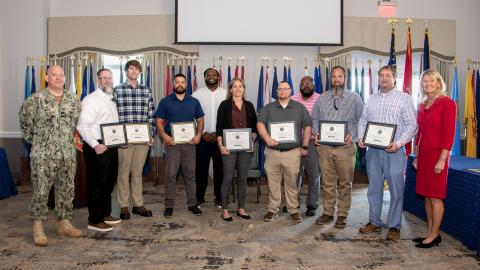
Fleet Readiness Center East (FRCE) recently piloted a new leadership program for the Naval Air Systems Command (NAVAIR) enterprise, serving as the exclusive testing ground for skilled trade employee development. After months of training, FRCE celebrated the graduation of the program's first cohort Sept. 2, paving the way for a new, one-year development program that is now being offered NAVAIR-wide.
As a key component of the NAVAIR Leader Development Continuum, the new Federal Wage System Leadership Development Program (FWSLDP) provides Federal Wage System employees with foundational leadership, communication and problem-solving skills. FRCE served as the proving ground for the program, making the command’s nine participants the first in the enterprise to complete the curriculum.
Ann Wood, who is performing the duties of Commander, Fleet Readiness Centers, and FRCE Commanding Officer Capt. Randy Berti presented the graduates with certificates of completion during the ceremony. Wood stated in her remarks that as the enterprise’s first leadership development program for Federal Wage System personnel, the FWSLDP bridges a critical gap in professional training for front-line artisans, improving the depot’s support of warfighter readiness.
“These graduates have played such an important role in the genesis of the readiness that is generated here every day,” said Wood. “This program was a powerful step in their journeys to become the best leaders and teammates possible. Artisans have to be leaders, leading themselves and others. This training helped prepare them for the responsibilities and challenges ahead. It’s not the challenges that matter but how we overcome them, and that’s where these graduates can make a difference. The fleet always comes first, so drive your teams to outcomes that matter for the fleet and remove barriers quickly.”
During the six-month pilot program, the nine participants engaged in a comprehensive training curriculum with nine core competencies: communication, problem-solving, accountability, developing others, team building, conflict management, decisiveness, influencing and ethical behavior. Rather than relying on traditional classroom instruction, the program focuses on enhancing leadership capabilities through hands-on, interactive training scenarios and continued mentorship.
The initiative is driving enterprise-wide readiness through the continuous development of its industrial workforce, according to the depot’s lead training administrator Tonya Hill.
Samuel Hall, nondestructive inspection technician at FRCE and graduate of the FWSLDP pilot program, said this program gave him the confidence and knowledge to become a better leader and teammate.
“I gained the ability to analyze how people think and how I can best address people who are not only junior to me, but also at my level and senior to me,” said Hall. “I learned how to communicate my ideas and thoughts more effectively. It helped me understand how to collaborate as a team member and how to come together to develop something that not only can benefit FRC East, but also NAVAIR. It made me, hands down, a better leader.”

Sep 17, 2026
FRCE cuts ribbon on new Global TransPark facility, strengthening capacity for future growth
Officials from the Department of War, Department of the Navy and the state of North Carolina cut the ribbon on a state-of-the-art repair complex at the North Carolina Global TransPark Sept. 17, significantly boosting Fleet Readiness Center East’s (FRCE) ability to deliver mission-ready aircraft to warfighters.
The new facility expands FRCE’s maintenance, repair and overhaul (MRO) capabilities for three key defense platforms: Navy C/KC-130T Hercules, Marine Corps C/KC-130J Super Hercules and Air Force HH-60W Jolly Green II aircraft.
Spanning approximately 75 acres, the purpose-built facility covers more than 700,000 square feet and has direct taxiway access to the North Carolina Global TransPark’s 11,500-foot runway, one of the longest civilian runways in Eastern North Carolina, streamlines ground logistics, enabling aircraft to transition seamlessly from touchdown to active maintenance.
“This new hangar is more than just concrete and steel – it is a symbol of commitment that both FRC East and the state of North Carolina are making to our nation’s warfighters,” said FRCE Commanding Officer Capt. Randy J. Berti. “It gives us a powerful new capability to keep combat-ready aircraft in the air, while demonstrating North Carolina’s unmatched dedication to national defense.”
The partnership between the Navy and the state of North Carolina is the first of its kind within the Department of War and represents an innovative collaboration. In 2023, North Carolina state lawmakers allocated $350 million to prepare the Global TransPark site for FRCE’s new facility. Under a lease executed by Naval Facilities Engineering Systems Command, the Navy will manage and operate the facility. This public-state alignment drastically reduced typical federal construction timelines while securing substantial cost savings for taxpayers and the Department of War.
“Readiness and lethality are what peace through strength actually looks like in practice, and sustainment is at the heart of both,” said Maj. Gen. David Walsh, Deputy Portfolio Acquisition Executive (Aviation) for Marine Corps Aviation. “This facility means our combatant commands get more mission-ready aircraft, faster – the C/KC-130 and the HH-60W fleets included – while cutting the cost burden on the American taxpayer. It’s a partnership between the Department of War and the state of North Carolina that puts readiness first, and I couldn’t be prouder of what delivers for our warfighters.”
Beyond strengthening frontline readiness, the facility serves as a major economic cornerstone for Eastern North Carolina. The operation is projected to add roughly 400 high-skilled positions to Kinston and Lenoir County, including sheet metal artisans, aircraft mechanics, avionics technicians, quality assurance specialists, and aerospace engineers. To fuel this growing talent pipeline, FRCE is leveraging strong educational partnerships with regional institutions, including Lenoir Community College and Craven Community College, whose specialized aviation maintenance programs will help train the next generation of depot artisans.
Berti emphasized that bringing a project of this scale from concept to reality required seamless coordination, noting that its success relied entirely on deep cross-command collaboration and unwavering backing from Navy leadership at all levels.
This effort will lead to enhanced sustainment and logistical support for critical military aircraft. Deputy Assistant Secretary of War for Logistics Erica Plath, said the support comes at a critical time to meet the needs of the fleet.
“We are here to deliver on a single, uncompromising mandate: prioritize the American warfighter and generate decisive, operational lethality,” said Plath. “When our Marine Corps relies on the KC-130 to project rapid tactical power across global domains, or when Air Force aircrews push the HH-60W Jolly Green II into hostile territory for combat search and rescue, their survivability and success depend directly on our depot-level maintenance.
While FRCE engineers, logisticians, and artisans already support the C-130 platform, the mission now transitions into its permanent home in Kinston. Previously constrained to short 30-day inspection cycles and minor repair tasks under the C-130 Minor Depot Inspection Branch, FRCE’s footprint at the TransPark enables full-scale depot-level MRO operations. This expanded workload directly lengthens the service life and operational availability of the Navy and Marine Corps' primary tactical airlift and aerial refueling assets.
Simultaneously, the complex establishes FRCE as the designated depot repair point for the Air Force’s newest combat rescue platform, the HH-60W Jolly Green II. Artisans got an unexpected jumpstart on the workload ahead of this month's scheduled arrival date, successfully completing an unscheduled on-site repair on an aircraft. That early unscheduled event served as a high-value practical training exercise, validating shop procedures, tooling and technical data before full depot operations kick off.
FRCE Executive Director David Rose emphasized that the new maintenance complex stands as a powerful testament to the enduring partnerships that have strengthened FRCE’s mission and will continue to drive its success for generations to come.
“We are deeply grateful for the unwavering support of the counties, municipalities and communities across Eastern North Carolina,” Rose said. “This great state, along with the leadership at Global TransPark, has stood with FRCE every step of the way. What we see here today is more than a facility; it is the result of passionate people coming together with a shared sense of purpose, an unwavering commitment to our nation and a steadfast belief in the strength of our region.
“This facility will no doubt directly enhance the readiness of our warfighters and strengthen our ability to answer the call when our nation needs us most,” Rose added. “At the same time, it will create tremendous opportunities for the citizens of eastern North Carolina to be a part of something greater and contribute to something truly meaningful.
“Additionally, this achievement demonstrates what is possible when federal, state and local partners unite behind a common purpose,” he continued. “Together, we are investing in the future of this region, strengthening our nation’s defense and equipping the men and women who stand at the ready every day to defend the freedoms we hold dear.”
FRCE is North Carolina's largest maintenance, repair, overhaul and technical services provider, with nearly 4,000 civilian, military and contract workers. Its annual revenue exceeds $860 million. The depot provides service to the fleet while functioning as an integral part of the greater U.S. Navy; Naval Air Systems Command; and Commander, Fleet Readiness Centers.


