Airspeed cuts H-53 engine repair time, makes life easier on workers
Airspeed cuts H-53 engine repair time, makes life easier on workers
By Robert Kaper
NAVAIR Public Affairs Office
An Airspeed black belt project has cut nearly 7,000 man-hours annually from repair work on H-53 helicopter engines at the Fleet Readiness Center - East, Cherry Point.
Just as important, the Airspeed-improved Data Reduction Program (DRP) also has eased frustration and drudgery for the 15-member maintainer crew by sharply reducing the repeated disassembly and reassembly that had been required to track down elusive causes of poor engine performance.
The Airspeed DRP Process Improvement project was launched by PMA 261, the H-53 Heavy Lift Helicopters Program. The project has increased the pass rate for the H-53’s T64 turboshaft engine from a 63% average to near 100% on the first acceptance test run after repairs.
It has also had another major benefit: data acquired with the new system helps the depot build better engines. “The process has a natural feedback mechanism,” said Airspeed team member Greg Hein of PMA 261. “Observing what has failed leads to a better build process.”
Although the subject of the Airspeed project was the 416A version of the T64 turboshaft engine, the improved Data Reduction Program can be applied to all jet engines that have a DRP Program. The 416A was selected initially because it’s where the depot was “feeling the pain” in Airspeed lingo, said Black Belt Tom Spidel of PEOA. “Our project focused on the 416A, because they were struggling to pass.”
Team member Frank Csavina, a retired Air Force lead propulsion engineer, said the engine is particularly susceptible to minor maladjustments. “The T64 is a thoroughbred,” he said. “It’s sensitive to things like clearances.” But now that the improved DRP has been developed, said NAVAIR Propulsion Lead Paul Singshinsuk, “it will benefit other engines, test cells and repair depots across the military.”
The goal of the DRP Process Improvement was to create a comprehensive, effective procedure for troubleshooting the T64 “without tearing it apart,” Spidel said.
“What we’re doing now is giving Cherry Point the tools to diagnose the disease,” said Singshinsuk. “Before it was like going to the doctor with a problem, and all he did was take your temperature. Now we’ve given him X-rays, MRI, and all the other diagnostic tools he needs to determine exactly what the problem is.”
Spidel and his 14-member team started with a complex Data Reduction Program developed by the T64’s manufacturer, General Electric. After six months of hard work, they had converted the DRP into a streamlined, user-friendly tool that maintainers and depot artisans could employ to diagnose an engine’s internal problems.
Along the way the team had to develop ways to ensure accurate readings of temperature, pressure and performance, compile the data acquired into a format that could be easily analyzed and develop trouble-shooting procedures based on the analysis to pinpoint internal problems.
The icing on the cake was an internet-based Data Translation Program (DTP) that brought the information compiled into focus with clear, easy-to-understand graphs. “The important thing is that we got all relevant minds together to come up with procedures to define what to look for in specific plots,” Hein said. “This is huge,” added team member John Munroe of Cherry Pt. FST. “The DTP lets you analyze it visually.”
Before the Airspeed-improved DRP, engine diagnosis “was based on experience and guesswork,” Spidel said. As the Airspeed Project Charter succinctly summarized the problem: “There is not a standardized process to analyze test data from engines that do not meet the power requirements at the test cell.”
Not meeting power requirements is the main reason the T64 engines are pulled from the H-53 and sent to Cherry Point in the first place. Depot artisans first dismantle the engines, clean them, check component tolerances and install new parts when tolerances aren’t met. After the engine is reassembled, workers adjust the guide vanes that control air flow through the compressor to make sure they’re within tolerance. Then they run it on a test stand to see if the initial overhaul has improved performance. Before the Airspeed-improved DRP, only 63% passed the first acceptance test after overhaul.
Some problems leading to failure, such as an oil leak, are easy to diagnose, Spidel said. “You can see it.” But the more common problem of low power could have many causes, he said, and most aren’t obvious to the eye. “A lot of it was trial and error. If you were trying to find out why an engine had low power, there were four areas you could tear apart – compressor, combustor, gas generator turbine or power turbine – and you might not know what area to start with.”
Depot engineers and artisans would start working on one or more areas, repair or adjust components that appeared to need it, then put the engine back in the test cell for a second acceptance test run. If it failed, it was repaired again, and given a third acceptance test run. . Although the average first-pass rate was 63%, some engines were far worse. “There could be up to 12 failures for a single engine,” Spidel said.
More often though, an engine that still wasn’t working right on the second test run was turned over to contract engineers from the manufacturer, General Electric. The data reduction program GE had developed could analyze instrument readings from the engine to locate the problem. Unfortunately, only specialists with years of experience could use the program effectively. “You needed to be a performance engineer to figure it out,” said Spidel. “It was all in bits and pieces. It took an expert several weeks to do the analysis. But at the depot they need to know what to do by the next day.”
It was a situation made to order for Airspeed. “Airspeed set up a disciplined approach to analyzing performance so people at Cherry Point could do it themselves,” said team member Dan Longhurst of General Electric. “We basically streamlined the process. All the logical steps we went through at GE were now put down in a guide so people at Cherry Point could use it too.”
But there was much more to the six-month project than just writing down procedures. Temperature and pressure sensors and the test cell itself had to be analyzed and verified for accuracy. “The reason it took so long is because of all the things that had to be fixed first,” said team member Chris Lucas of Cherry Pt. FST. “You can’t get a correct diagnosis if the data are not correct.”
Once accurate measurements have been made, the DRP process compiles the data in a way that makes it possible for someone without 25 years as a propulsion engineer to analyze, said team member Jan Kretzing of NAVAIR. “The last piece of the puzzle was to make it user friendly.”
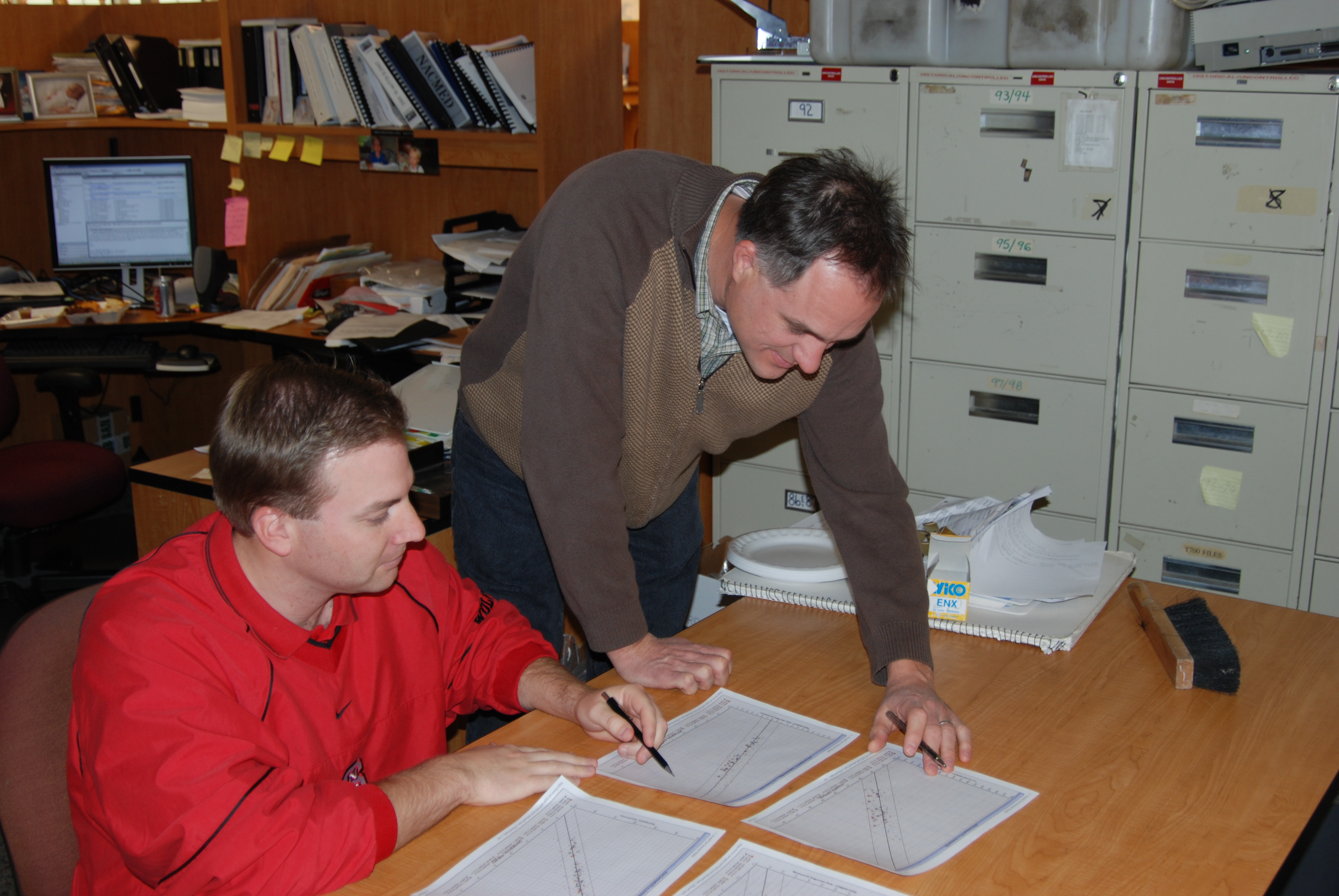
That’s where the Data Translation Program (DTP) came in. Maintainers and artisans can enter the measurement numbers they’ve recorded into an on-line database program. The program then creates graphs that compare one variable against another. “It’s done in a logical order, the same way an experienced performance engineer would do it,” said Spidel.
The Data Translation Program calculates upper and lower boundaries above and below the line on the graph. If data points fall outside the boundaries, a specific set of troubleshooting steps is triggered. Following the troubleshooting steps then leads to the cause of the engine’s low-power problem.
“In the past when we made an adjustment,” said team member Stuart Sugg of Cherry Pt. FST, “we didn’t know which way to make it, or how far to go, or had we gone too far. Now we’re using the DRP data to see if we make an adjustment, it was in the right direction - or if we overshot it, and we have to go back.”
The Airspeed-improved DRP brings clarity, order and method to the work, Spidel said. “Now we have a clear path. We save labor, save materials cost. Now we don’t have to guess.”
-Sidebar
Quick Wins
As the Airspeed analysts were working through early versions of the improved DRP, they uncovered two “Quick Wins” that could bring immediate horsepower improvements. One was a previously unknown problem caused by the protective screen that prevents foreign object damage (FOD) on the test stand. It was disturbing airflow into the engine, and the disturbance was not picked up by inlet pressure probes.
The result was faulty data into the computer that calculated engine horsepower. “It distorted the data, which in turn would send you looking in the wrong direction for a problem that may, or may not be there” Spidel said. He noted that the screen is still in use, but now that engineers know the magnitude of its effect, they’re able to read the correct horsepower value lurking behind the faulty data. “We can still see it, but it’s harder,” he said. “It’s like looking through a dirty window.”
The second quick win was more subtle. The engine had been modified to improve cooling and increase durability. But the changes caused a big horsepower loss. “The modification was made without changing the specs,” said Lucas. “They thought the engine had plenty of margin to absorb this mod, but these unaccounted-for changes were costing 160 horsepower.”
“They were asking more from it than it was capable of delivering,” Spidel said. “But they thought it was hearsay. So we proved it to them with data. There was a significant difference in horsepower.”
Fortunately the engine was capable of running at a higher temperature than the specs allowed, so the solution was a simple one, Spidel said. “We changed the specs so we can run it hotter.”
The keys to both quick wins – pressure readings distorted by the FOD screen and the overly conservative specifications – were the precise and dependable data now available from the Airspeed project and improved DRP.
Photo cutlines:
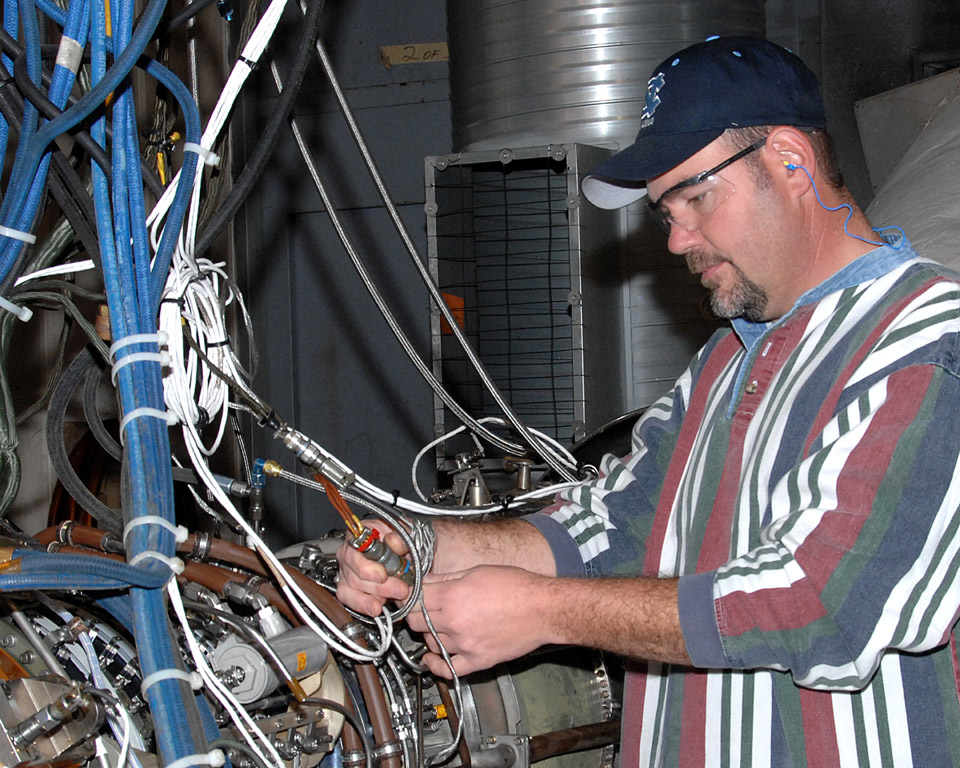
Top - Glenn Pope, aircraft engine mechanic, builds up a T64 engine.
Photo by Dykie Whitfield
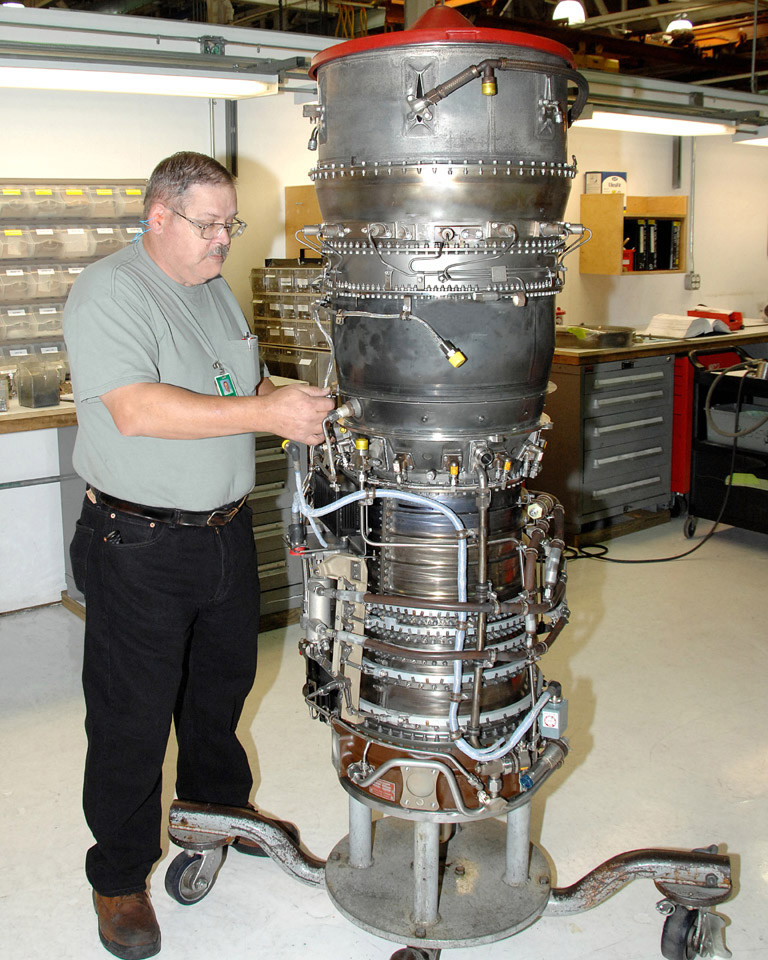
Middle - Jay Miller, aircraft engine work leader, prepares a T64 engine for testing.
Photo by Dykie Whitfield
Bottom –Stuart Sugg (L) and Chris Lucas (R) Cherry Pt. Fleet Support Team analyze performance plots for an engine that was tested to determine the cause of low power failure.