
Commander’s Greenbelt Project Yields Savings for NAE
CORRECTION TO PHOTO CAPTION BELOW!
CORRECTION TO PHOTO CAPTION BELOW!
By Vicky Falcón
NAVAIR Public Affairs
A NAVAIR AIRSpeed Green Belt project headed by VADM Wally Massenburg, NAVAIR’s Commander, is saving more than $476,000 by developing a more rigorous tracking system for Depot-Level Repairable “carcass” parts on the E2/C2 program at Naval Aviation Depot North Island, Calif.
Depot-level repairables are parts that can be re-serviced by the Navy; a carcass is the broken part turned in for repair.
Depot artisans order repairables from the Naval Inventory Control Point (NAVICP) to replace non-working parts on an aircraft. DLRs are dual priced. A net price is initially billed to the depot for the replacement part under the assumption that a carcass will be returned to NAVICP for re-servicing. If a carcass is not returned, a significantly higher standard price is charged instead.
According to Massenburg, unnecessary fees could rise into the millions of dollars, which made tracking repairable carcasses a solid Green Belt project.
“My goal of freeing up NAE assets to directly benefit the fleet and my need for hands-on experience in Lean Six Sigma came together in this project,” said Massenburg, who is one of several NAVAIR leaders to complete their mandatory Green Belt training this summer.
Team member LCDR Ken Flaherty elaborated on the project. Flaherty works for the Fleet Industrial Supply Center (FISC) and currently serves as the NADEP Supply Officer at North Island. Coincidently, he’s an AIRSpeed Black Belt.
“Say a rudder actuator was just taken off an aircraft because it was malfunctioning by not moving the rudder from left to right,” he said. “This bad part just happens to be a depot-level repairable. Therefore, instead of throwing the part away, it will be re-serviced. The bad part, the carcass, will be repaired, making it ready-for-issue.”
According to Flaherty, NAVAIR re-services many aircraft parts because they are very expensive to buy new. Having a carcass to turn in will significantly reduce the price, sometimes by millions of dollars.
The Green Belt project team worked with the E2/C2 Business Team at NADEP North Island, examining their process for returning carcasses. The problem, explained Flaherty, was that there was no process or procedure for properly turning in a carcass.
“NAVICP gives us 90 days to return a carcass,” he said. “But we found no accountability for returning the part and no metrics for a timely release.”
NAVAIR Black Belt Veronica Higgs acted as mentor to VADM Massenburg on the project. Higgs is the Assistant Program Executive Office/Business Financial Manager on the Tactical Aircraft Program Office staff.
“My job was to supplement his Green Belt training and answer any questions regarding the Lean Six Sigma methodology the team might have,” she explained.
“In order to fix the problem [of returning carcasses on time] we created a rigorous tracking system that has already created Type I savings of $476,831 from six outstanding E2/C2 carcass bills at North Island,” she said. “The potential for savings is much higher, though, even as much as $11 million.”
Savings in the category of Type I benefits have a direct and certain impact on the Naval Aviation Enterprise (NAE) resources made available to the Navy for recapitalization. Type II savings are actually waste elimination where assets/resources are freed up to be reassigned to other value-added work and/or potential future savings.
The project has seen more than $17,000 in Type II savings, freeing up nearly 50 man hours reconciling carcasses within NAVICP and FISC.
“This was a great project to be a part of,” said Higgs. “Admiral Massenburg’s enthusiasm was contagious and his dedication was phenomenal. He even called in from overseas so he wouldn’t miss the weekly meeting.”
The team stayed on schedule, made significant improvements and savings and now has a process that can be replicated by at least six other parts of the organization for even greater savings across the Navy.
“My team was dedicated and worked hard to create an efficient and effective tool that can now be replicated throughout the Naval Aviation Enterprise,” said Massenburg. “What we did is just one example of the efforts taking place throughout this organization. AIRSpeed has already made and will continue to make a significant difference in how we do business.”
For more information about NAVAIR AIRSpeed, go to http://www.navair.navy.mil/navairairspeed/.
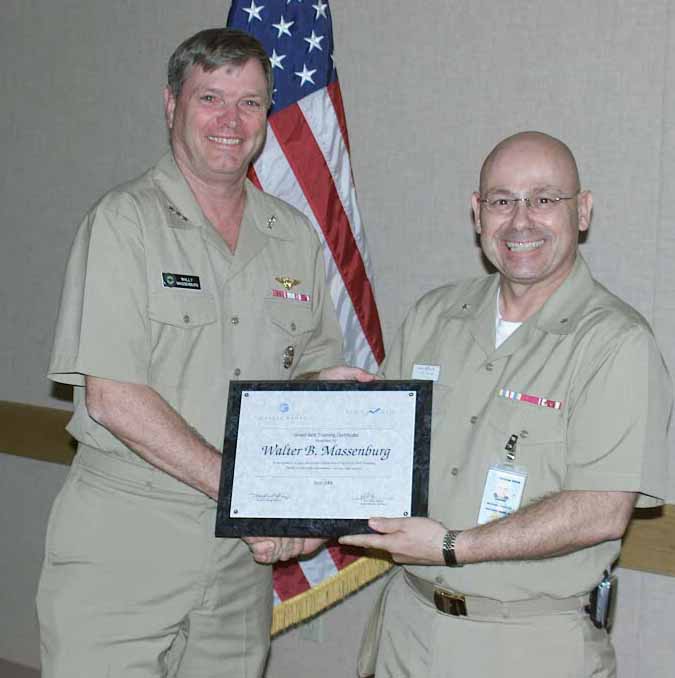
Photo: VADM Massenburg (left) receives his NAVAIR AIRSpeed Green Belt certificate from RDML Michael Hardee, Commander, Fleet Readiness Centers.