
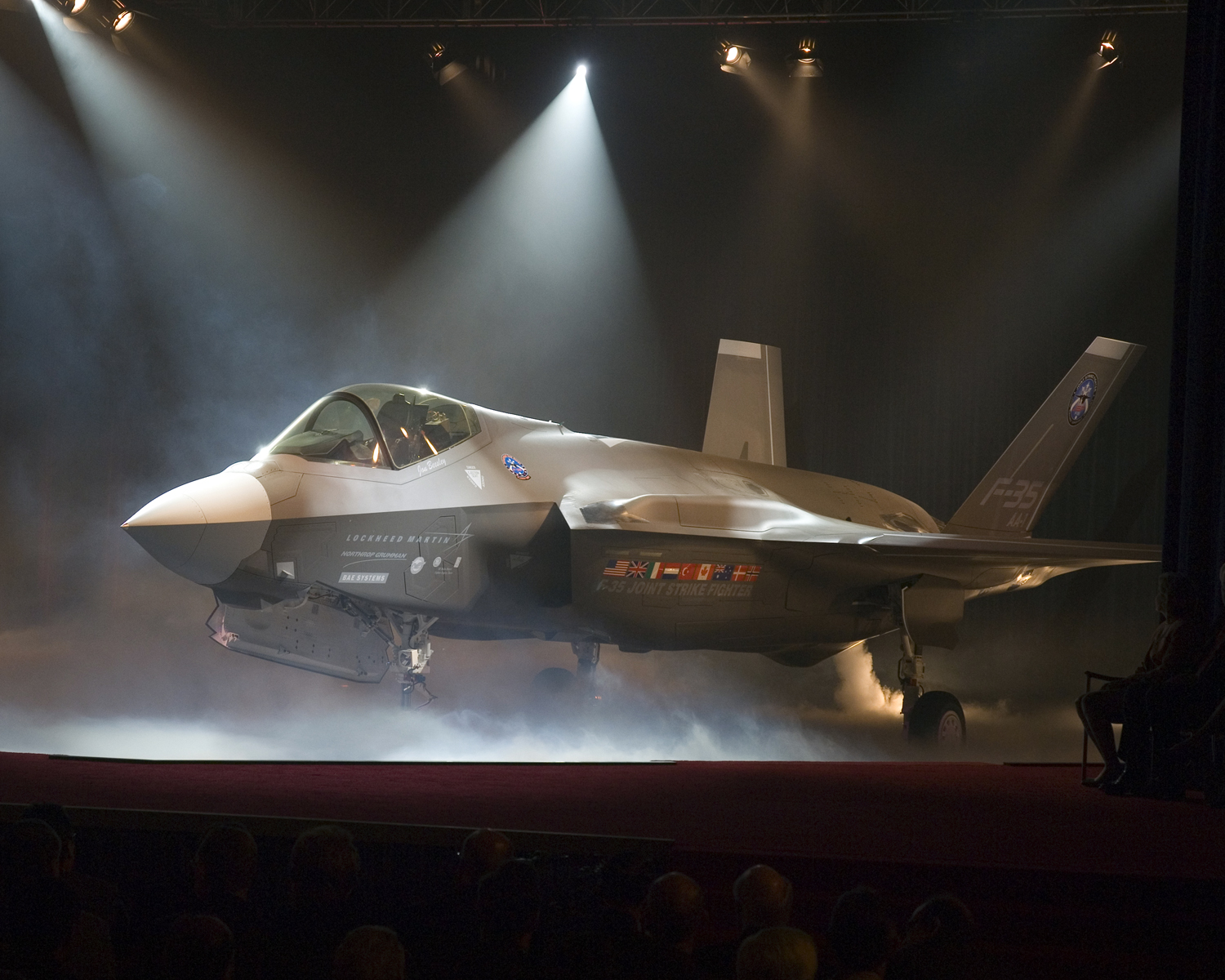
The first F-35 Lightning II is unveiled at the Lockheed Martin Aeronautics Co. in Fort Worth, Texas, on July 7. The stealth fighter was officially named at the ceremony, with the name Lightning evoking two historic fighter aircraft: the Lockheed P-38 Lightning and the English Electric Lightning. (U.S. Navy Photo)
Joint effort develops new method to test emissions from JSF and other jets
NAVAIR is working with government authorities, scientists, and engineers to create a new test methodology to measure particulate matter (PM) emissions from aircraft gas turbine engines. The new test method will be used first on the Joint Strike Fighter (F-35 Lightning II), then throughout DOD and eventually the commercial aircraft industry.
Until the new test is complete, an interim PM emissions test, which is based on lessons learned from tests run in 2004 and 2005, will save more than $1 million, three weeks of test cell time and over 200 hours of engine run time per test – while providing more accurate data for the further development of a final test procedure.
Curtis Kimbel, program manager for Particulate Matter Test Plan Approval, a new program within NAVAIR’s Power and Propulsion department (AIR-4.4.1), took on the challenge of redefining state-of-the-science techniques for measuring jet engine emissions. His quest began two years ago when he began his Senior Executive Management Development Program (SEMDP) rotation with the United States Environmental Protection Agency (EPA) Climate Protection Partnership Division.
Curtis worked with the EPA’s Dr. Stephen O. Andersen to craft an agreement that abandons the antiquated previous test method and replaces it with a state-of-the-art method that satisfies the immediate concerns of the EPA, supports the process for an internationally approved test method, and provides new data to atmospheric scientists.
The program’s success prompted NAVAIR’s Commander, Vice Admiral Massenburg, to extend Kimbel’s one-year assignment for a second year. Now Curtis is back with NAVAIR leading the program at Naval Air Station Patuxent River, Md.
“We’re working with the global aircraft emissions testing community including JSF, DoD, EPA, the FAA (Federal Aviation Administration), and NASA (National Aeronautics and Space Administration), engine manufacturers GE and Pratt and Whitney, academia and several US and international organizations,” said Kimbel.
“We are investigating a new method to test aircraft PM emissions that will be applicable to all jet aircraft – both military and commercial,” he continued. “The new method, in addition to being an improvement scientifically, will save time and money, and is expected to provide a more representative emissions profile than existing test methods.”
Prior to going to the EPA, Kimbel had discovered that the Joint Strike Fighter Program was seeking a new way of characterizing emissions that would satisfy a joint services operating environment.
In particular, JSF needed to bring its propulsion contractors on board with a standardized measurement approach that could be used to gather emissions data as the production engines were becoming available for testing. The data would then be modeled to support air quality studies necessary to comply with the U.S. Clean Air Act (CAA) Conformity requirements.
The CAA requires accurate estimates of the size, distribution and chemical species of PM less than 2.5 micrometers in diameter (PM 2.5) emitted from mobile sources, in this case aircraft. There is a health hazard (including heart and lung diseases) resulting from exposure to these tiny particles. Military and commercial aircraft communities test jet engine exhaust to determine the the contribution to local air quality and climate change.
The out-dated method previously used to measure PM emissions was a modification to US EPA Test Method 5. “Method 5” was originally developed in the 1950’s for testing emissions from smokestacks and is an expensive, time-consuming process that yields questionable and incomplete results when applied to jet aircraft engines.
Jean Hawkins is the JSF Environmental, Safety, and Occupational Health team lead. As such, she is charged with insuring that the JSF program is capable of demonstrating compliance with the Clean Air Act.
“A method developed for a stationary source, such as a smoke stack, cannot adequately address a mobile source, such as a military jet,” said Hawkins. “Because of the large flow area required by the engine and the high velocities of the exhaust flow, there are no existing JSF test cells that can strictly follow the EPA Method 5 requirements.”
“Right now we’re developing what we expect will be a state-of-the-science measurement protocol for emissions profiling,” she said. “This joint effort will benefit all stake-holders in the end. By being involved early-on, we are able to make changes along the way as we develop an EPA sanctioned protocol which can become an industry standard.”
“Military aircraft are under increased scrutiny because of their testing and training environments,” said Hawkins. “JSF must be able to forecast (based on best data and modeling techniques) what our emissions will be at our basing locations and be able to draw comparisons with the legacy aircraft we will be replacing.”
“For the most part, the JSF will be replacing existing aircraft, so it is expected that there will be no net increase in direct or indirect emissions,” she said. “Nevertheless, we are required to forecast the numbers.”
“Repeated take-offs, landings and the hovering of aircraft generates combustion by-product related emissions,” she continued, “but the overall contribution of military aircraft particulate matter to the mixing layer is very small.”
The ground level “mixing layer” – the space between the ground and a 3,000-foot ceiling – is where the EPA regulates air quality. Prevailing winds and climate can significantly affect a population, reducing visibility and creating a haze that can coat vehicles and structures.
According to Hawkins, the largest contribution of PM 2.5 to the mixing layer is from commuter vehicles and large truck traffic.
“Airport expansion projects often require emissions information to determine the effects of additional air traffic on local air quality.” said Kimbel, adding that many European nations are also concerned with aircraft emissions and several have stricter air pollution regulations than the U.S.
“Emissions from aircraft gas turbine engines are a particular concern to the EPA because nearly all PM emissions are smaller than 2.5 micrometers in diameter,” said Andersen. “The DOD will need accurate PM 2.5 data to demonstrate conformity in any National Ambient Air Quality Standards (NAAQS) Non-Attainment area where military aircraft might be based,” he said. Non-attainment areas are areas that have unacceptable levels of air pollution.
Given that the JSF Program is seeking a near term alternative to Method 5 and the measurement and analytical techniques required to fully understand the volatile portion of the exhaust are still several years away, the team is focusing on the development of an interim PM test method.
The EPA has agreed to accept the state-of-the-science for this interim method while the team continues to pursue a permanent methodology.
“The current state-of-the-science with the new test is evolving quickly,” explained Kimbel, “and it is already significantly better than the expensive, time consuming EPA Method 5.”
The new method should be available during Spring 2007, and requires testing of only one engine for a few hours, which is a tremendous savings compared to Method 5, which costs $1.5 million per test, requires three-to-four weeks of test cell time and the running of three engines 80-100 hours each.
“Our inter-agency team will use peer review and accept the test method and the data as we move forward,” said Kimbel.
That acceptance team has representatives from a wide variety of organizations, including the EPA, the JSF, DOD, NAVAIR, NASA, the FAA and the Society of Automotive Engineers (SAE) Aircraft Exhaust Emissions Measurement Committee (E-31), which is coordinating its work with the United Nations International Civil Aviation Authority (ICAO). The ICAO committee is the global PM testing community responsible for developing test procedures for measuring aircraft PM emissions for gas turbine engines used by commercial and military aircraft engine manufacturers.
According to Andersen, sharing information via the E-31 committee will accelerate the science of PM testing and provide aircraft engine manufacturers with new information that may allow future engines to be more fuel efficient while generating fewer emissions.
“The EPA will accept the experimental test results as satisfying JSF emission validation requirements under the Clean Air Act if EPA’s review and evaluation confirms the scientific validity of the interim methods and resulting data,” said Andersen.
Upon receiving EPA approval of the interim PM test method for the JSF the Navy will work with the EPA to apply the improved test method to the Navy’s new upgraded H-53 Heavy Lift helicopter, a multi-mission antisubmarine aircraft (P-8A MMA) and an upgraded T-45 Trainer jet that will also require PM data.
“Our goal is to be able to scientifically demonstrate our emissions contribution to air quality,” said Hawkins.
Kimbel agrees. “The work we are doing will enhance our understanding of a jet engine’s combustion chemistry and will eventually lead to the development of cleaner, more efficient aircraft engines for both military and commercial applications.”
For more information about the JSF contact Kathy Crawford, JSF Public Affairs Officer, [email protected]. For more information about NAVAIR’s Particulate Matter Test Plan Approval program, contact Curtis Kimbel, [email protected].
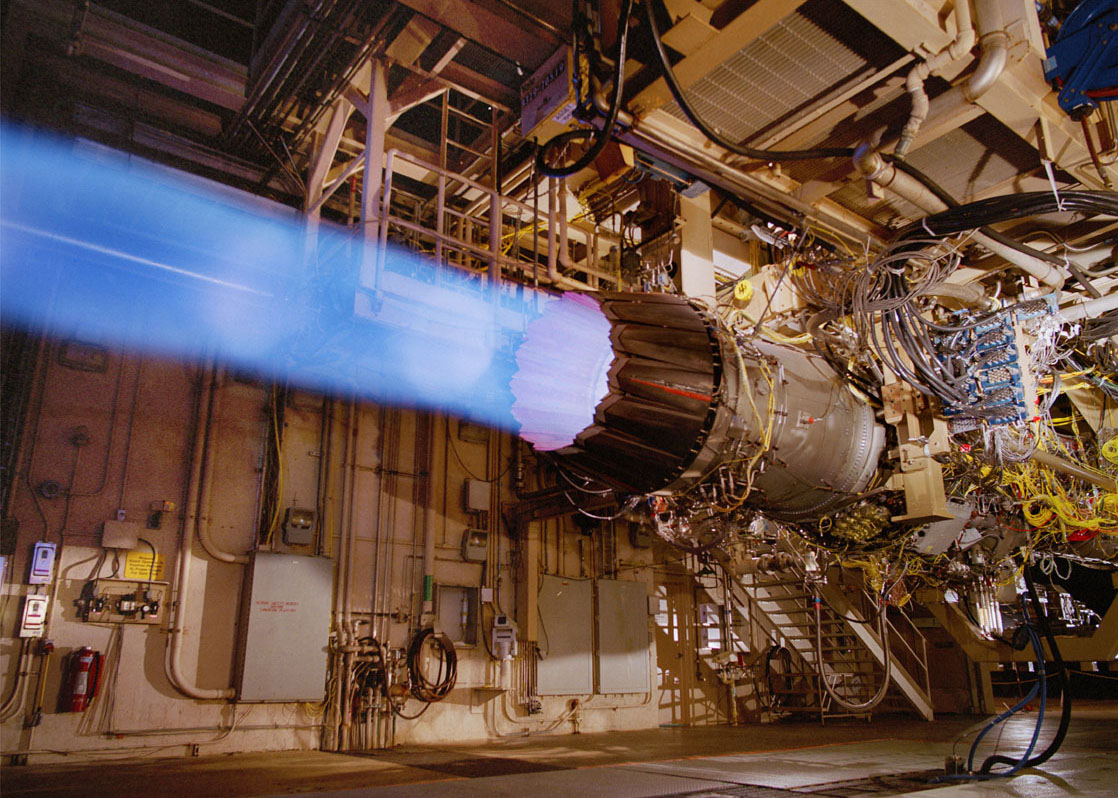
F135 CTOL engine in full power test. (Image courtesy of Pratt and Whitney)
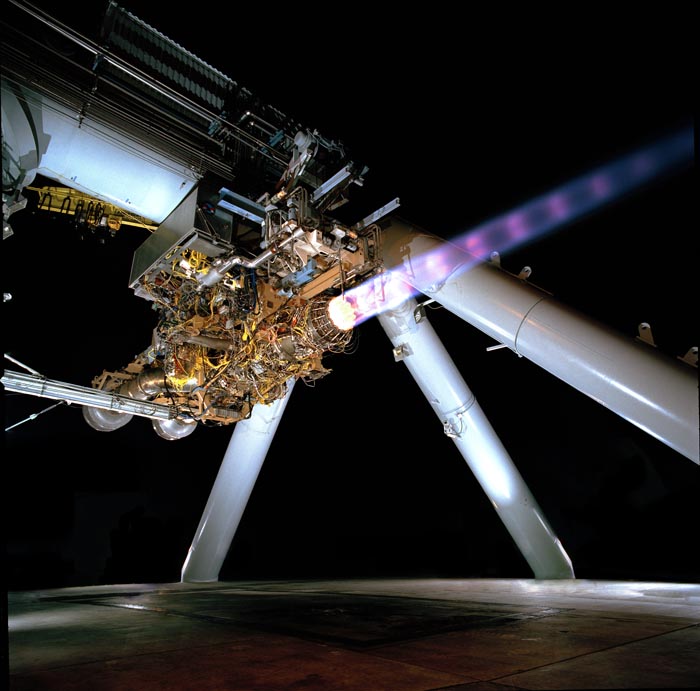
Night time aft view. Photo of F135 STOVL in full power. (Image courtesy of Pratt and Whitney)