
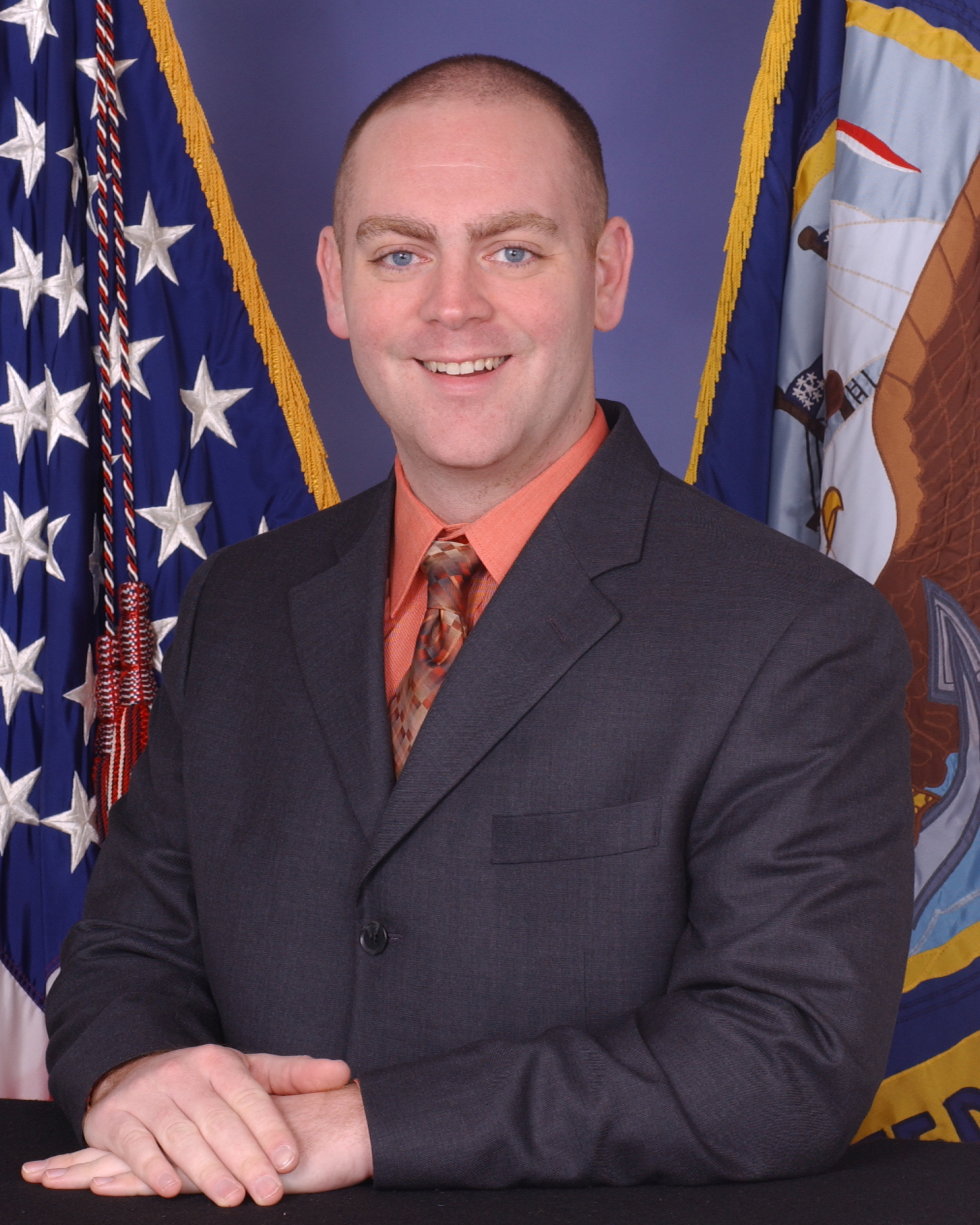
NAWCAD Engineer Among 40 Honored in May 2 Pentagon Ceremony
An electronics engineer at the Naval Air Warfare Center Aircraft Division (NAWC), Patuxent River, MD, was among 40 scientists and engineers to receive one of the Navy’s top honors in a May 2 ceremony at the Pentagon.
Brandon Cochenour of the Electro-Optics and Special Mission Sensors Division received the Assistant Secretary of the Navy (Research Development and Acquisition) Top Navy Scientists and Engineers of the Year Award as an emerging investigator. He was honored for his research in underwater laser communications. The work may one day provide high-speed optical data links between submarines, autonomous underwater vehicles and ocean sensors.
The Navy is exploring laser-based optical data links because current acoustic techniques can not carry much information, Cochenour said. “It’s like the early days of the internet – acoustic data rates are 10’s, maybe 100’s of kilobits per second.” Radio frequency energy isn’t suitable either, he noted, even though it is employed widely in conventional above-water technologies such as cell phones, satellites and radios. “It doesn’t propagate well underwater.”
An optical data link on the other hand provides much greater bandwidth for voice, video, and data transmission with less chance of being intercepted. “It may be able to provide gigabit rates - around 100,000 times faster than current acoustic techniques,” he said. The optical link also offers the potential for communicating between underwater and airborne platforms, since the laser beam can penetrate the air-water interface.
For his research, Cochenour adapted a hybrid laser-radar technology pioneered by his mentor at NAWC, Dr. Linda Mullen. Originally used for underwater laser imaging, the technology modulates, or varies, the laser beam intensity by “piggybacking” a high-frequency radar signal on it. Since this modulated signal is similar in nature to the signals used by satellite and cell phone technologies, he said, “we can apply all of the well established, above-water techniques to the underwater scenario.”
A major challenge for the optical data link is water clarity, he said. “Ocean water isn’t as clear as what comes out of your tap. Sending lasers through ocean water is like driving in a snowstorm with your headlights on - light begins to scatter away from your main beam.” As a result, the optical link is limited to a distance of a few hundred meters or less. Although an acoustic signal can travel kilometers or more, he said, it radiates outward in all directions and is easier to intercept. “You’re broadcasting to everyone.” By contrast, the optical data link’s laser beam is narrow and targeted, he said. “You’d have to be pretty close to pick it up.”
Even with its current distance limitations, an optical data link would be a big improvement over acoustic methods for retrieving data from underwater sensors, Cochenour said. “Right now we can do it with acoustics, but it takes a lot of time and a lot of processing inside the sensor or platform to simplify the data so it can be transmitted.” With an optical data link an underwater vehicle could swim by and receive a complete data transmission from another platform in a fraction of the time it takes with acoustics.
Cochenour’s work so far has included laboratory experiments and theoretical modeling to determine how and to what extent water clarity affects bandwidth capacity, link range and transmitter/receiving pointing accuracy. Future experimental plans may include implementing both the imaging and communications functions in a single system. Installed on an unmanned underwater vehicle, he said, “the warfighter could task it to image an area of interest, and then use the same technology to wirelessly transmit that information back.”
Just 25 years old, Cochenour “has quickly become an innovative and significant researcher in the Naval community,” said his boss, Jeffrey J. Noel, Head of the Electro-Optics and Special Sensors Division. “His impact on the Navy far exceeds his years of service, and his calm and passionate approach to innovative research has provided an outstanding foundation for a bright future as a Navy scientist.”