
WD engineers see what life’s like on USS Nimitz
By Renee Hatcher
NAWCWD Public Affairs
Nine engineers and scientists from Naval Air Warfare Center (NAWC) Weapons Division (WD) China Lake and Point Mugu got an up-close look at real life and operations on an aircraft carrier during a recent visit onboard USS Nimitz.
“This was a real eye-opener for these engineers,” said Cassie Gorish, coordinator of the NAWCWD Engineer and Scientist Carrier Experience Program. “It was an opportunity for them to see firsthand how the work they are doing here directly affects the warfighters.”
The group spent five days on the carrier while it was out at sea preparing for its upcoming six-month deployment to the Persian Gulf. Since the Nimitz was already underway, the group couldn’t just walk down the pier and board; they had to be transported onto the carrier deck in a C-2A Greyhound, an aircraft that provides critical logistics support to carrier strike groups.
“The whole experience was a once in a lifetime opportunity,” said Scott Howes, an aerospace engineer at China Lake. “We are usually neck-deep in research, development and testing here so the chance to interact one-on-one with the warfighter was invaluable.”
Once onboard, the group witnessed the launch and recovery of aircraft on the flight deck, both during the day and at night. They scoured the flight deck during a morning foreign object and debris walk down, and participated in bomb assembly, an underway replenishment operation, and jet engine repair testing.
“When we first got there it was like a different planet,” said Katie Yazzie, an electrical engineer who has been at NAWCWD China Lake for three years. “Seeing how the Sailors live and work on a daily basis as compared to our civilian life left me with so much respect for these men and women on our ships. They make huge sacrifices for us.”
Some end-users of NAWCWD products on the Nimitz gave valuable feedback to the engineers during their visit.
Lt. Curtis Haug, the bomb assembly and maintenance officer on the Nimitz, said that some ordnance are getting bigger in size while the elevator and magazine space remained fixed and limited, causing some logistics issues. A few F/A-18 pilots provided some suggestions to improve the functionalities of the aircraft’s mission computer software. The flight deck crew voiced their preference for more insensitive munitions while the pilots said they would like to see more powerful and lethal weapons.
“The feedback was constructive and it gave us good insight into what the warfighter is looking for from NAWCWD products,” said Jerry Gamboa, electrical engineer at China Lake for the last four years. “It was very helpful to see how the warfighter actually uses the weapons that we develop.”
Capt. T.N. Branch, the ship’s commanding officer, was impressed with the group’s enthusiasm and curiosity during their visit. Their bravery during the arrested landing on the carrier was noted in certificates provided to the whole group and read, “…For this feat they shall be recognized as a ‘NIMITZ TAILHOOKER’ and accorded the honor and all consideration and privileges due such title.”
“I came back to WD with even more appreciation for the Sailors we are supporting,” said Tri Bui, a chemical engineer at China Lake. “I’m very thankful to have had this opportunity to participate in such an amazing Navy experience. I was able to see firsthand that the work I’m doing here is very important and it has a positive impact on a lot of people.”
PHOTO CUTLINE
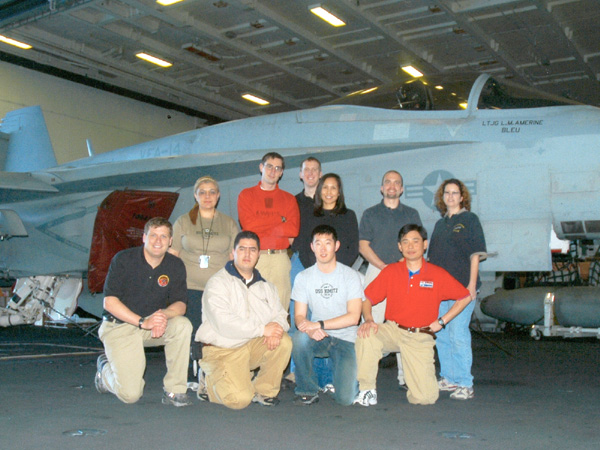
A group of engineers from NAWCWD China Lake and Point Mugu visit the USS Nimitz as part of the Engineer and Scientist Carrier Experience Program. Pictured in the front from left are: Kyle Norman; Jerry Gamboa; John Ma and Tri Bui. In the back from left are: Lucine Hovakimyan; Lt. j.g. Nick Hall, assistant weapons officer on the Nimitz; Michael Witham; Katie Yazzie; Scott Howes and Diane Marshall.