
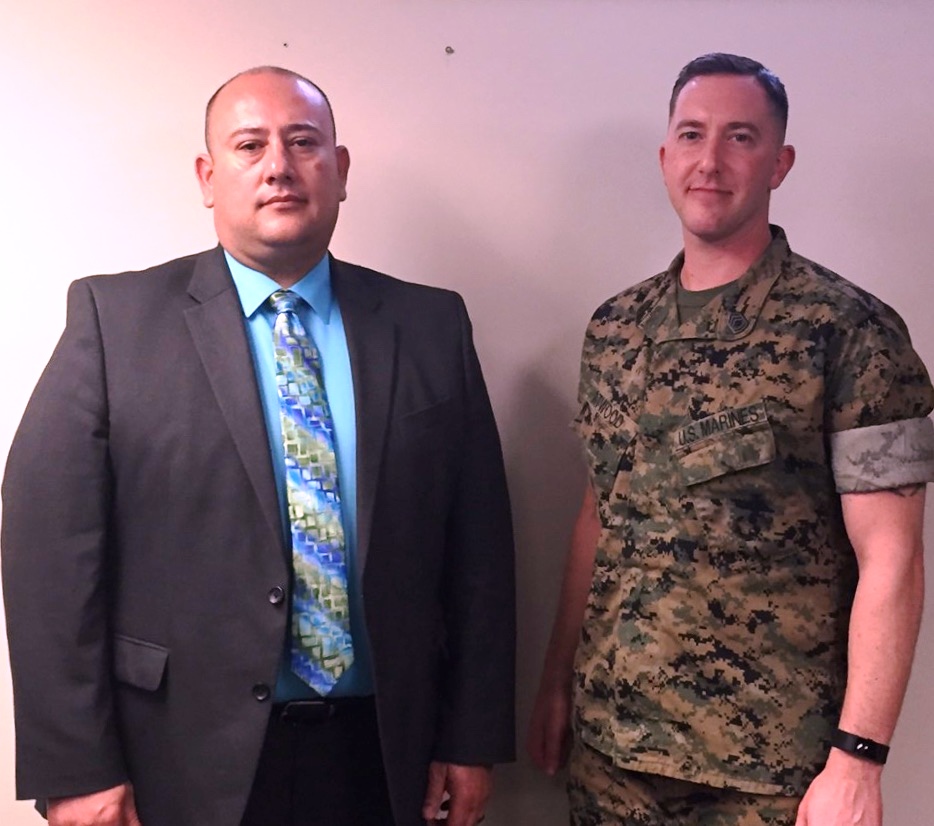
Fernando Zuniga, Deployed Support Team lead, and Gunnery Sgt. Scott Atwood, work to coordinate In-Service Repairs for Commander, Fleet Readiness Centers. Normally, aircraft and components are brought to FRCs for maintenance, repair or overhaul. But when that can’t happen, the ISR DST works to improve readiness for the customer at their location. (submitted photo)
COMFRC ISR team comes through for Kuwait government
NAVAL AIR SYSTEMS COMMAND, PATUXENT RIVER, Md. -- The Government of Kuwait, one of the U.S.’s key allies and partners in the Middle East, recently requested assistance with repairs to F/A-18 Legacy Hornet fuel cell bladders in-country. Commander, Fleet Readiness Centers (COMFRC) was able to complete the task to improve the readiness of the partner nation.
The Kuwait Air Force (KAF) had seven F/A-18 aircraft in aircraft-on-ground, or AOG, status due to problems with fuel cell bladders. Fuel cell bladders are one of the Navy’s top material readiness degraders for the F/A-18. Because of commitments to other customers, the normal channels of assistance were unavailable within the time needed and the COMFRC Deployed Support Team (DST) stepped up to find a solution.
A coordinated effort between Fernando Zuniga, DST lead; Gunnery Sgt. Scott Atwood, Deployed Support Analyst; Troy Monaghan, Fleet Readiness Center Western Pacific In-Service Repair (ISR) Coordinator; Clifford "Bud" Lewallen, KAF F/A-18 Deputy Assistant Program Manager for Logistics; and Ernesto Gonzalez, FRC-Southeast International Programs Fleet Support Technician, accelerated the deployment of an ISR team to Kuwait.
"Usually the process begins with local coordination between the FRC and the customer,” Atwood said. “When there's a need for additional resources for an ISR, the Deployed Support Team here at Patuxent River coordinates tasking with the pertinent production Integrated Product Team at COMFRC and other FRC locations with like capability to provide readiness for the customer as soon as possible.
“Once production impacts are assessed and the pertinent Class Desks are made aware, a collective decision can then be made to reallocate resources from other FRC locations,” he said. “In this instance, we were able to capitalize on our overseas resource pool by connecting our FRC Western Pacific (FRCWP) ISR coordinator with the appropriate Kuwait liaisons to make this happen.”
While most aviation maintenance takes place in hangars as planned maintenance events, some aircraft need emergent, unscheduled repairs in the field known commonly as an ISR. COMFRC has ISR teams that provide greater agility for rapid deployment to customers on short-notice to return aircraft or components to mission-capable status. Repairs are typically performed shipboard, stateside, overseas and in austere environments around the world.
“The fuel cell replacement for a Foreign Military Sales (FMS) customer overseas is one example of a field ISR which is typically classified as an unplanned and unscheduled maintenance service,” Zuniga said. “Our team here works hard to ensure that the process is expedited when an overseas ISR requires additional resources in order to support readiness for the fleet and our FMS customers.”
A team of two artisans, Jalwin Yuchongtian and Matthew Mendiola, and one quality assurance specialist, Leroy Chung, was dispatched to Kuwait. Two aircraft were repaired and returned to mission-capable status.
Five other KAF aircraft are expected to be repaired later in 2018.
During Fiscal Year 2017, the FRC Enterprise completed 4,231 Field ISRs which returned 1,508 aircraft to the fleet.
“We have great teams of folks throughout the enterprise,” Atwood said. “But when it comes to ISR, FRCWP, along with a host of supporting staff, are the Level III movers and shakers consistently helping on short notice to generate aviation readiness for our deployed forces."