
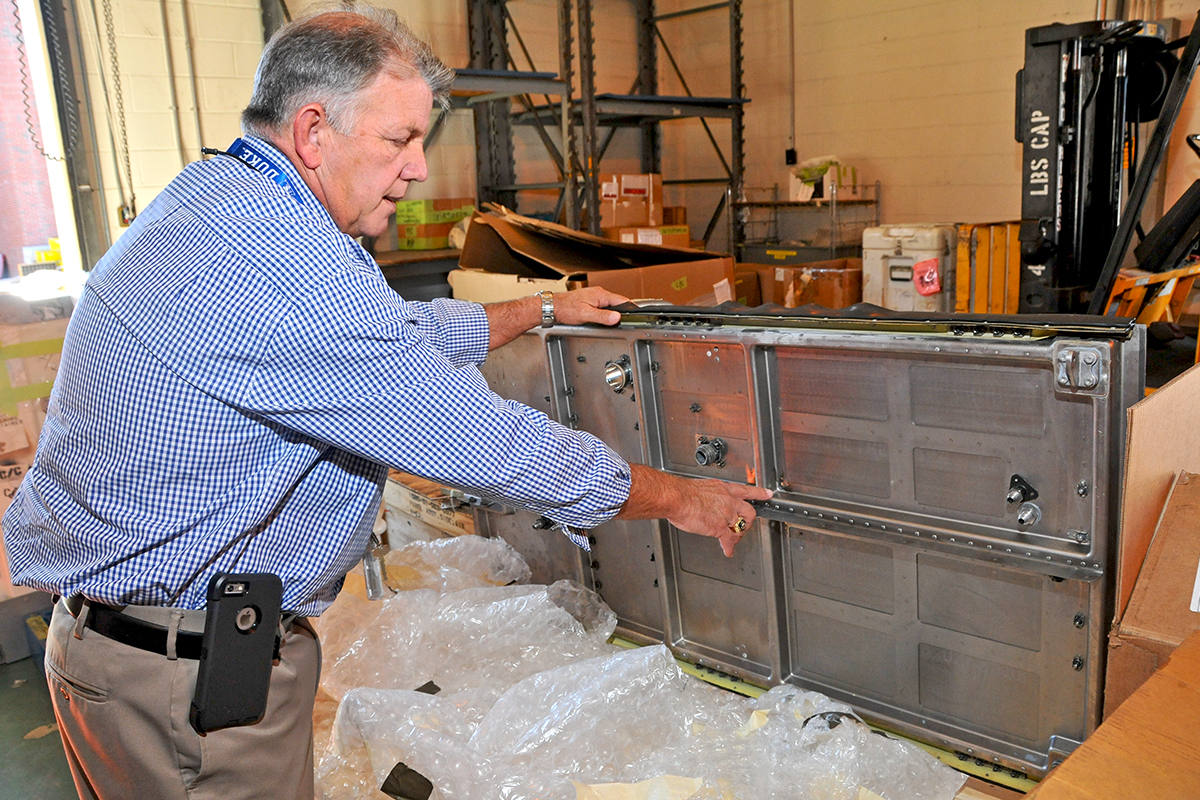
Steve Yates, customer liaison branch head, points at an area on an H-1 auxiliary power unit deck while explaining details regarding a unit Fleet Readiness Center East artisans and engineers recently repaired to support Marine Aviation Logistics Squadron 39.
FRC East artisans manufacture fix for problem APU decks to get MAW/MALS-39 H-1s airborne again
MARINE CORPS AIR STATION CHERRY POINT, NC — Bolstering fleet readiness is a primary objective at Naval Air Systems Command depots.
So when Marine Aviation Logistics Squadron 39 needed urgent help to repair a few fragile H-1 aircraft auxiliary power unit decks that had impacted Marine readiness for about 18 months, Fleet Readiness Center East was ready and eager to accept the challenge.
The deck supports the APU, which is situated above an engine and provides electrical power for system checkout, hydraulics to permit control movements for ground check and blade fold, and compressed air for starting the GE-T700-401 engines. Over time, the titanium deck supports succumb to the natural vibrations resultant of propeller activity and wear and tear, and become problematic, compromising the structural reliability of the support deck.
When Mark Sapp, FRC East welding and materials engineer, saw pictures of the decks he said, “send them to FRC East,” touting the skillsets of local engineers and manufacturing (sheet metal) artisans as “second to none.”
Having seen such issues with other projects and parts before, Sapp was confident that FRC East’s knowledge and previous successes would deliver the resolution the 3rd Aircraft Marine Wing Marines based at Camp Pendleton, Calif. needed.
“I bet we can do it. Send them,” said Robynn Storm, 6.0 Logistics and Industrial Operations group head, who said the MALS-39 maintenance officer solicited help from FRC East after visiting the facility in the summer.
And while the images of the parts did not fully convey the extent of the damage, Storm’s conviction that local artisans could deliver a fix was sure. “I never had any doubt we could do it,” she said.
In May, FRC East artisans were confronted with a similar problem when artisans at the detachment at Marine Corps Air Station New River, N.C. had to address titanium cracking on decks of aircraft that were in progress/process for scheduled depot maintenance, according to David Oravecz, H-1/V-22 overhaul and repair supervisor at New River. A technical engineering instruction was issued and the problem was fixed in about two weeks.
“Because of where the unit is mounted on an aircraft … it could cause a loss of structural integrity,” said Oravecz, who has 29 years of (Marine and civilian) maintenance experience with H-1s.
Such occurrences are now becoming typical of the airframes to attending mechanics, as H-1s have been in the Marine inventory since 1968.
“This is a commonplace repair now. … The more mature aircraft … are showing their age,” said Oravecz. “We often see things like this.”
Eric Galloway, FRC East engineering technician, said in order to develop a suitable TEI for the MALS-39 decks he referenced the one issued by FRC East in the spring and received input from FRC Southwest engineers. Sheet metal mechanics from Shop 93553 then manufactured the solutions which included fabricating a pattern, metal cutting, bending and shaping, and welding.
“It’s nice we could repair an aircraft and get it back to the fleet,” said Galloway, adding “we are doing more to mitigate this problem and prevent repeated damage.”
FRC East repaired and returned the first deck to MALS-39 within two months of receiving it. The other two were returned shortly thereafter.
Storm said she knew FRC East artisans would “rise to the challenge” and exhibit such an “awesome sense of urgency.”