
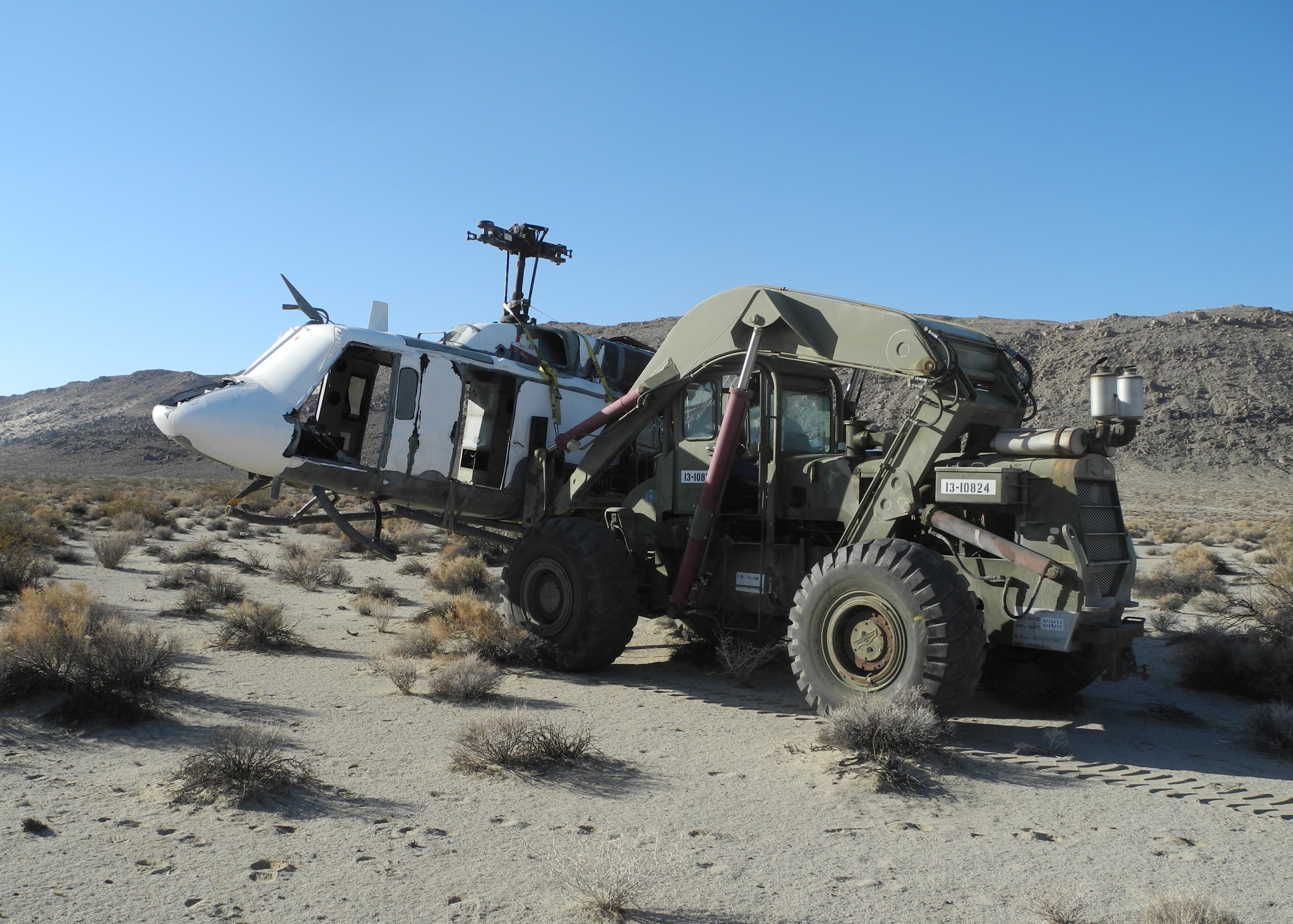
A battle-damaged UH-1N Iroquois helicopter in transport to a new Joint Combat Assessment Team (JCAT) Training Range at Naval Air Warfare Center Weapons Division at China Lake, Calif. in Oct. 2013. March 2014 was the first time the new range was used to train new assessors to deploy forward. JCAT results aid operational commanders in identifying enemy threats, tactics, and procedures, and helps aircraft survivability engineers make aircraft systems better. (U.S. Navy photo)
JCAT: Training the Joint Combat Assessment Team in aircraft battle damage assessments
NAVAL AIR SYSTEMS COMMAND, CHINA LAKE, Calif. — News of an aircraft shot down by enemy fire is always unsettling. Casualties are common, rumors are many and facts are few.
However, one thing is clear: everyone involved wants to know “What happened?” Enter the Joint Combat Assessment Team (JCAT).
Only two words long, “What happened?” can be a difficult question to answer. Since 2003, the Navy has relied upon the Naval Air Systems Command Reserve Program’s (NRP) JCAT team to answer this complex question.
JCAT assessors have been forward deployed in Iraq and Afghanistan since 2003. On call 24/7, JCAT is available to respond immediately to any battle damage event. JCAT efforts provide critical information to operational commanders by identifying the enemy threat, their tactics and procedures.
The JCAT’s work also supports the aircraft survivability community by capturing and archiving aircraft damage effects. The former provides for the safety of the mission now, the latter provides feedback on how to make aircraft systems more survivable in the future.
Before deploying, JCAT hopefuls receive hands-on field training at the JCAT Phase 2 course taught at NAWCWD, performing assessments on actual weapons-damaged aircraft in a fenced-in compound.
Returning from the field, however, course graduates wanted better options for future JCAT assessors.
In March 2014, one of the NRP’s units – In Service Engineering and Logistics Detachment Bravo (ISEL Det B) – took a big step in ensuring JCAT assessors are ready to answer the call with creation of a new battle damage training facility at Naval Air Warfare Center Weapons Division (NAWCWD) in China Lake, Calif.
“The more realistic the training site, the better the training experience is for the JCAT assessor,” said Cmdr. David Storr, who had the vision for a new site while serving as officer-in-charge of ISEL Det B. “This range will enhance the realism and complexity of the training experience and improve the readiness of the NAVAIR Reservists about to deploy.”
Storr said ISEL Det B, working with several elements of NAWCWD, asked for and received permission to construct a new site on 340 acres, large enough to allow staging of realistic, full-size crash sites as well as the topography to allow staging of notional enemy firing positions. The first Phase 2 class to use the new JCAT Training Range convened in March.
U.S. Air Force Maj. Michael Hough was one of the first students to receive training using the new facility.
“Before participating in the exercise, I had some confidence in my assessment abilities based on my previous JCAT training at Ft. Rucker,” Hough said. “However, those assessments and discussions were during the day, with maximum light available and the ability to disregard environmental concerns. The night time mission at the new test range drastically changed my point of view.”
Even during optimal conditions, thorough assessments can be a daunting task due to the variety, severity and complexity of a battle damage event. Often, the crash site wreckage leaves little to work with and weapons effects can be subtle. Eyewitness accounts, if available, are often inaccurate.
“Catastrophic events are the most challenging events a JCAT assessor has to deal with,” said Rear Adm. Kirby Miller, director of the NAVAIR Reserve Program. “Assessing a crash site is difficult, to say the least. Assessing a crash site in a combat situation is even more difficult, and the stresses of the battlefield complicate an already difficult task.”
In addition to requiring the students to perform assessments at night, instructors from ISEL Det B also added realism and battlefield stress by requiring students to limit the use of light sources.
“The change to night time assessing elevated the stress level, because you knew you were missing details,” Hough said. Conserving flashes “elevated the stress to formerly unknown regions. You had to know your camera prior to getting to the field. There was no time to learn as you go and realizing we could injure others with our attempts to gather information, dramatically altered our thought process.”
BUILD IT AND THEY WILL COME
“This took a lot of coordination, and I couldn’t have asked for more cooperation from the NAWCWD Weapons Survivability Laboratory,” Storr said. “Particularly, Jay Kovar and Al Bermudez. They have been 100 percent supportive from the start and were instrumental in the creation of this training facility.”
The principal reservist on the ground working the details of the new JCAT Training Range is ISEL Det B member Ensign Mark Buffum, who is also a civilian NAWCWD employee.
“Ensign Buffum did an outstanding job,” said Capt. Cliff Burnette, the current ISEL commanding officer. “The weapons-damaged aircraft we used in the past have served us well, but the opportunities created with the JCAT Training Range provide a phenomenal opportunity to re-qualify assessors or train new ones. ”
Buffum also coordinated closely with the Range Sustainability Office to meet environmental concerns.
Co-location with NAWCWD also offers additional benefits from “all the live-fire test events at NAWCWD, which can provide a steady stream of test assets to help us build out our range in the future,” Burnette said.
“JCAT is a critical mission,” Miller said. “Our Navy’s capability resides only within the NAVAIR Reserve Program, and we need to maintain the team’s currency whether deployed or not. This range will enhance the complexity of the training experience and improve the readiness of our Reservists about to deploy now or in a future conflict.”
JCAT has assessed more than 1,200 rotary- and fixed-wing aircraft battle damage incidents since 2003.