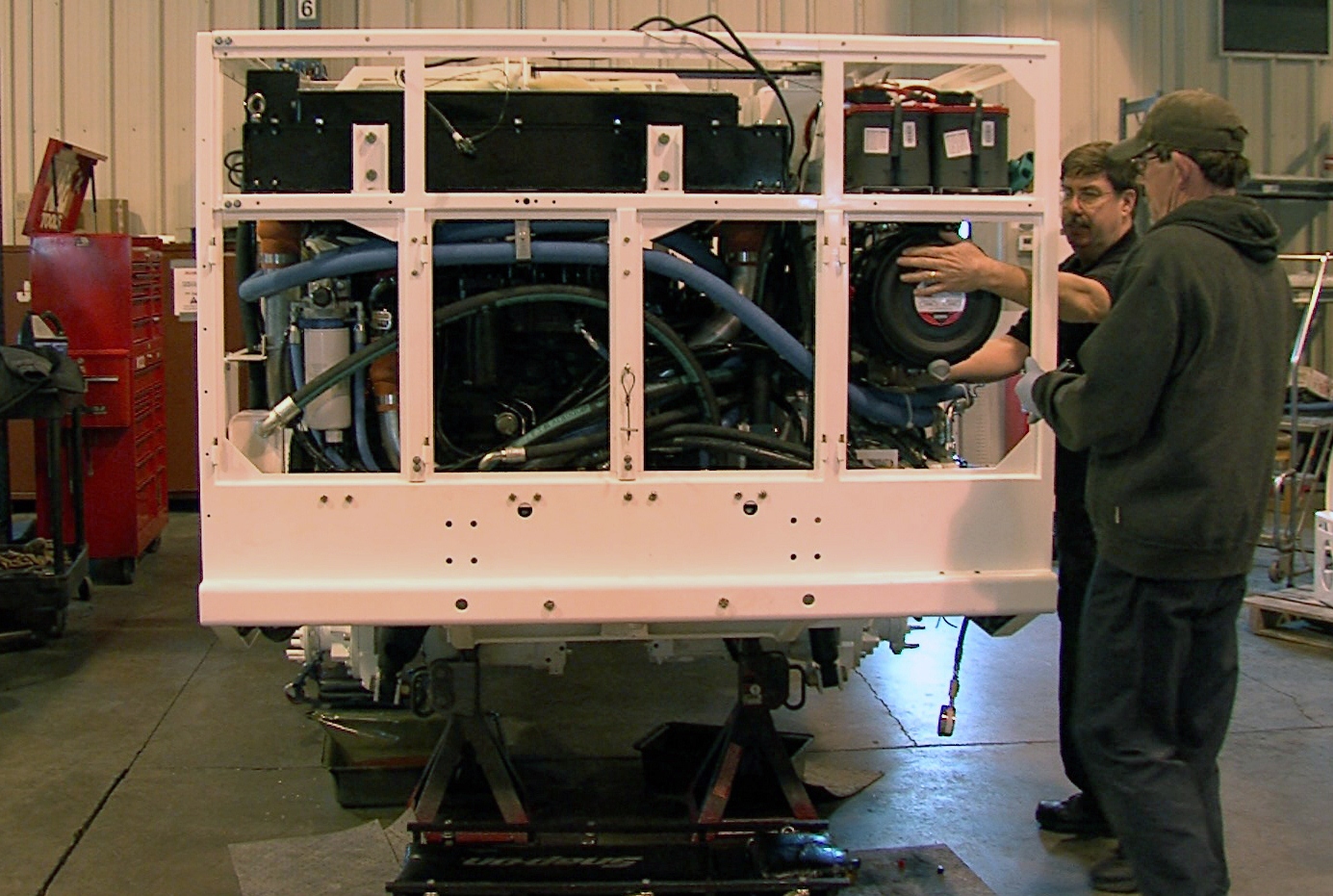
Charles Wood, left, and William Arnold, DynCorp International ground support equipment mechanics, upgrade a P-25A Shipboard Fire Truck at Fleet Readiness Center – Aviation Support Equipment at Solomons Island, Md. The first P-25As are expected to be deployed to the fleet in June 2014. (U.S. Navy photo)
Fighting fire with a new fire truck: Fleet Readiness Center upgrades venerable shipboard vehicle
NAVAL AIR SYSTEMS COMMAND, PATUXENT RIVER, Md. — Flight decks of aircraft carriers are busy places, and with limited escape accesses and confined spaces, they can be catastrophic if a fire breaks out. Sailors will soon receive an upgraded tool to help fight maritime fires, as the Navy has begun upgrading its venerable P-25 Shipboard Fire Truck, a self-propelled vehicle designed for flight-deck use.
Those upgrades, which include newer, stronger engines, pumps and more, are being performed by Fleet Readiness Center — Aviation Support Equipment based at Solomons Island, Md., in cooperation with Naval Air Systems Command’s (NAVAIR) Common Aviation Support Equipment Program Office (PMA-260), as part of a scheduled rework, said Ken Sands, Non-Avionics Common Support Equipment Branch Head with PMA-260.
Watch the related video below.
If you are having problems viewing the video, click here.
Called a Conversion in Lieu of Procurement, or CILOP, revising or upgrading existing equipment with new parts is less expensive than building a new fire truck from the tires up.
“It saves the Navy time and money,” said Paul Scatko, project lead engineer. “We don’t have to procure a whole new truck and it is a lot less expensive to just revamp the one we have.”
As a result of the conversion, it is redesigned as the P-25A Shipboard Fire Truck. In addition to being used on aircraft carriers, the fire truck is used on amphibious assault ships with the possibility of being used on future vessels.
A shipboard fire truck is an essential piece of equipment to extinguish a blaze or limit its severity until other systems can be activated. So essential is the fire truck that if it is not functioning, flight operations are halted. Two operating fire trucks are required on the flight deck during flight operations.
Powered by a diesel engine, the P-25, and converted P-25A, hauls more than 800 gallons of water and 60 gallons of foam. It has three 20-pound Halon extinguishers and is equipped with a 500 gallons-per-minute (GPM) turret and 100 feet of 1.5-inch hose with a 95 GPM nozzle. There's also an intake, for connecting to the ship's mixed aqueous film-forming foam, or AFFF, system.
Part of the reason for the conversion is, due to environmental regulations, the original Detroit Diesel two-cycle engine is no longer available for the 15-year-old apparatus. The new engine also has a newer radiator in a different position. In addition to the engine change, new pumps, radiator, heat exchanger, power takeoff and other items were upgraded as well.
“We’re bringing these vehicles in for a normal rework so we’re saving money by doing the modification at the same time,” Sands said. “The flight deck of a carrier is one of the worst environments on earth (for corrosion). We’re stripping the fire truck down to the bare chassis for corrosion control and rebuilding it back to new.”
Given that the fire truck is used on ships where space is a premium, the length and width must remain the same. Because of the placement of the new radiator, the P-25A is just slightly taller than its predecessor.
Mike Belcher, FRC-ASE Director, is proud of his team’s contribution.
“Many of our team members have used support equipment like this on ships, so they understand what it means for Sailors to have the best tools we can give them,” Belcher said. “Because of that bond with the warfighter, there is a level of commitment that goes beyond just putting a new coat of paint on a piece of equipment. Our team has a real sense of pride in ownership – when we deliver equipment back to the Fleet, we’re confident that it’s going to work as required, in its intended operational environment.”
The cost of converting 65 trucks, planned at four per quarter, is estimated at approximately $12.4 million. The program began in March 2010, and initial conversion work began in December 2013. The first P-25As are expected to be deployed to the fleet starting in June 2014 with the program running through November 2017.