
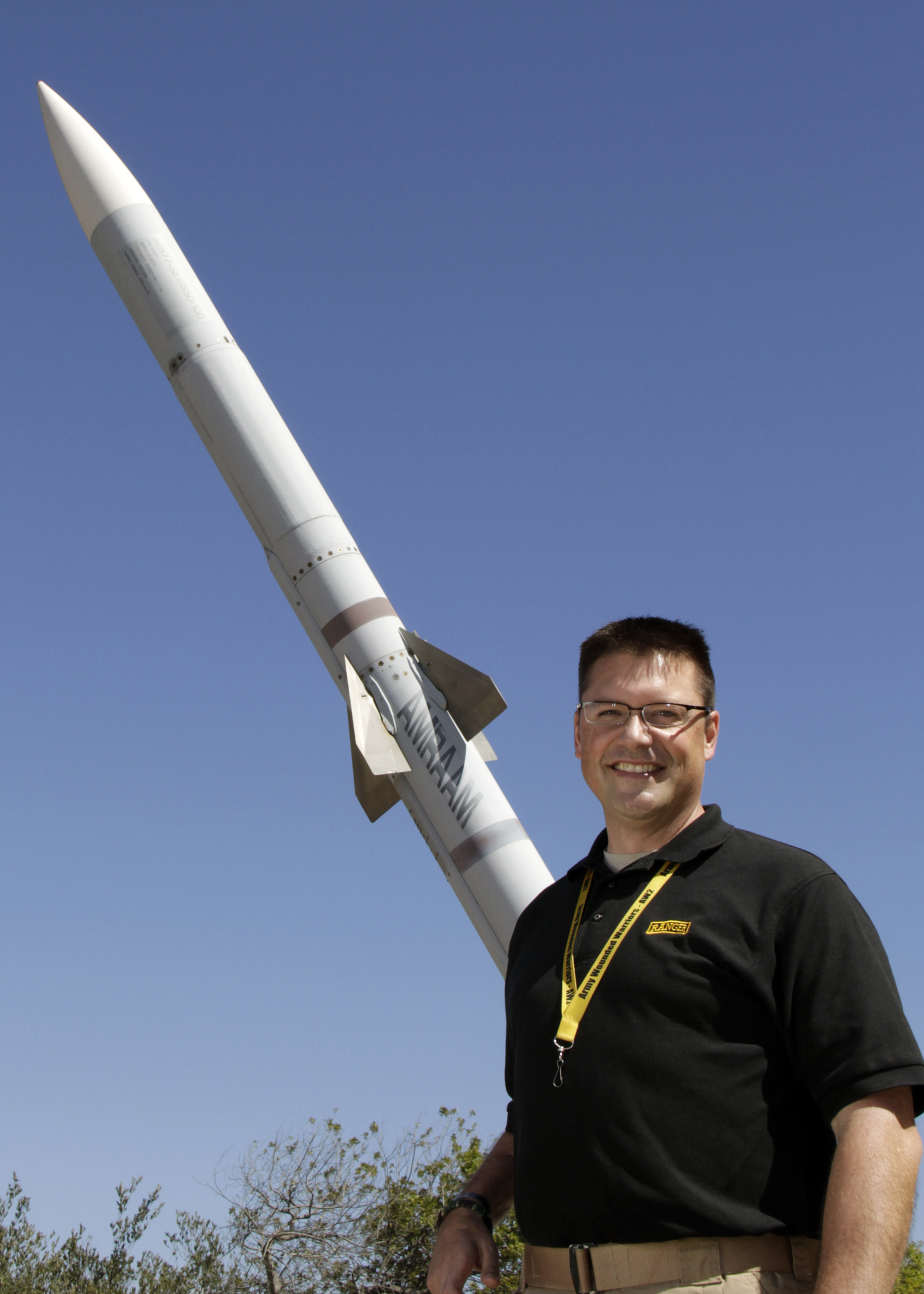
Retired Army captain Eivind Forseth is a Sea Range test manager at Naval Air Warfare Center Weapons Division, Point Mugu, Calif. (U.S. Navy photo by Mike Johnson)
Staying in the fight: How one wounded warrior's journey led him to NAVAIR
NAVAL AIR SYSTEMS COMMAND, PATUXENT RIVER, Md. – Many wounded warriors and veterans would still be on the battlefield if an improvised explosive device (IED) had not detonated nearby.
For retired Army Capt. Eivind Forseth, it was an IED in a taxi in Mosul, Iraq, in 2005 that paralyzed his right hand and disabled his arm. However, after 23 surgeries and three years of recovery, Forseth remains committed to the men and women on the front lines.
“I knew my Army career was coming to an end, but I also knew I wanted to stay in the fight,” he said. “I still wanted to use my background, specialized training and tactical experience to support the warfighter.”
That attitude led him to his job at Naval Air Systems Command, Naval Air Warfare Center Weapons Division (NAWCWD), Point Mugu, California, where he serves as a sea range test manager for the MQ-8C Fire Scout. He also is facilitating future flutter tests for the F-16 Seek Eagle stationed at Edwards Air Force Base, California.
“I’m so grateful to NAVAIR and NAWCWD for the opportunities I’ve had,” he said. “I honestly don’t know where I’d be if I weren’t here.”
(To find job opportunities and employer resources for wounded warriors, veterans and their spouses, plan to attend the DoN's 4th Annual Wounded Warrior Hiring and Support Conference May 28-29 in Raleigh, N.C.)
Serving his country
Forseth enlisted in the Army in 1993 and served two tours in Germany and Bosnia-Herzegovina. Looking for a change, Forseth separated from the Army in 1998 and earned a bachelor’s degree in English from the University of California at Riverside.
Degree in hand, Forseth took his mother’s advice and re-enlisted. “She knew that military service was still in my blood. I thought, ‘Here’s my chance to provide strong, competent leadership to soldiers who were heading off to war in Iraq,’” he said.
Forseth deployed to Iraq in November 2004 in support of Operation Iraqi Freedom. On Jan. 4, 2005, Forseth was leading his platoon back from a casualty evacuation mission when he was severely wounded by an IED.
He was put into a drug-induced coma for six days, sent to Walter Reed Army Medical Center in Washington, D.C., and was treated off and on for more than three years before retiring in March 2008.
When doctors told the Purple Heart recipient his right hand was paralyzed, he became angry and depressed, realizing he would not be able to do things he had enjoyed, such as fly fishing.“It was our family sport, and I wanted to teach my son how to fly fish,” he said.
Hooking new opportunities
At Walter Reed, a retired Navy captain asked Forseth to help start a fly fishing program. Initially, he was reluctant to get involved because he was having a hard time accomplishing daily tasks, he said.
“I was afraid I would fail, and I just couldn’t face more failure,” Forseth said.
After much cajoling from his mother and the captain, Forseth focused his energy on adapting himself to tying flies and casting.
“I remember the first time I adaptively caught a trout. That moment really turned things around for me. I attribute Project Healing Waters Fly Fishing with saving my life,” Forseth said. “Once you see that you can adapt in one area, then that mentality transfers into other activities of daily living.”
Project Healing Waters is a nonprofit organization that has helped more than 4,000 veterans and wounded warriors. Forseth is a founding member and continues to serve as an advisor.
Forseth also took advantage of the Operation Warfighter program sponsored by DoD. The program offers internships to active duty military with intelligence agencies such as the National Reconnaissance Office, where he served as a subject matter expert for counter-IED programs. That internship led to his first civilian job with the National Geospatial-Intelligence Agency, where he worked for two years before moving west to work at NAVAIR.
Forseth quickly earned a positive reputation within the command. Thomas Bluhm, a computer scientist at NAWCWD, said Forseth encourages and inspires his co-workers with his positive attitude.
“Eivind is extremely motivated to help the warfighter,” Bluhm said. “His uniformed military service was extensively served in combat so he really knows what goes on in the field, what the stakes are, and just how important our work here at NAWCWD is to supporting the warfighter.”
Forseth encourages other wounded warriors and veterans to get out of their comfort zones and be open to new opportunities.
“Do not be afraid to give a command like NAWCWD a try,” he said. “It doesn’t matter if electronic warfare is not your background; it doesn’t matter if you are not an engineer or a computer scientist. There are so many other things that you can do here, and the command offers training, certification programs and credentials to learn to do this type of work.”
Hiring wounded warriors
Employers and recruiters agree with Forseth that most wounded warriors are highly trained with battlefield experience. “We have the background and we speak the language,” he said.
These men and women know what the threats and requirements are because they had boots on the ground,” he said. “They are able to convey that to NAVAIR managers, analysts and engineers who are working to meet requirements for warfighters. It makes a big difference when you have that insight. We bring a sense of urgency and reality that others can’t.”
Adjusting to desk job
One challenge Forseth and other wounded warriors face is transitioning from being out in front on the battlefield to working behind a desk.
“It’s a tough adjustment for warriors wounded in combat,” Forseth said. “We are wounded because we were out front – we are the tip of the spear.”
Forseth said the next best thing to being out front is working for NAVAIR.
“Behind every warrior on the front line, there are tens of thousands of people supporting them,” he said. “I had my time out front, but now I can work hard in the office and still make a difference.”
NAVAIR’s Wounded Warrior Program seeks to recruit, hire, train and retain wounded warriors from across the U.S. Since October 2010, NAVAIR has placed more than 600 wounded warriors in open jobs or developmental programs.
According to DoN hiring statistics for February 2014, NAVAIR’s Patuxent River, Maryland, location was among the top 10 locations for hiring veterans.
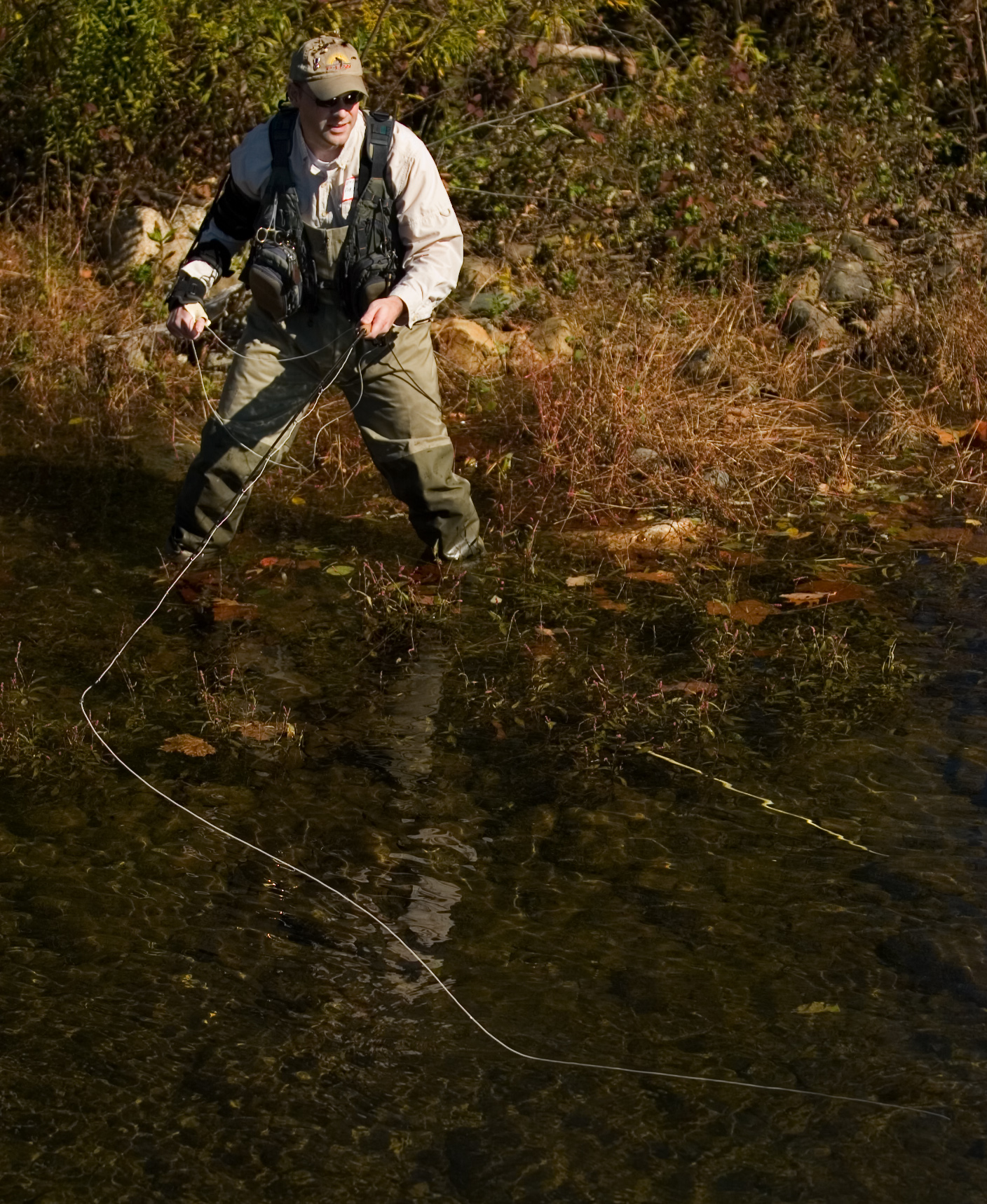
Eivind Forseth, Sea Range test manager at Naval Air Warfare Center Weapons Division, Point Mugu, Calif., uses adaptive methods to cast his fly in the Rose River, Va. Forseth, a retired Army captain, was injured in Iraq by an improvised explosive device. He credits Project Healing Waters Fly Fishing with saving his life. (Courtesy photo)
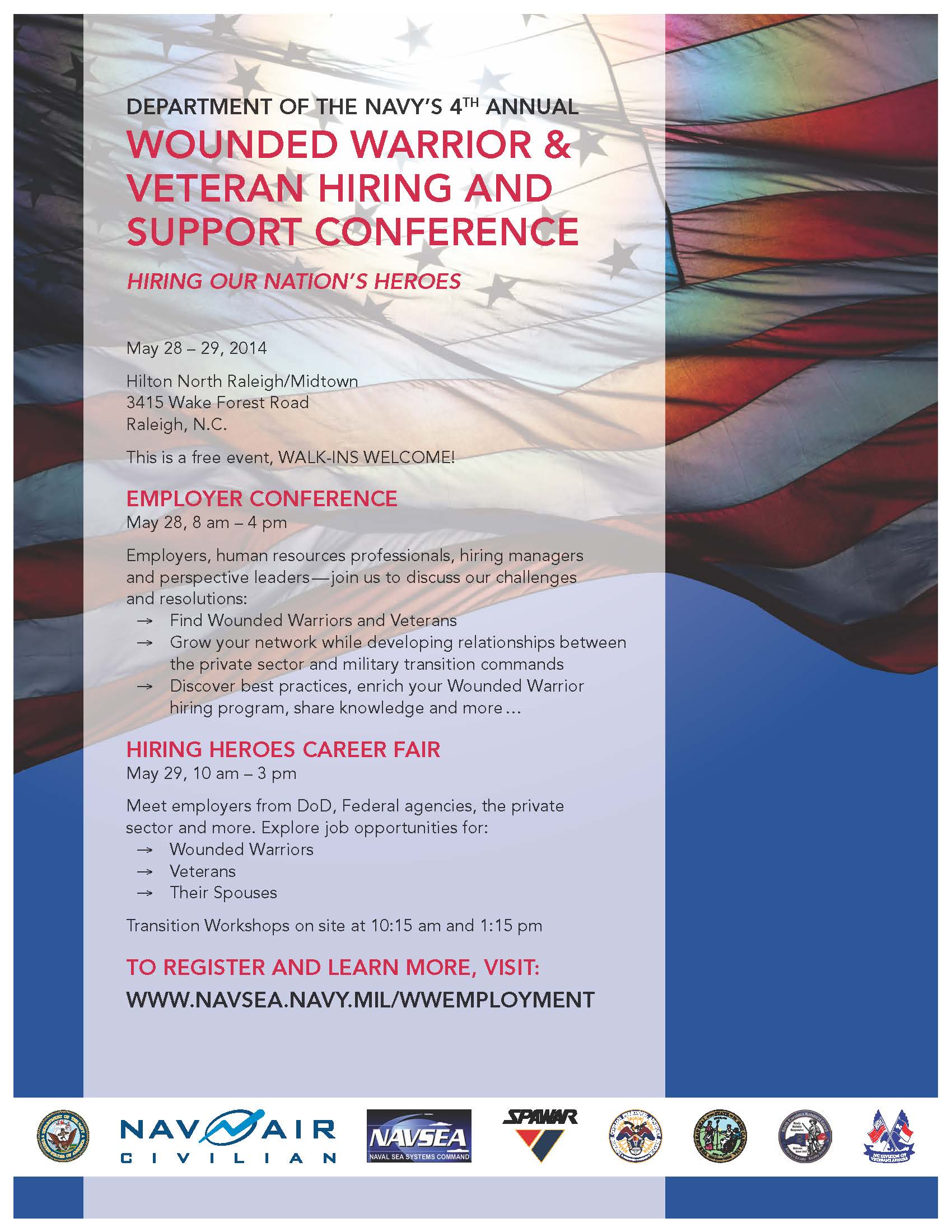
Informational flyer regarding the 4th Annual Wounded Warrior Hiring & Support Conference May 28-29 in Raleigh, N.C.