
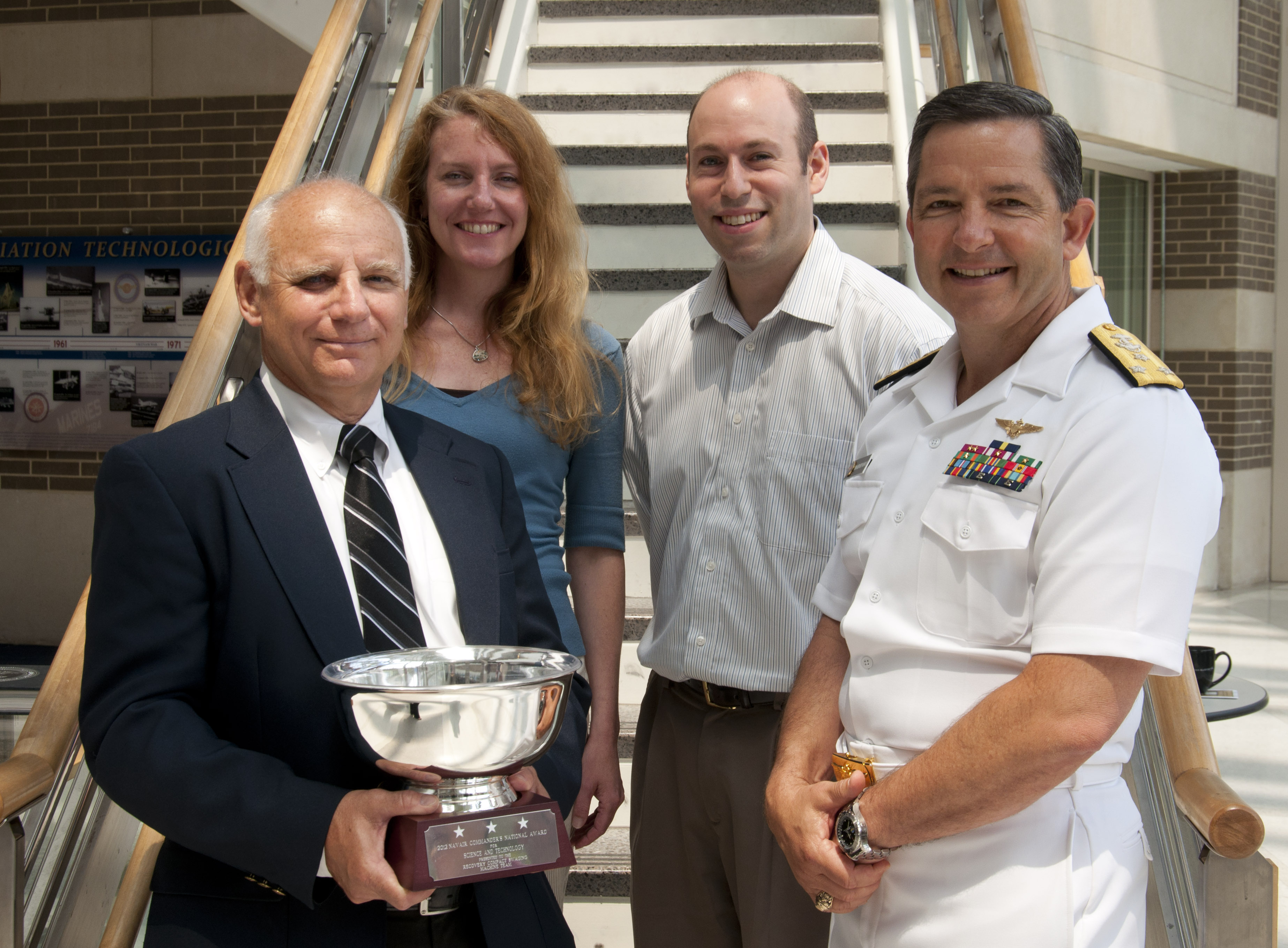
Aircraft Launch and Recovery Equipment program’s Compact Swaging Machine Team Lead, Jim Raevis; Recovery Deputy Assistant Program Manager for Logistics, Paula Parsons and Recovery Team Lead, Andrew Sussman; join NAVAIR Commander, Vice Adm. David Dunaway, to accept the 2012 NAVAIR Commander’s award for Science and Technology on June 27 during a ceremony held at NAVAIR headquarters in Patuxent River, Md. (U.S. Navy photo)
Aircraft recovery team earns NAVAIR Commander’s award
NAVAL AIR SYSTEMS COMMAND, PATUXENT RIVER, Md. – The Navy team responsible for developing the Compact Swaging Machine (CSM), which automates a current hazardous fleet process, was honored with a NAVAIR award June 27.
The Aircraft Launch and Recovery Equipment (ALRE) Program Office (PMA-251) CSM team, located at Joint Base McGuire-Dix-Lakehurst, received the NAVAIR Commander’s award for Science and Technology during a ceremony here.
“I am extremely proud of the CSM team,” said Capt. James Donnelly, ALRE program manager. “This group has done extraordinary work developing a machine that will enhance the fleet’s future warfighting capability and effectiveness.”
The current time-intensive process requires four to six Sailors and can take up to 12 hours to complete. During this process, 1,000-degrees Fahrenheit molten zinc is poured into a socket on the moving ship, exposing Sailors to toxic materials and noxious gases. The CSM requires only one Sailor and forms the replacement terminal in approximately one hour, keeping arresting engines ready to recover aircraft.
"Endorsed as the number one priority by the ALRE fleet community at the last three annual Aviation Boatswain’s Mates Association conferences, this machine will reduce workload and dramatically increase the quality of life for the Sailor,” said Andrew Sussman, ALRE recovery integrated product team lead.
PMA-251 and industry partner, Creare Engineering Research & Development, while under NAVAIR Small Business Innovation Research (SBIR) contract, designed an advanced hydraulic system that uses up to 800 tons of pressure to swage a terminal onto an aircraft carrier purchase cable. This terminal connects to the cross deck pendant that stretches across the flight deck which engages the arresting hook of a landing aircraft allowing for a smooth, controlled arrestment.
“In light of the fiscal environment, the team, led by Jim Raevis, developed a work-around that allowed the program to proceed with testing and progress toward fleet delivery,” Sussman said.
According to the award nomination submission, the criticality of cost constraints within this program resulted in novel approaches to achieve all program requirements within a limited budget. The team also utilized an Abbreviated Acquisition Program (AAP) approach, while in essence melding two programs into one: development of the CSM as well as development of a new swaged terminal.
“The CSM and newly swaged terminals each successfully endured numerous qualification tests to ensure they could withstand the rigors of an aircraft carrier environment,” said Jim Raevis, CSM team lead. “Later this summer, the CSM will complete its final test, and we will prepare for onboard swaging.”
The first onboard swaging will take place during fiscal year 14 in Norfolk, Va., on a yet-to-be-determined carrier. The machine will be housed in an intermodal freight container and then hoisted on deck. Sailors will have the opportunity to swage terminals that will be used for flight operations during the carrier’s next deployment.
In 2011, the CSM team received the NAWCAD Commander’s Innovation Award for the successful technical efforts during the system’s development.
“The CSM will replace a process that has been practiced by the fleet since the Navy started using aircraft carrier arresting gear,” Raevis said. “I’m grateful to have seen the system from its initial development to fruition and fleet integration. I’m anticipating positive feedback as Sailors incorporate the CSM into daily operations.”