
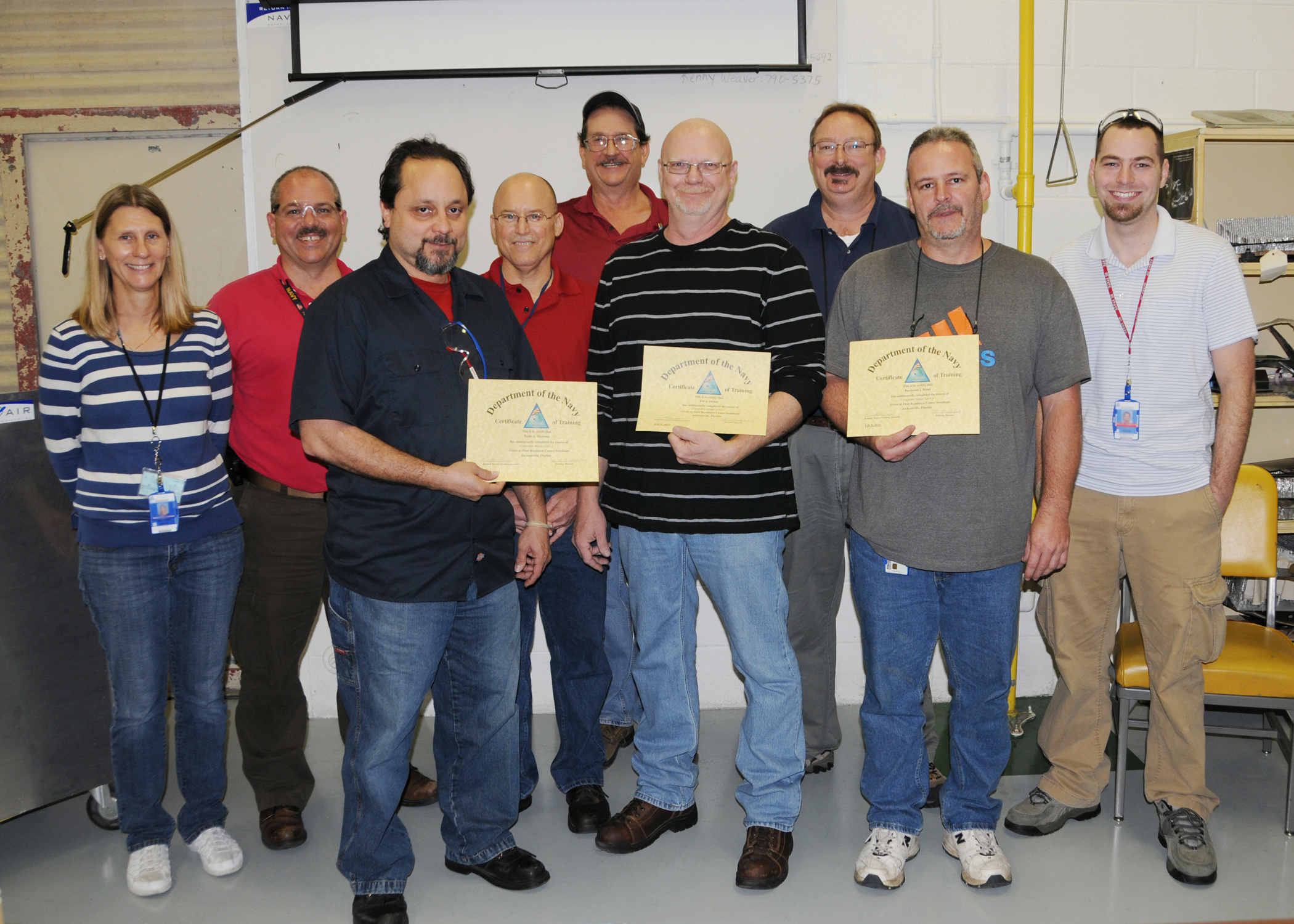
Pablo Maurosa (front row from left), Ted Dinkel and Raymond Bizier display their Composite Repair Level II certificates during a ceremony at Fleet Readiness Center Southeast Feb. 8. The plastics fabricators successfully completed a variety of patches made from carbon graphite cloth using a double vacuum debulking process to earn their certification. As the Navy moves away from aluminum airframes on its newer platforms, these artisans’ skills to make composite repairs will be invaluable. Also pictured are Lorrinda Seiberling (back row from left), Ed Galluccio, Kenny Weaver, Jerry Watson, Tim Moore and Stephen Starnes. (U.S. Navy photo/Released)
FRCSE plastics fabricators make tricky composite patches, earn certification
JACKSONVILLE, Fla. – Plastics fabricators at Fleet Readiness Center Southeast (FRCSE) successfully completed the rigid requirements to make composite patches used to repair military aircraft, earning them advanced repair certificates presented at the facility Feb. 6.
Pablo Maurosa, Ted Dinkel and Raymond Bizier earned their Composite Repair Level II Certification after successfully completing a three-week course during which time they made a variety of composite patches using carbon graphite cloth impregnated with epoxy resin.
“On a scale of 1 to 10, it was a 9.5,” said Maurosa of the course’s difficulty. “For the repair patch to be perfect, the cloth had to be saturated without any excess resin. It was very precise, down to the gram.”
The plastics fabricators must be level 1 certified with a minimum of one year’s experience working with composites to qualify for the course.
FRCSE Composite Training Specialist Kenny Weaver was first to teach the newly-offered course in Jacksonville. He said by establishing training capability locally, FRCSE is realizing “tremendous savings.” Weaver, who instructs recertification classes for levels I and II composite repairs, said the time-sensitive repairs proved very challenging for the students.
“All the repairs were challenging, especially the intricate sanding they had to do when making the double stacked, precured patch repair,” he said. “It has to be tapered back with stringent requirements. It was kind of awkward for me to say, ‘Do it again.’ They were ready to give up, but I gave them some helpful hints, and they overcame their obstacles. They all did an excellent job.”
Tim Moore, also a composite training specialist, traveled from FRC Southwest in San Diego, Calif. to serve in a “train the trainer” capacity and assist Weaver. He brought two double vacuum debulking (DVD) boxes needed for the training.
Moore has instructed the level II course for about six years. He said the Navy is moving away from aluminum airframes on its newer platforms in favor of composites, although composite repairs take longer. He said aluminum is 235 percent heavier than carbon fiber for the same strength ratio. The lighter aircraft can travel longer distances and carry heavier loads.
“It’s economics,” he said. “The [composite] aircraft are lighter and stronger than aluminum, and they use less fuel.”
Students fabricated a variety of repairs including a flat and angle panel, and a batwing repair. They also performed a bonded and a bolted repair using jo-bolt fasteners. They cut carbon fiber patches and applied epoxy, a time sensitive process. The stacked patches were placed in a DVD box to remove air and excess resin. Next, the inner vacuum bag was reconfigured for final cure at 245 degrees making for a stronger repair.
FRCSE Materials Laboratory performed nondestructive inspection (NDI) on the flat panel repairs to ensure baseline standards were met. NDI Technician Richard Polinsky used a C-scan to inspect the cured patches for high porosity levels to determine the presence of tiny holes where air is trapped.
Materials Engineers Stephen Starnes and Javier Resto reviewed the test results and with the assistance of Keith Bennie, a composites and polymers technician, they conducted interlaminar shear testing, a mechanical three-point bend test to assess the strength threshold on small samples called coupons taken from each flat panel.
"The first samples were very successful,” said Starnes. “These panels tested well and far exceeded the minimum requirements for mechanical testing.”
The plastics fabricators will use their new skills to make composite repairs on components of the F/A-18 Super Hornet Strike Fighter aircraft. Level II recertification must be renewed biannually.
FRCSE machinists and welders are fabricating DVD boxes using scrap aluminum rough cut on a water jet. Manufacturing the boxes in-house is estimated to save the command thousands of dollars.
Lorrinda Seiberling, the FRCSE training officer, spearheaded efforts to bring the level II training to Jacksonville.
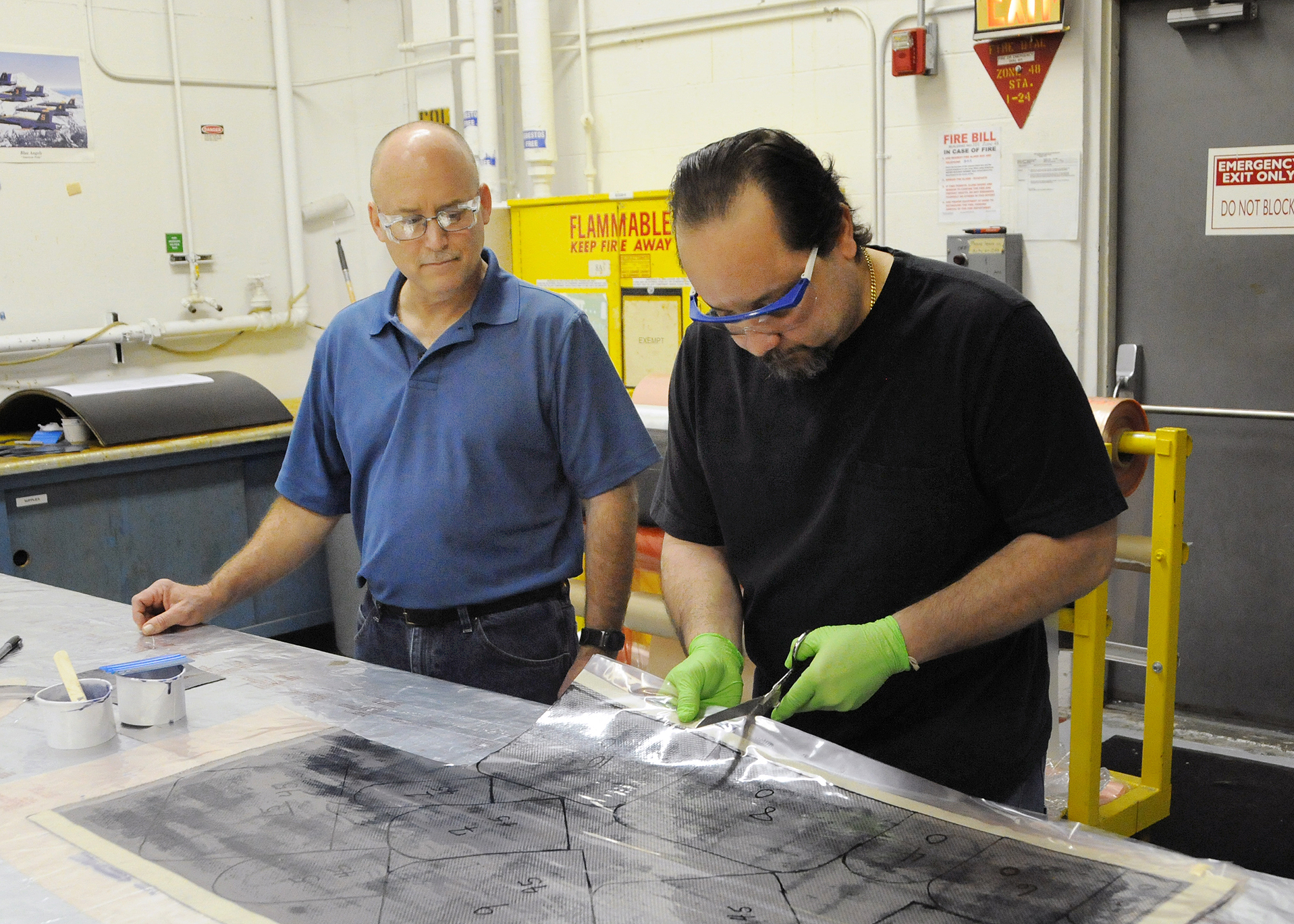
Kenny Weaver (left), the Composite Repair Level II instructor, looks on as student Pablo Maurosa cuts carbon graphite to fabricate a composite repair patch during the course at Fleet Readiness Center Southeast Feb. 6. (U.S. Navy photo/Released)
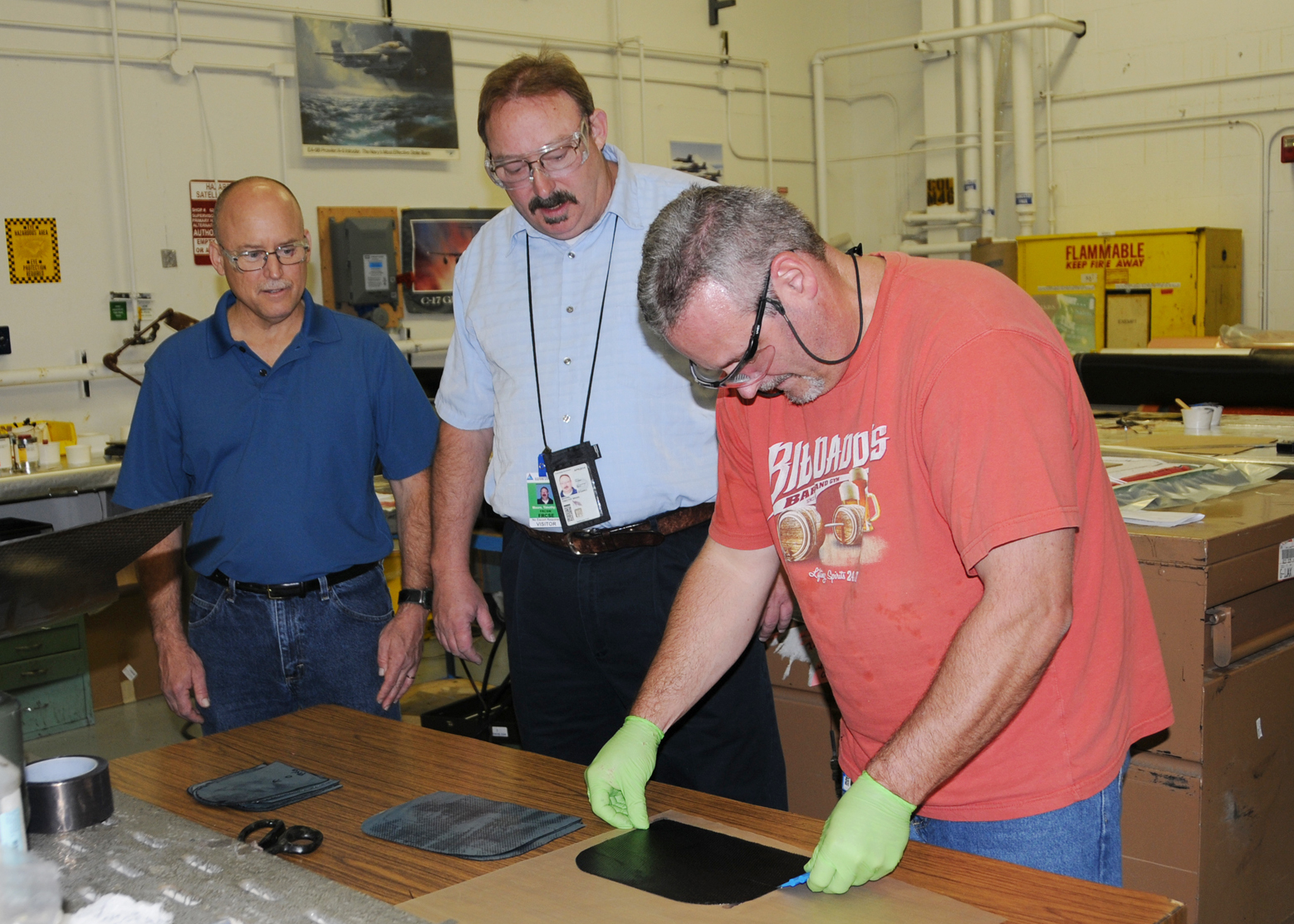
Fleet Readiness Center (FRC) Southeast Training Specialist Kenny Weaver (from left) and Tim Moore, a Composite Repair Level II instructor visiting from FRC Southwest, critique student Raymond Bizier as he applies epoxy resin to carbon graphite cloth during the course Feb. 6. The Navy is moving to lighter composite airframes on newer aircraft platforms. (U.S. Navy photo/Released)
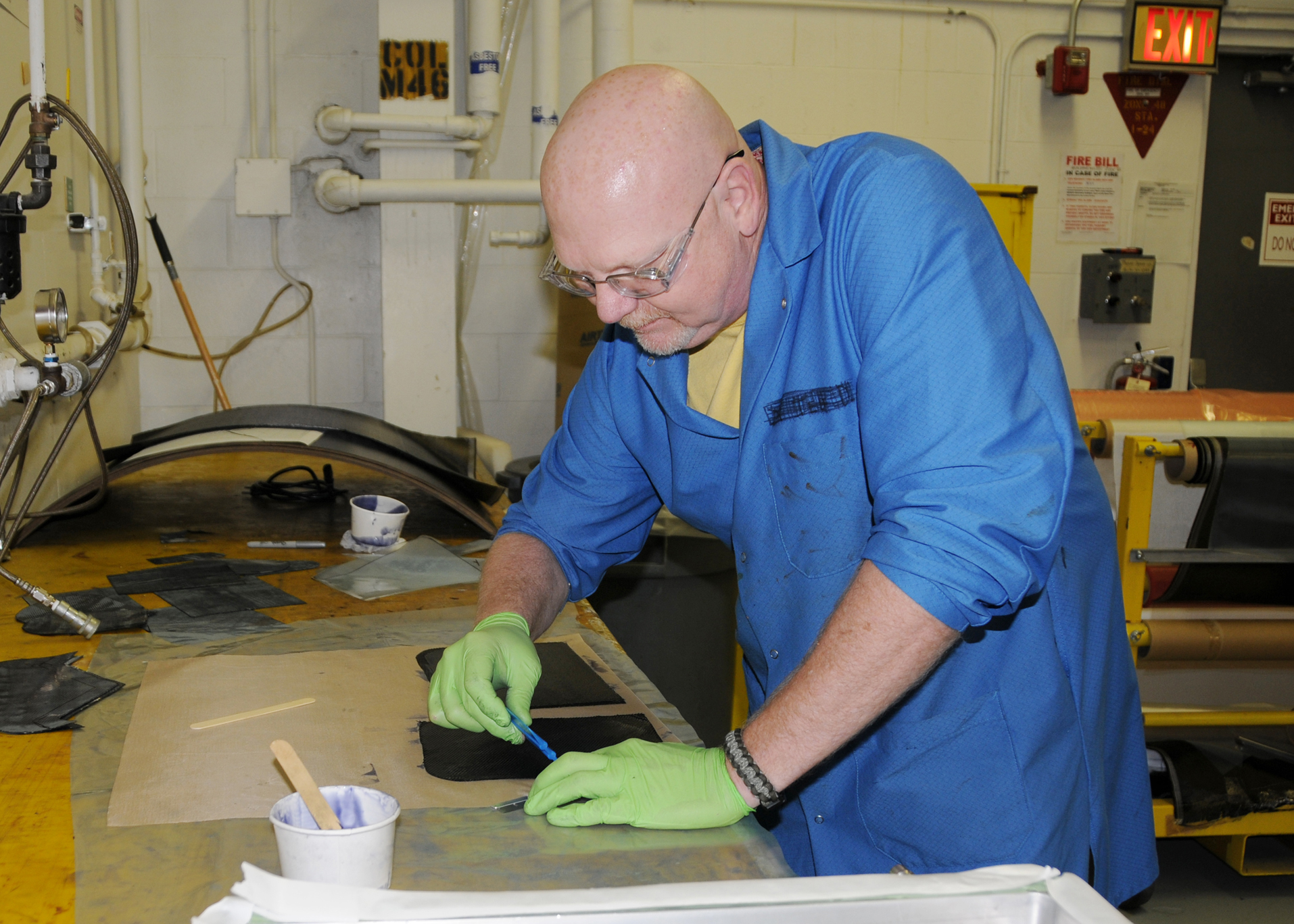
Plastics Fabricator Ted Dinkel saturates carbon graphic cloth with epoxy resin during Composite Repair Level II training at Fleet Readiness Center Southeast Feb. 6. The students must be level I certified with one year’s experience to take the course. (U.S. Navy photo/Released)
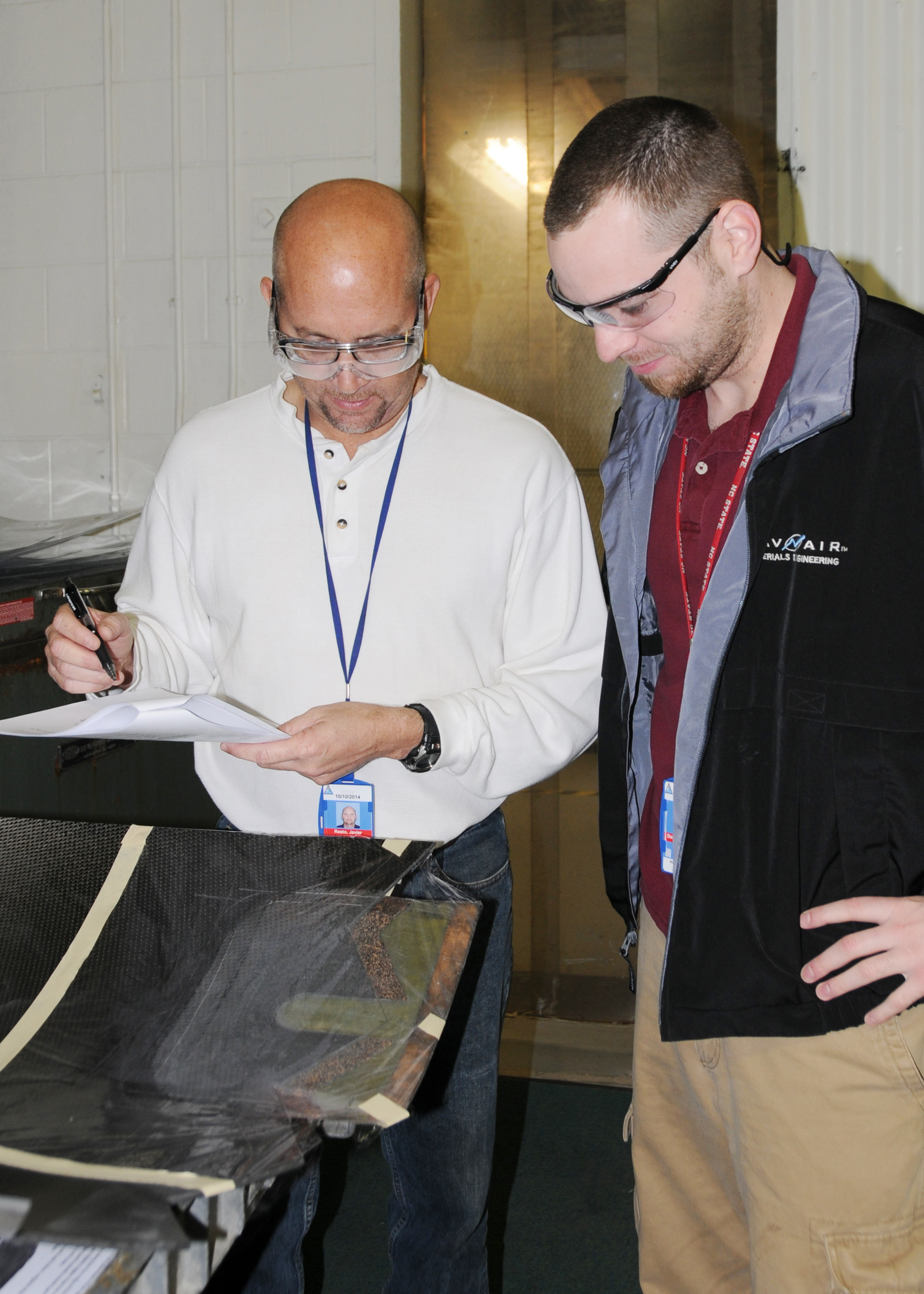
On Feb. 6, Materials Engineers Javier Resto (left) and Stephen Starnes visually inspect a batwing composite repair made by a student attending the three-week Composite Repair Level II course at Fleet Readiness Center Southeast. The engineers perform testing to ensure the samples meet baseline standards. (U.S. Navy photo/Released)