
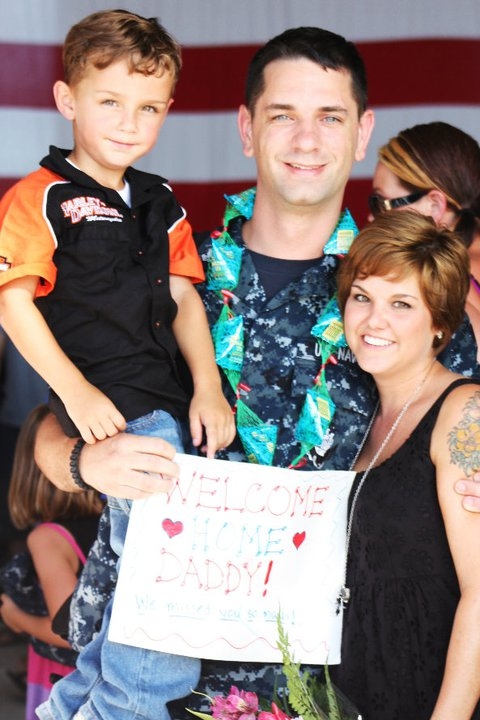
Clifton Mouliere, center, with his son and wife at the VP-4 homecoming in May 2011 at Marine Corps Base Hawaii. Mouliere was separated from 10 years of active duty service as part of the Navy’s Enlisted Retention Board and joined NAVAIR as an engineering technician in July 2012. (Courtesy photo)
From shipmate to NAVAIR workmate
Archived Body
NAVAL AIR WARFARE CENTER WEAPONS DIVISION, CHINA LAKE, Calif. — Clifton Mouliere spent more than six months applying for jobs, honing his resume and networking.
Now a civilian engineering technician based in China Lake, Mouliere was separated from active duty service as part of the Navy’s Enlisted Retention Board in 2011. This past fall, the board elected not to retain active duty Sailors from certain pay grades, including 41 Sailors from NAVAIR.
Mouliere came to NAVAIR in July 2012 as part of the “Shipmates to Workmates” program, which provides guidance to Sailors who are transitioning out of the Navy and into the civilian workforce. The program helps separating Sailors find and compete for jobs at partnering commands, such as NAVAIR.
“NAVAIR continues to partner with other Navy commands to ensure people like Clifton have access to the transition and employment resources they need to bring to their next career,” said NAVAIR Recruiting and Retention Program Manager Tania Dawson.
Mouliere had completed 10 years of active duty military service with the U.S. Navy, including two deployments to the Persian Gulf in service of Operation Iraqi Freedom, Southern Watch, and Unified Assistance and a deployment to Okinawa, Japan.
As a NAVAIR civilian, Mouliere provides U.S. service members and foreign military with accurate and cost-effective aviation life support and escape systems — the same work he performed when he was on active duty.
“This [job] allowed me to expand my knowledge in my profession, and I was hoping to bring some new ideas to the workplace that would add value to DEPOT-level maintenance operations,” he said.
Mouliere said his favorite part of working for NAVAIR is the people, since many of his co-workers have ties to the military.
“They have been more than helpful toward me transitioning to the civilian sector,” he said. “I am learning so much from everyone that I work with that I don’t think that I would have ever found out in any other industry.”
He advises employers to consider hiring Sailors because they are well trained and have a sense of urgency in everything they do, as well as an understanding of their part in the big picture and overall mission.
To job seekers, Mouliere cautions that networking is key.
“Start talking to people — and I mean a lot of people — and tell them what your plans are and to let you know if they hear about any positions opening soon in any field you might be interested in,” he said. Mouliere knows the importance of networking firsthand; he learned about his current job from a fellow separating Sailor.
Job seekers should begin early, at least one year ahead of the end of their active obligated service, he said. Specifically, he recommends Sailors attend Navy Transition Assistance Program classes and work to refine their resumes and Verification of Military Experience and Training form.
Find out more about the “Shipmates to Workmates” program and register for upcoming career forums.