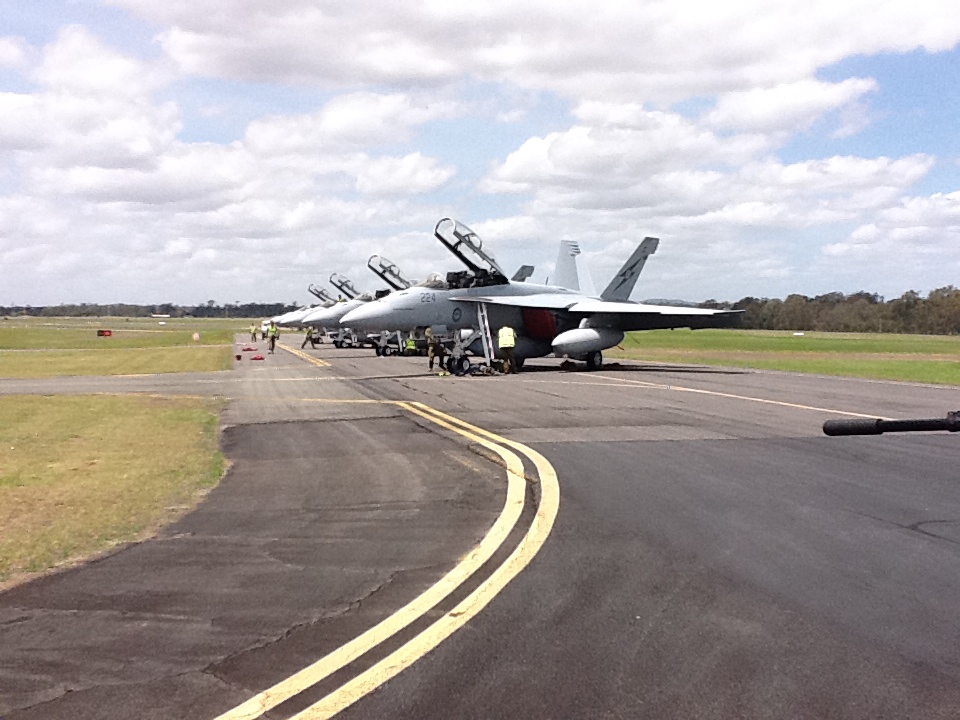
The final four of 24 Royal Australian Air Force Super Hornets line the runway at RAAF Base Amberley Oct. 21. The touching down of the four aircraft mark the complete delivery of all 24 Super Hornets, affectionately called “Rhinos” by the Australians, on cost and ahead of schedule. (U.S. Navy Photo)
RAAF receives final 4 Super Hornet during ceremony
ROYAL AUSTRALIAN AIR FORCE BASE AMBERLEY, Australia – The sun-filled sky over Australia provided a fitting backdrop as a formation of 20 Boeing F/A-18 F Super Hornets flew today to celebrate the delivery of the final four aircraft to the Royal Australian Air Force here.
The touching down of the four aircraft marks the complete delivery of all 24 Super Hornets, affectionately called “Rhinos” by the Australians, on cost and ahead of schedule.
“The Super Hornet gives us the fire power we need to protect Australian skies until the arrival of the Joint Strike Fighter later this decade,” said Australian Minister of Defence Materiel Jason Clare. “Today, we know that until that day comes we are in good hands.”
In 1981, Australia began a more than 30-year partnership with the United States with the purchase of Legacy Hornets. Australia secured the road to the Australian Super Hornet in March 2007 when then Australian Minister of Defence announced the country would be the first international Super Hornet customer. The Australians accepted the delivery of the first five Super Hornets in March 2010.
“There is a long relationship between the Royal Australian Air Force and the Navy that has paid a dividend for not just the RAAF but the military alliance herein this part of the world,” said Rear Adm. Donald Gaddis, Program Executive Officer for Tactical Aircraft, Naval Air Systems Command, Patuxent River, Md. “The Chief of Naval Operations yesterday said the Asian Pacific region is his top priority and he wants to see an increase in Naval presence in the region. Evidence of that is the delivery of 24 Super Hornets. In my mind, the Super Hornet is one of the most capable multi-mission aircraft in the world today.”
The RAAF Rhinos, built on a common-U.S. Navy configuration, provide the RAAF with the same war fighting capability as the U.S. while ensuring future interoperability. Now that the acquisition part is completed the sustainment of the aircraft begins.
“The fun part of delivering the aircraft is over,” said Gaddis. “Now, the professional part of sustaining the aircraft is now about to begin. Making sure the aircraft is serviceable and ready for combat is important to Australia, the RAAF and us. So, the sustainment and the operational support is the life blood of this aircraft, and we, [the Hornet International Team], will put our focus on that piece.”
The Super Hornet is a viable and technologically current platform. Block II improvements give the aircraft upgrades like sensors, data links, open computing architecture and an arsenal of precision weapons. The Super Hornet is revolutionizing the networked battlefield fight. As part of the Navy’s “Flight Plan,” it will continue to stay ahead of the threat for decades to come.