
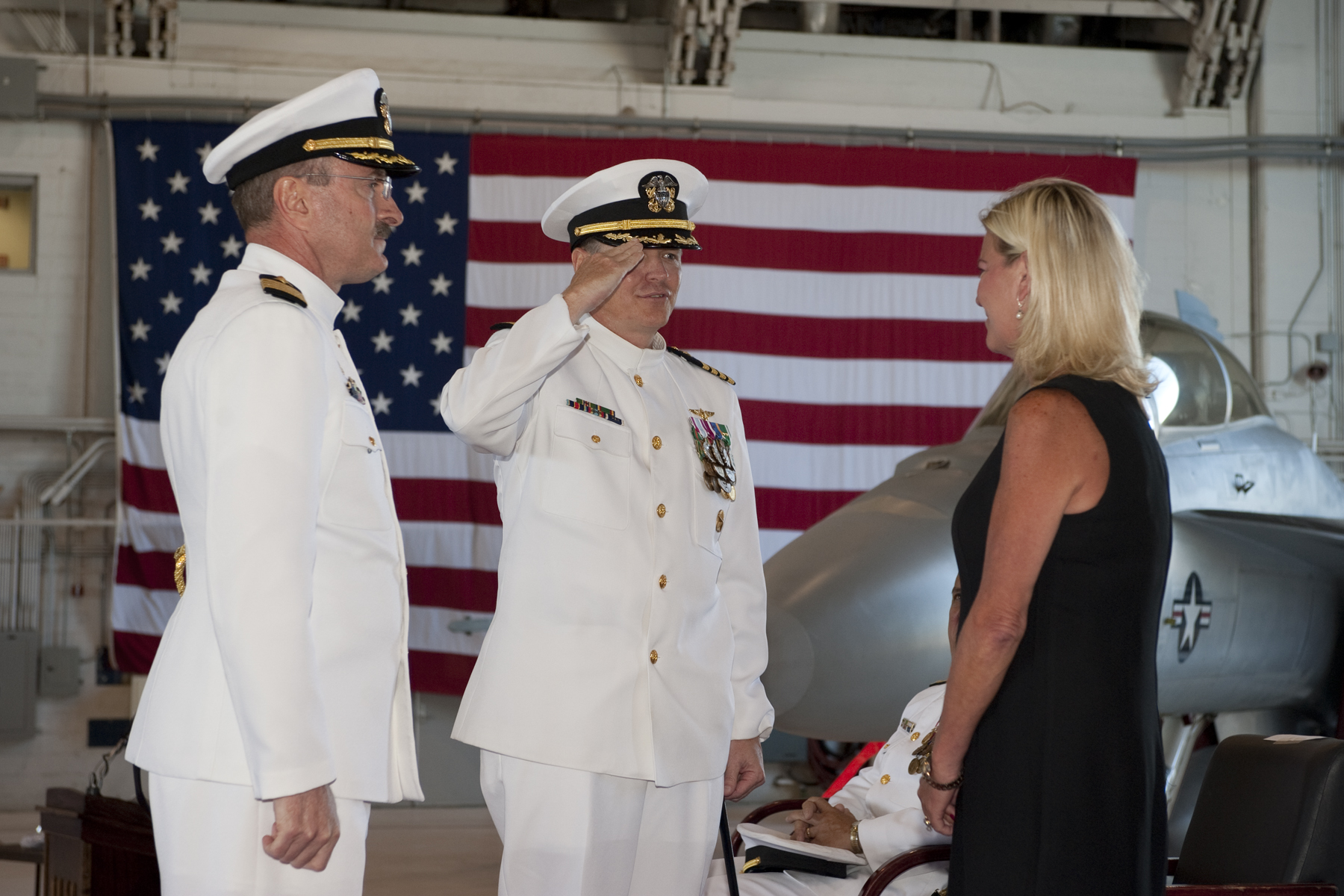
Capt. Francis Morley, incoming program manager for the F/A-18 and EA-18G Program Office (PMA-265), reports to Lisa Nyalko, deputy Program Executive Officer for Tactical Aircraft, while Capt. Mark Darrah, outgoing program manager for PMA-265, during a change-of-command ceremony July 14 at Air Test and Evaluation Squadron 23 (VX-23) here. (U.S. Navy Photo)
PMA-265 welcomes new program manager
NAVAL AIR SYSTEMS COMMAND, PATUXENT RIVER, Md. – The reigns of command for the F/A-18 and EA-18G Program Office (PMA-265) changed hands during a ceremony July 14 at Air Test and Evaluation Squadron 23, VX-23, here.
Capt. Frank Morley relieved Capt. Mark Darrah, who was recently selected to the rank of rear admiral lower half, as F/A-18 and EA-18G (PMA-265) program manager.
“This event is the perfect opportunity to renew our commitment to our Sailors and Marines,” said Vice Adm. David Architzel, commander, Naval Air Systems Command, “and inspire each other to continue to provide them with the aircraft, weapons, and systems they need to fight and win.”
The ceremony was attended by more than 500 family, friends and colleagues as well as distinguished guests from across the country.
As PMA-265 program manager since July 2007, Darrah led a 2,800 member team at more than 15 locations, supporting 63 U.S. Navy and Marine Corps F/A-18 squadrons and seven international business partners.
In the past year, under Darrah’s leadership, the PMA-265 Multi Year Procurement III team was awarded the Acquisition Excellence Award, the Distributed Targeting System was approved for Milestone C and the Infrared Search and Track system was approved for Milestone B.
“One of the marquee events during Mark’s tenure was the successful award of the F/A-18E/F and EA-18G Multi-Year III procurement contract,” Architzel said.
The MYPIII contract allows the Navy to acquire 124 aircraft over four years, making it the first-ever four-year multi-year contract with an expected cost savings of $605 million dollars.
“Good for the Navy, good for the naval aviator, good for industry. Win-win-win,” Architzel said.
During Darrah’s tenure as program manager, the EA-18G Growler achieved initial operational capability, consistently met delivery deadlines ahead of schedule, and made the first expeditionary and carrier-based deployments of this new aircraft. The program also facilitated the first active electronically scanned radar combat deployment with Strike Fighter Squadron (VFA)-22.
Under his leadership, the international business team delivered 15 Royal Australian Air Force Super Hornets ahead of schedule to support initial operational capability, with 20 of 24 aircraft delivered to date.
Over the last four years, Darrah piloted the service life extension program for the F/A-18A-D Hornet aircraft. The program will extend classic Hornets service life by more than 60 percent with modifications scheduled to begin next year.
As a result of his consistent leadership and guidance of the PMA-265 team, Darrah was presented with the Legion of Merit by Architzel during the ceremony. This is the third Legion of Merit received by Darrah during his military career.
“PMA-265 as a team continues to keep our heads down, delivering advanced capabilities that no one can match,” Darrah said. “I have every expectation that PMA-265 and its key partners will continue this trend well into the future. I am satisfied that we have built a platform with growth capability that will bridge us well into the future.”
Morley graduated from the United States Naval Test Pilot School and has a M.S. in Aviations Systems from the University of Tennessee.
He was selected to be one of three original Navy test pilots for the beginning of the F/A-18 E/F Super Hornet Engineering and Manufacturing Development flight test program. Morley was assigned as the Navy’s performance, propulsion and carrier suitability test pilot for the first two years of the Super Hornet program. In this capacity, he conducted the first Super Hornet shipboard landing in January of 1997 as part of its initial sea trials.
“This plane as been the centerpiece of my professional life,” Morley said. “I have seen the world pass before me looking through the canopy of this aircraft. It has allowed me to log an equal number of landings as takeoffs to date.”
Morley served as deputy program manager, PMA-265, overseeing the EA-18G program, F/A-18 A-F radar, electronic warfare and electro-optical and infrared programs from November 2007 through Aug. 2010. While serving in this position, he was selected for the 2010 National Security Management Program at George Washington University.
During his time as deputy program manager, the EA-18G achieved many milestones including successful entry into operational assessment, conclusion of systems design and development and initial operational test and evaluation and began fleet transition in 2009. In 2010, the Growler was designated “effective and suitable” by the commander, Operational Test and Evaluation Force.
“Five years ago to this day and hour, I had the opportunity to embark on the greatest professional honor of my life – to take command of a strike fighter squadron. Today, I top that honor. Command is a privilege and leadership is servitude,” Morley said.
The F/A-18 and EA-18G program facilitates the individual acquisition schedules of the Hornet, Super Hornet and Growler.
The F/A-18 Hornet became operational in 1983, replacing the Navy’s A-7 Corsair and the Marine Corps’ F-4 Phantom, and today its maneuverability, survivability, and maintainability keep it relevant in the current threat environment.
The Super Hornet provides aircrew the capability and performance necessary to face 21st century threats and is scheduled to remain in service beyond 2035. In Operation Iraqi Freedom and Operation Enduring Freedom, its open architecture design has allowed it to perform new combinations of varied and distinct missions.
Similarly, the Growler is the latest variant of the F/A-18. This electronic attack aircraft combines the newly developed jamming capability upgrades of the EA-6B Prowler with the tactical versatility, advancements and capabilities of the Block II Super Hornet.