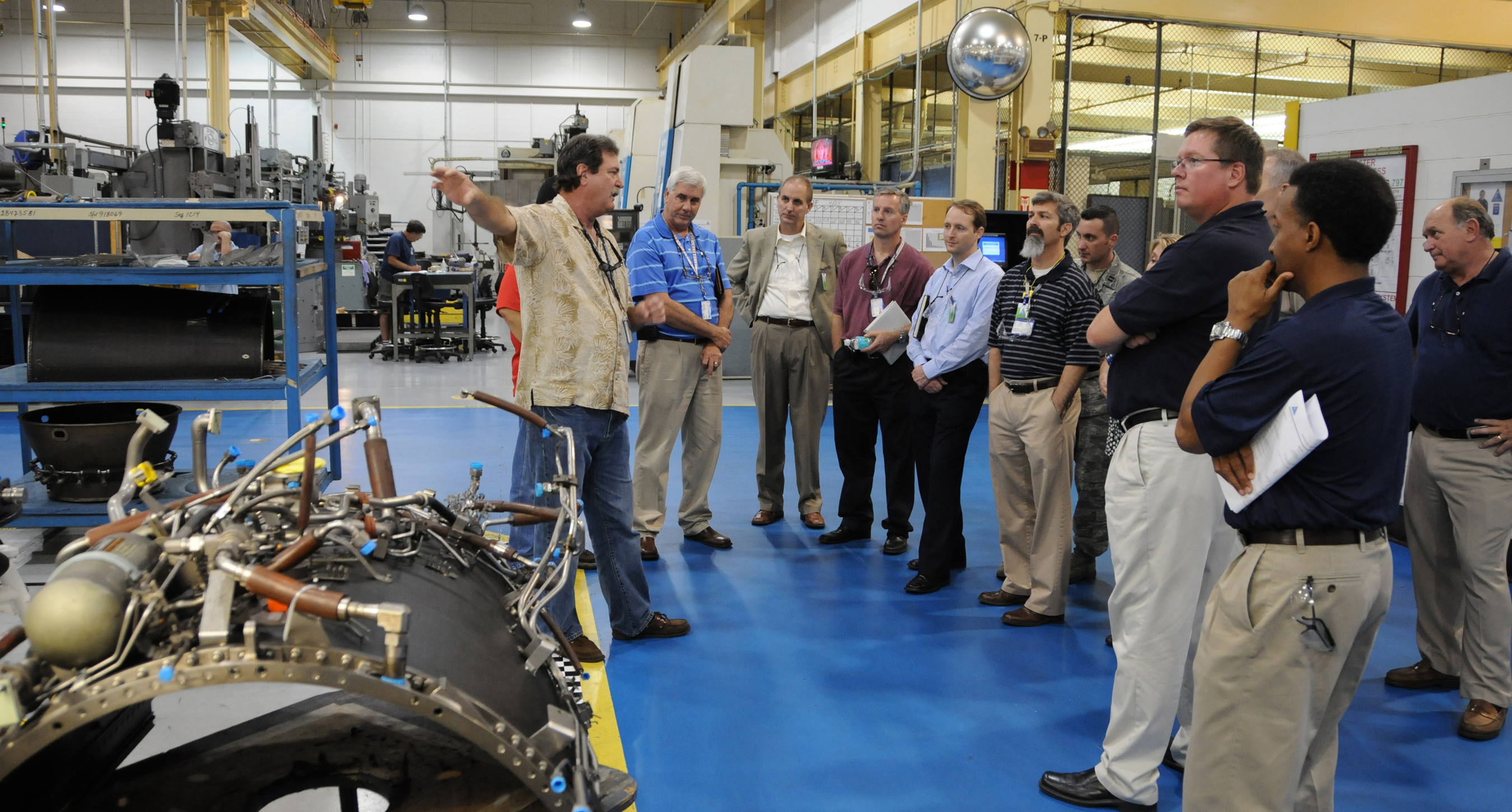
F414 Engine Product Manager Ken Traylor (left) explains repair capabilities to members of the Joint Strike Fighter Depot Activation Team (J-DAT) during a tour of the Crinkley Engine Facility at Fleet Readiness Center Southeast April 27. The J-DAT is assessing the processes and products at six military service depots slated to maintain various subsystems for the multirole F-35 aircraft. (U.S. Navy photo by Vic Pitts/Released)
JSF Depot Activation Team tours FRCSE, reviews repair capabilities
The Joint Strike Fighter (JSF) Depot Activation Team (J-DAT) responsible for planning and implementing JSF depot-level maintenance and repair capability at six joint military sites visited Fleet Readiness Center Southeast (FRCSE) to assess activation issues April 27.
The 14-member team is traveling the country to review the capabilities at three U.S. Air Force and three U.S. Navy maintenance depots to evaluate each facility’s processes and products and to provide guidance and support during the implementation phase.
The joint team includes representatives from Lockheed Martin, the F-35 Lightening II Program prime contractor and its principal partners in the project, Northrop Grumman, BAE Systems and Pratt & Whitney, in addition to the Military Service Depot personnel.
FRCSE will provide engine and avionics systems maintenance and repair support for the F-35 Lightening II aircraft, also known as the JSF. Artisans will maintain Pratt & Whitney’s F135 production engine, the multi-function radar, and the electro-optical equipment.
Business Management Specialists Greg Daniels and Mike Schoonover, both J-DAT members, organized the facility tour. They agreed the FRCSE tour set a high standard for the remaining military service depot tours.
"The J-DAT is very integral to depot maintenance planning for the JSF systems assigned to FRCSE,” said Schoonover. “It is important that we are engaged early in the process to deliver the right maintenance solution at the right cost."
Lockheed Martin Site Activation Lead Tammy Moffet said it is important for the team to tour each site and see where the artisans will maintain the various subsystems.
“We want to leverage off of each activity’s strengths,” said Moffet. “I’m very impressed with FRCSE, especially manufacturing. The technology has come a long way.”
Bob Sajewski with BAE Systems, Inc. is responsible for depot maintenance for the activation team. He said BAE is combining resources and collaborating with Lockheed to provide the fuel system, life support and more for the aircraft.
“BAE fills in the gaps in the partnership environment with Lockheed,” he said. “We want to see the leaning process and make sure each depot gets stood up as efficiently as possible. FRCSE is doing an impressive job; it is very refreshing.”
Deputy Depot Planning Lead Jim Shalbrack with the JSF Program Office said visiting each military depot and getting the standup status for various components is worth a thousand words.
“We put dollars to the contract,” he said. “The program office is taking major budget hits, but we are all doing our fair share to save money. Jacksonville will have to upgrade their test cells to support the F135, but the individual services are responsible for funding the MILCON (military construction).”
Wes Johnson, the JSF program manager at FRCSE, said the JSF engine is twice as large as the largest engine artisans are currently maintaining at the facility.
“We need upgrades to the anteroom of the test cell to allow for engine testing and module swaps to streamline the process,” he said.
Lockheed Martin is developing four versions of the F-35: U.S Navy, U.S. Air Force, U.S. Marine Corps and the United Kingdom Royal Navy and Air Force. The Navy’s variant designed to take the stresses of carrier landings and catapult launches has larger wings to enable low-speed carrier approaches. The larger wing area also increases payload capability.
The development of the world’s most advanced multirole strike fighter with optimized air-to-ground and air-to-air capabilities is a joint military and private industry venture that combines sophisticated manufacturing, engineering and technological capabilities.
As of April 5, the F-35 flight test program has conducted 769 flights total, including 222 flights in 2011. Flight numbers include production model-flights. All 19 System Development and Demonstration (SDD) test aircraft are out of the factory, according to the Lockheed Martin F-35 Communication Team.
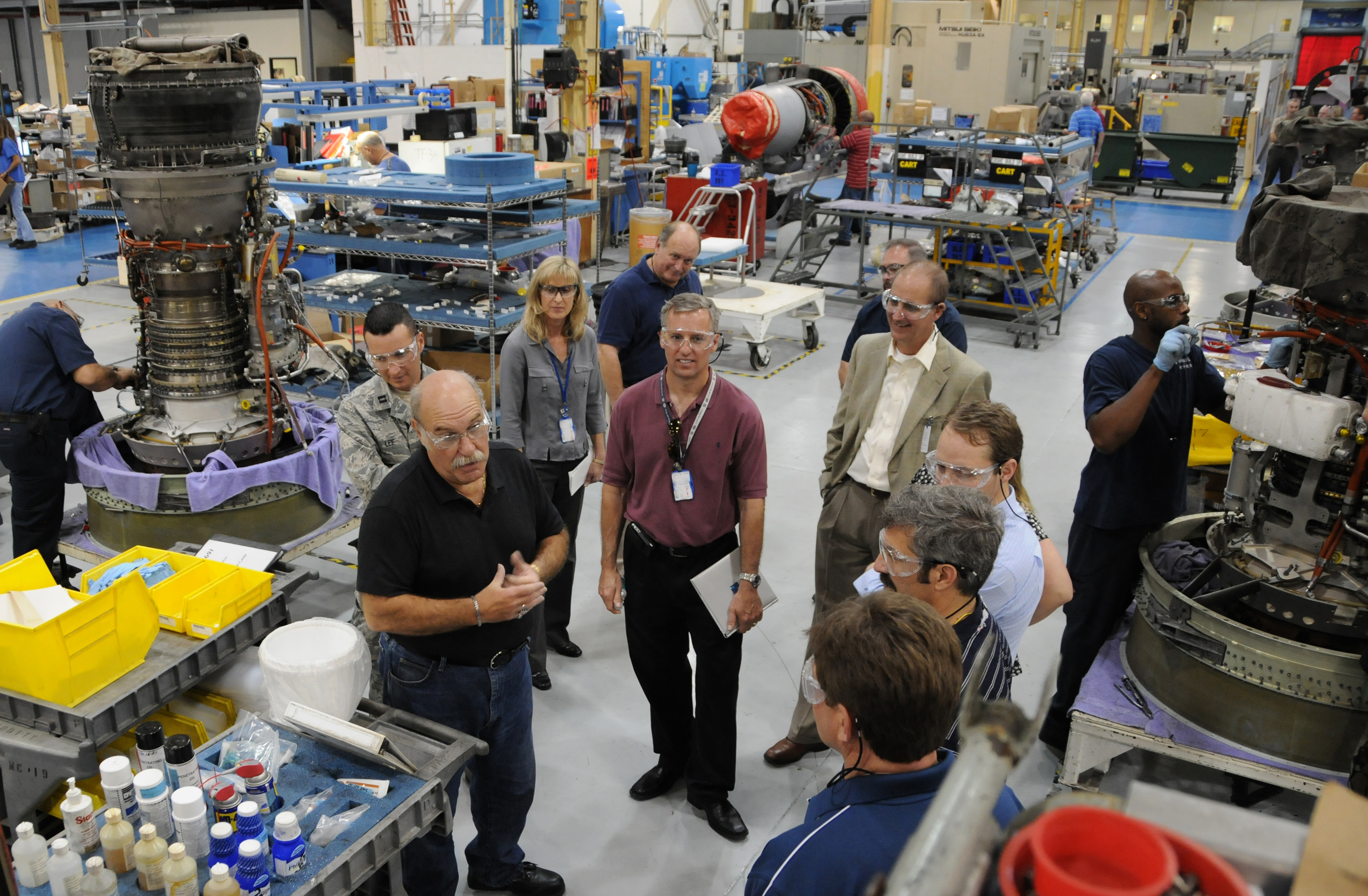
Members of the Joint Strike Fighter (JSF) Depot Activation Team (J-DAT) representing Lockheed Martin, the JSF Program Office and six military service depots listens as Bill Ockenhouse (front center left), the TF34 engine repair supervisor, explains the engine’s repair process during a tour of the Crinkley Engine Facility at Fleet Readiness Center Southeast (FRCSE) April 27. FRCSE artisans will repair the multirole aircraft’s F135 engine, multi-function radar, and electro-optical equipment when Lockheed delivers the JSF to the Fleet. (U.S. Navy photo by Vic Pitts/Released)