
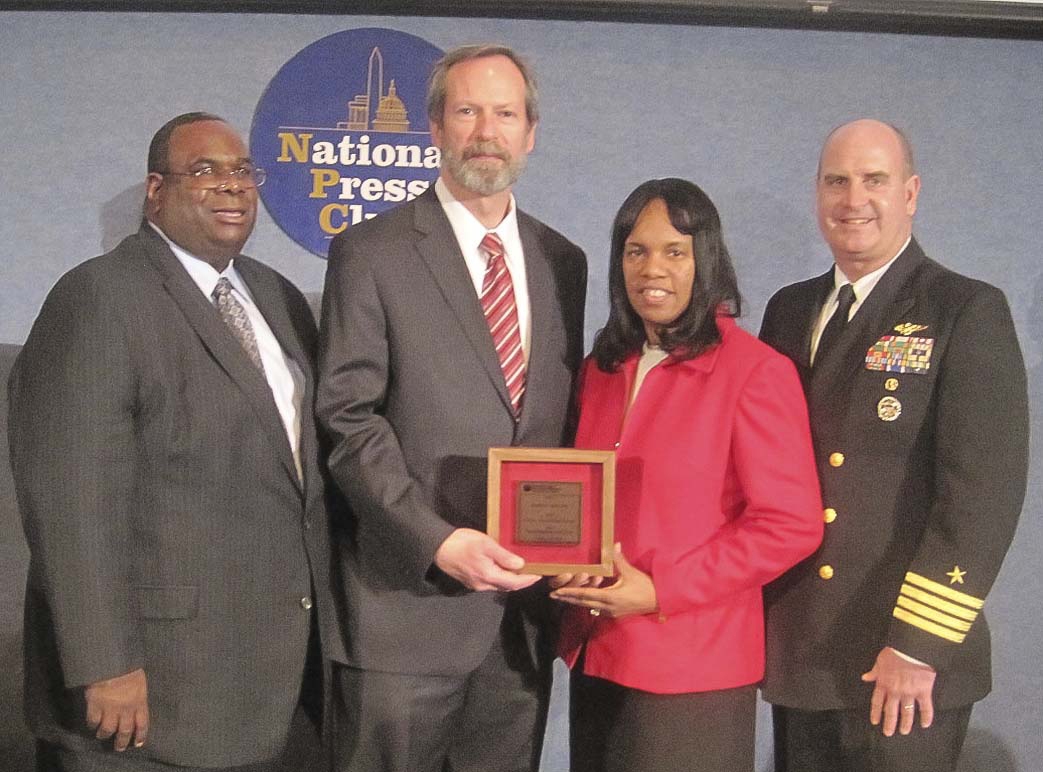
Stephen Keefe is presented with the NAVAIR civilian engineer of the year award by Larry Hollingsworth, National Director, NAVAIR Avionics at the National Press Club, Washington, D.C., Feb. 24. Also in attendance at the ceremony sponsored by the National Society of Professional Engineers was Capt. Andrew Macyko, National Military Director, NAVAIR Avionics and Maria Thorpe, Head, Avionics Systems Integration Branch at NAVAIR. (U.S. Navy Photo)
PMA-265 employee named Engineer of Year
NAVAL AIR SYSTEMS COMMAND, PATUXENT RIVER, Md. – The science and technology lead engineer for the F/A-18 and EA-18G program office (PMA-265) was presented with the NAVAIR Civilian Engineer of the Year award during at ceremony at the National Press Club in Washington, D.C., Feb. 24.
Stephen Keefe was one of more than 20 engineers within the federal government recognized for their outstanding achievements.
The event was sponsored by the National Society of Professional Engineers.
“Mister Keefe is a dedicated engineer and is well deserving of this prestigious award for his leadership and support of PEO(T) (Program Executive Office (Tactical) and Naval Air Systems Command),” said Larry Hollingsworth, national director for NAVAIR avionics.
Keefe, who has been at NAVAIR since 2004 and with the F/A-18 and EA-18G program office since 2007, works with his team to identify technologies that provide the F/A-18 Hornet, F/A-18 Super Hornet, and EA-18G Growler platforms with new capabilities.
Coordinating with the Small Business Innovation Research program, Keefe works with small businesses that are developing the technologies as well as NAVAIR and the Office of Naval Research to fund those technologies, with the goal of implementing them onto the platforms.
One of Keefe’s projects has been the repair of fiber-optic technology. While currently there is no way to quickly and permanently repair fiber-optics, Keefe notes that the new technology will drastically simplify the repair process and will be able to be performed quickly by people who are not necessarily experts in fiber repair.
“This repair is permanent, while the current repair is temporary and difficult to implement,” Keefe said of the technology which will be executed within the next two years.
Keefe is glad to see that while his work is focused on the F/A-18 and EA-18G platforms, others will eventually benefit as well.
“We are taking the initiative to develop it and deploy it to the fleet,” he said. Once we do that, we are going to turn this technology over to other departments. Other platforms and surface ships will benefit from this technology. I think it will be a great success.”
Keefe’s team is also working on a strike accelerator technology that will help pilots identify targets faster than the current technology they are using.
He is also a member of the Green Hornet team, which is partnering with the Office of Naval Research and General Electric Aircraft Engines in implementing technology to reduce noise levels on the F414 engine nozzle of the Super Hornet.
“The work that Steve has done for our program office has been amazing, and of great value to our fleet. Ultimately, our warfighter benefits on a daily basis from the innovative concepts Steve and his team implement on the F/A-18 and EA-18G,” said Capt. Mark Darrah, PMA-265 program manager.
“I feel like I can make a difference for the warfighter, who is the end customer,” said Keefe. Working for the Hornet and the Growler platforms has truly been a joy.”
-30-