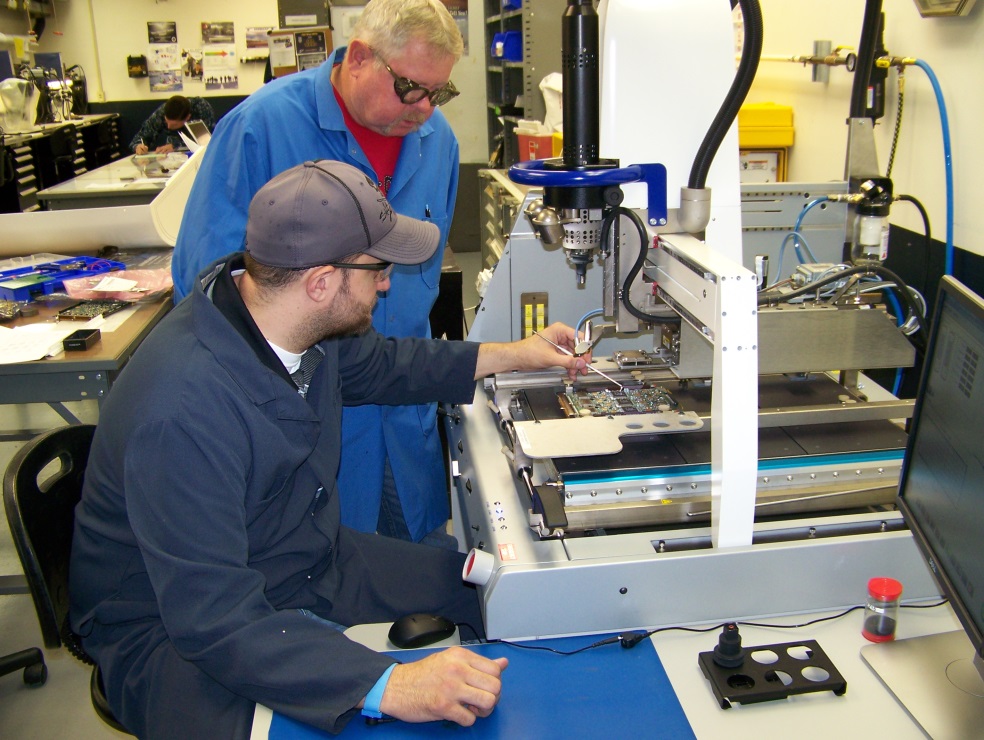
FRCW Artisans Darren Gravitt (left) and Jeff Koehler (right) operate the DRS-27 Solder Machine. 
 (U.S. Navy photo)
New capability at Fleet Readiness Center West increases complex component removal throughput by 400 percent
FLEET READINESS CENTER WEST, LEMOORE, Calif. -- In the current economic climate of rising costs and shrinking budgets, the future of Naval Aviation repair demands that Fleet Readiness Centers (FRCs) continually seek out new ways to improve production quality and to reduce maintenance costs. With this in mind, Fleet Readiness Center West (FRCW), aided by Commander, Fleet Readiness Center (COMFRC) and the Aviation Rapid Action Team (ARAT), acquired the AirVac DRS-27 soldering bench, a modern piece of avionics rework equipment for removal and installation of soldered components on circuit cards.
This state-of-the-art capability allows FRCW artisans to remove and replace surface-mounted and ball joint gate array (BGA) components with greater precision, reducing the possibility of damage from the standard hand removal and installation methods. The improved precision has drastically reduced complex component removal time to 10 minutes, down from an average 55 minutes -- a 400 percent improvement in throughput.
Within two days of the unit becoming operational, artisans repaired three A2 and one A3 generator control unit (GCU) circuit cards resulting in a repair cost avoidance of $27,753.
“At this rate of repair and cost avoidance, the unit paid for itself in less than seven working days and can average cost avoidances of $297,440 per month,” said Denzil Younce, FRCW 600 Division lead artisan. The machine also had the unexpected benefit of being able to repair a backlog of 26 circuit cards that were slated to be processed as beyond capability of maintenance (BCM). Those cards can now be repaired in 13 working days and realize a cost avoidance of $193,336.”
DRS-27 outshines older methods of circuit repair because it reduces thermal shock damage to a circuit card by both limiting the heating surface area and automatically adjusting the level of the heat applied, thereby lowering the overall circuit card temperature, Younce said. Also, more technicians can be trained in the soldering process, becoming fully qualified to operate the unit within one day instead of taking the traditional, four-week training course.
The DRS-27 is currently used to repair lead BGAs, but it was originally designed for lead-free BGAs, which require higher heating thresholds. FRCW can still expand to the lead-free BGA repair capability and apply some of the advanced avionics repairs to the F/A-18 E-G platforms, or to the F-35 in the future. F-35 avionics repair has yet to be determined, but with DRS-27 capability, FRCW is standing by ready to repair whatever the future holds.