
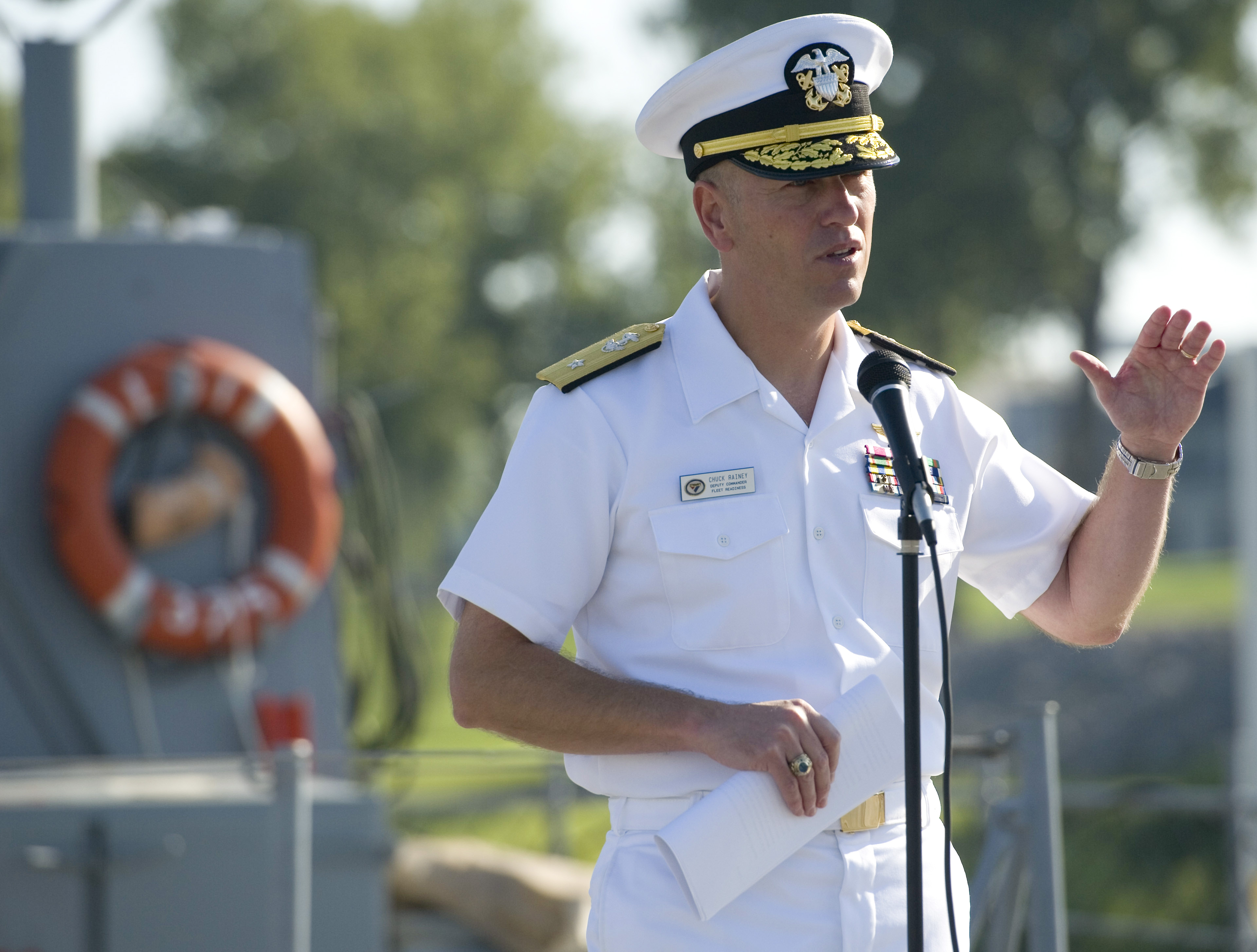
EVANSVILLE, Ind. – Rear Adm. Charles Rainey answered questions from attendees during his visit to LST 325 in Evansville, Ind., Aug. 22. Questions ranged from the role of women in the U.S. Navy to the Post-9/11 GI Bill. Rainey retired Sept. 30 after a 32-year Navy career and handed over the directorship to Rear Adm. Kirby Miller, a native of Bellevue, Wash.(Photo courtesy of The Evansville Courier & Press/Denny Simmons)
Q&A: Director of NAVAIR Reserve Program looks back at his tenure
Archived Body
NAVAL AIR SYSTEMS COMMAND, PATUXENT RIVER, Md. – For almost three years, Rear Adm. Charles Rainey worked to improve the agility and flexibility of NAVAIR's Reserve force. This past August, the recently retired director of the Naval Air Systems Command’s Reserve Program reflected on the organization’s successes and areas left for improvement as he turned over the watch Sept. 30.
Q: By the time you hand over the reins of leadership, you will have been the NRP director for almost three years. That’s a long time. What were some of your goals for the NRP and how do you think you did?
A: There was a time in our history when we were a very large program and through [budget cuts and thorough organizational reviews], etc., our numbers were reduced. If you looked at the way the NRP was structured in 2009, there was a lot of legacy infrastructure. In terms of alignment, the number of units and our locations, it all didn’t really lend itself to a very efficient operation. It was also difficult to grow leaders, because we had a lot of units and a third of the people – so by simple math, our commanding officers didn’t have a lot of people in their units.
I knew it would be about a three-year effort to restructure and realign the program, but it was important that the next NRP director had a flexible organization that could respond to the demand signal. At the time, I didn’t know how long we would be in [Operation Iraqi Freedom] and [Operation Enduring Freedom], but at some point, those operations would come to an end, and the next NRP director was going to need flexibility to respond to the post-[overseas contingency operations] environment at NAVAIR.
Q: A realignment sounds like a change from a strategic to operational Reserve. Is that the demand signal you were trying to meet?
A: Yes and no. There will always be a need for a strategic depth capability, so we had to achieve a good balance. We’re transforming the NRP from a pre-9/11 Reserve program to a post-9/11 program. The NRP has to be something the next director can move in whatever direction is needed.
Q: So how did that transition go?
A: We knew going in that it was going to be a pretty painful transition. Anything we did in the NRP would have a big impact on the [Aviation Engineering Duty Officer] and [Aviation Maintenance Duty Officer] communities, but we were aligning them for success in the future. We looked the numbers. We also looked at the [rank structures] and the sustainability of the AEDO and AMDO communities. For the future success of the communities, we were looking at trading senior officer billets for junior officer billets, so whenever you have to make those kinds of decisions, that’s pretty painful.
Understandably, people worried about their future in the program, but I think we responded very well. [Restructuring billets] has some ancillary effects that were perfectly predictable and some folks chose the door instead of sticking around. Some folks retired a little bit earlier than they would have otherwise, and others stepped up their performance. I think they understand the new reality, and they are committed to doing what it takes to succeed. The realignment had some hiccups, but overall I think we did a very good job of talking it over with NAVAIR leadership, [Navy Personnel Command, Commander, Navy Reserve Forces Command], and other customers to make sure the changes made sense from a community management standpoint.
Q: Can you tell us more about how the NRP is so involved with shaping the AEDO and AMDO communities?
A: We’ve come full circle and with the help of PERS, [Navy Recruiting Command] and our NRP manpower folks – and in consultation with our NAVAIR customer – I think we’ve largely right-sized our force from a seniority standpoint.
NAVAIR is a senior community on the active side, and it always will be. We just want to reflect NAVAIR. We’re senior, but not overly senior. Because we’ve done it in consultation with the smart folks at PERS, they see our community as being sustainable, meaning we’ve got the right number of junior officers, commanders and captains, etc. They see us as a very sustainable community now.
Seeing the numbers and the folks staying behind, I have no doubt we have growing leaders in those [commander] and [captain] billets. They will be of higher quality than I’ve ever seen, so I’m very happy.
Q: You mentioned earlier that you had to cut almost two-thirds of your people. Can you put some numbers to the transition?
A: When I joined the program in 1992, there were more than 600 folks in the NRP. Before that, it was even larger. Most of the reduction was in enlisted manning. At the time, we had a large enlisted force doing maintenance at the test squadrons, but the current model at those squadrons is for contract maintenance. There is still a demand signal for Reserve maintainers, primarily at the [Fleet Readiness Centers], that we are exploring and we feel that this is a potential area for growth in the NRP.
Today, we’re 240 folks strong, including officer and enlisted. We’ve actually come up from our low point by about 18 billets. That was a result of a 2008 Reserve capability review that validated the need for additional billets, and we worked with NAVAIR to plan and budget for them. But based on the demand signal we see for our folks, I don’t think we’re anywhere close to where we need to be.
Q: Why is that? Other than the maintenance demand 20 years ago, how has the mission changed since then? Do you think your current people meet the current mission requirements?
A: The missions have changed. Some have been eliminated and some have been added. Our primary mission is to provide NAVAIR additional capability to execute on their strategic priorities, and for the NRP, that basically means we provide talented folks.
Primarily, we support on a part-time basis, but often people will come on active duty to support NAVAIR’s initiatives and fill gaps. But there are capabilities NAVAIR maintains only in its Reserve component.
Like all of the [systems commands], including [[Space and Naval War Systems Command] and [Naval Sea Systems Command], at NAVAIR you see a general reduction in military billets. The reduction increases the premium on uniformed presence we can provide in the NRP. We have a number of missions unique to the Reserve force because there just isn’t enough active-duty bandwidth to go around.
An example is the Combat Aircraft Survivability and Threat Lethality (CASTL) mission, and its Joint Combat Assessment Team (JCAT). From a uniformed perspective, CASTL and JCAT capabilities are housed entirely in the NRP working for the survivability branch under NAVAIR’s chief engineer.
Another Reserve capability that doesn’t exist on the active side is our forward-deployed combat repair folks. The artisans are Navy civilians, but the capability, structure and organization required to take those folks forward is purely a reserve function. It’s a complicated process. It includes the capability to get clamshells built in the middle of a desert and everything you need to make sure facilities are right, so the artisans can do depot-level work on aircraft in theater. We work very closely with the depots, but they don’t have the additional bandwidth to send folks forward to do this work.
And then on top, add in one-off or pop-up events, like NAVAIR’s response to Operation Tomodachi – those efforts are heavily Reserve-centric.
Those are some of the examples of how we provide support that isn’t just supporting a program office or a competency or a warfare center. We’re providing a unique capability to NAVAIR and to the warfighter.
Q: You said basically the NRP provides capability through its people. How would you describe the people in the NRP?
A: First and foremost, they are professional naval officers, not professional part-time naval officers. They are totally professional naval officers who happen to work part time. They’re smart. They’re highly educated and often they have very big responsibilities out there in the civilian workforce.
Obviously, they are very patriotic, and dedicated to supporting in any way NAVAIR sees fit, so they juggle quite a bit between their civilian jobs and their Reserve jobs. On top of that, they deploy. Mostly, we deploy individually in response to specific requests, so we deploy to a mission we’re trained to do from the very beginning.
Our program is pretty neat in that we’re not like a National Guard unit that says, “Hey, we’re all deploying together in 18 months, so get all your affairs in order. We’re all going to go over the horizon and a year later we’re going to come back.” Instead, we ask them to decide when they’re going to go, to help us figure out the deployment plan, and while it’s never convenient, we give them some flexibility, and then they work it out with their employers and their families.
What you get is someone who isn’t worried about a bunch of things over the deployment period. They’re worried about, or thinking about, that one thing, namely the mission.
The same thing goes for our [people who fill Active Duty for Special Work billets], whether they are going to deploy forward, or going to take a critical ADSW position within NAVAIR at a warfare center, a competency, or a program office.
We have a constant demand signal for ADSW support from the competencies and program offices, so those ADSW positions are something our NRP folks are expected to do on a fairly regular basis. Not every couple of years; about every four or five years. But they understand they are expected to tell us the window they’re looking at and we’ll get them prepared for that window.
Q: Looking back over the past three years, what are you most proud of?
A: Responsiveness. We ask our people to consider deployments or an ADSW that impacts their civilian career path. We ask our people to consider separation from their families, certainly not an easy thing to do. As exciting as an active-duty job might be, as much as that person might want to go out and contribute – to actually come forward, raise their hand, and say, “Yes, I’m willing to do this,”—it’s never an easy decision and always requires great sacrifice.
Every time somebody comes forward – and just about everybody is at some point – it’s overwhelming and makes me very proud. The men and women of the NRP are stepping up. Our people, deployers or people going on ADSW, or responders to events like [Operation] Tomodaci – our people are incredible.
Another thing I’m proud of is our ability to expand NAVAIR’s capabilities. We’ve been flying a lot of [unmanned aerial vehicles] forward – a lot of different ones supporting different customers in theater. When those folks flying UAVs came back, they didn’t just leave their experiences where they were based, whether they were in theater or back on a [frigate or destroyer]. They took those lessons learned and brought them back.
Their skills are new to the Navy, not just NAVAIR or the NRP. We needed to create opportunities for them to continue to provide this skill in operating UAVs – I don’t mean stick and rudder, because most of the Navy’s UAVs are mostly a pushbutton type of operation – but places where they can share the concepts of how to operate UAVs.
We put them in support of the [Broad Area Maritime Surveillance Demonstrator] at Pax River and on the West Coast we created a UAV test augmentation force at [Air Test and Evaluation Squadron] 30. For almost a year now, the test augmentation group has helped VX-30 participate in events like Black Dart, a counter-UAV exercise. I wouldn’t say VX-30 couldn’t play a significant role in Black Dart without us, but I do know we really enhanced their capabilities.
Q: In your three years, are there things that you would have done differently, or things that didn’t go as well as you hoped?
A: Over the last few years, we were entrusted with more resources than ever. The standard way a director of the NRP might have worked in the past would be to go out and see the units in action.
But at the same time, we were very aware that those resources were meant for a specific purpose: to support NAVAIR and [Overseas Contingency Operations]. So we were very conscious to use our resources as efficiently as possible for direct support. We tried to minimize the Reserve overhead. We gave people flexibility to support the mission during the week to save on travel and things like that.
I had to balance the benefit of being immersed in the force on weekends with using resources efficiently. I ended up traveling to units less, and used electronic means more – even to an incredible extent – because I wasn’t out there in person as much.
Electronic means [of communication] are not a replacement. They are a supplement, so I missed that hands-on, in-person contact previous directors had. That’s been a big disappointment to me.
Q: What would you tell someone who is considering the NRP as a new accession, or someone who is transitioning from active duty?
A: In the NRP, you can do meaningful things. You have a future, you have promotion opportunities and it is very rewarding.
One demographic I’d like to reach out to specifically is the young engineer at NAVAIR; not just at Pax River, but also at [Naval Air Warfare Center Weapons Division] at China Lake, at [Naval Air Warfare Center Training Systems Division] in Orlando and their satellite facilities. These young engineers can be so much more valuable to NAVAIR when they can get some operational experience, too, and it can take a long time to get that experience.
The NRP has a very robust direct commissioned officer (DCO) program. Through DCO, we can put those young engineers in uniform, and get them a great deal of operational experience relatively quickly. We can make them better engineers much earlier in their careers. We’ve gotten a number of them, but we could commission a few more.
All the opportunities in the NRP are the same for DCOs as those open to someone coming off active duty. We have a good training pipeline and good career track in place for them.
The NRP can become a second career, which is also very rewarding. And oh by the way, it’s pretty cool to wear the uniform.
Q: What advice would you offer to those people remaining in the NRP after your turnover?
A: My advice – which I provide more freely than I probably should – is don’t put yourself first. Put the folks working for you, put their concerns and welfare first and everything else will work itself out.
I don’t want that to come across like that’s not my priority, or that people have the wrong priorities – I think most people follow a similar philosophy, but it still bears repeating.
Put the people working for you first, put the program first, put NAVAIR first, and everything else will work itself out.
Q: Admiral, thank you for your time. Is there anything you want to add?
A: The NRP has been in-theater for 10 years! I am amazed when I think of the sacrifice and contributions the men and women of the NRP have made, both directly and indirectly, supporting our forces, especially the forward-deployed aviation warfighter in Iraq, Afghanistan and the Horn of Africa.
An interesting fact is that during those 10 years we have increased the annual number of man-days of support in each successive year. That is true even though we have left Iraq and as coalition and U.S. forces have been reduced in Afghanistan. In the fiscal year ending [Sept. 30, 2012], we will have provided nearly 13,500 man-days of mobilized support, including 8,000 forward deployed.
The totals from 10 years of support are almost 61,000 man-days of mobilized support, including 41,000 forward from 217 NRP reservists. Incidentally, we have averaged about 220 personnel in the program since 2007, so most of the folks in the program have had a paid vacation to the Middle East.
Some of these mobilizations were in Individual Augmentee assignments helping out our Army brethren by filling their critical billets. The vast majority, however, were in support of warfighter-requested capabilities that only exist in the NAVAIR Reserve Program. These are missions that we were trained to do and capabilities that will endure.
The Marine Corps has told us many times that our support will be required until their departure from Afghanistan in 2014, but I don’t believe that the NRP will be out of the deployment business at that time.
That this year is going to reflect our highest mobilization totals is indicative that the capability we bring and many of the missions we support are the low-density, high-demand kind that will endure beyond Afghanistan.
I think NAVAIR relies more and more on its Reserve component. We are filling many positions with big responsibilities, like the NAWCWD vice commander and my relief, Rear Admiral Kirby Miller, as the NAVAIR vice commander. They’re relying on the NRP to step up. I think they like the results they see, so they ask for more, and it’s great.
Many of the systems that are favored by the folks that will remain at the forefront of our national security are developed right here at NAVAIR and the demand for speed to capability means there is a constant developmental aspect to these systems – and that is one of our strengths, helping NAVAIR rapidly field the latest technology.
Going forward, our alignment will allow us to do even more. Not just in numbers, but also in responsibilities. As I mentioned before, I think we’re a little shy on our numbers — we need to look at those – but I like the way we’re positioned to respond to a growing demand signal at NAVAIR.
ABOUT THE NAVAIR RESERVE PROGRAM
The NAVAIR Reserve Program has nearly 250 officer and enlisted members supporting the command, its associated warfare centers and program executive offices. NRP members regularly deploy forward with operational units, providing tens of thousands of man-days of support each year.