
F-14 program builds business bridge to Poland
By Chuck Wagner
PEO Tactical Aircraft
Public Affairs
For a people who first heard of it while they lived under Soviet influence, this U.S. Navy fighter aircraft is a cause celebre.
Polish citizens invariably know it by name. Employees of PZL-Swidnik even refer to it with a hint of ownership – the F-14 Tomcat.
A business bridge between the U.S. Navy’s F-14 program and a Polish aerospace company is in many ways a first.
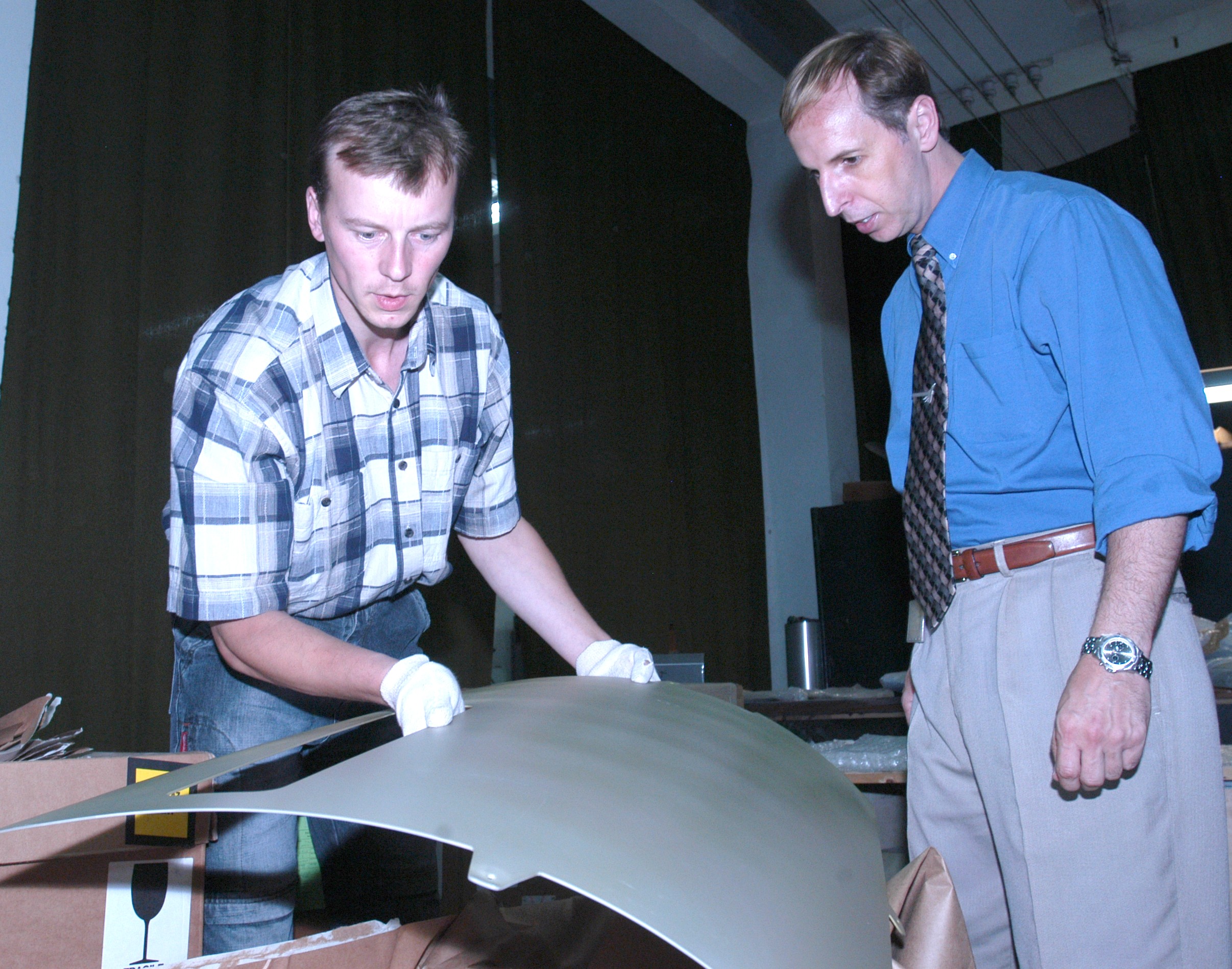
PZL’s construction of the transmitter bay access panel on the Tomcat’s fuselage is the first time a foreign company has contributed to the aircraft’s structure. It is also the first time the U.S. Navy has acquired a major aircraft part from a former East Block country.
The historic initiative is keeping the world’s most recognized fighter flying safely as it embarks on its last hurrah.
Early in September, F-14 squadrons VF-213 and VF-31 of Oceana Naval Air Station, Va. landed aboard the aircraft carrier U.S.S. Theodore Roosevelt for what will be their last Tomcat deployment before transitioning to the Super Hornet next year. On many of these combat-proven aircraft -which average 15 years in service – wind-tossed refueling drogues have worn the panel during in-flight refueling.
“It was important that we had a plan to replace these panels before they reached the end of their service life. We had repaired them enough,” said Cmdr. Dino Ferrari, F-14 deputy program manager at Patuxent River Naval Air Station, Md.
As the deadline for closing down shop on the Tomcat crept closer, dwindling resources forced program planners to seek unconventional options.
They found answers in an unlikely place. Swidnik is a town of gray, communist-era apartment buildings not far from Poland’s eastern border with the Ukraine. The town grew up around the PZL factory, which now employs about 3,300 workers. PZL began in 1954 building helicopters mostly for Russia and other nations under Soviet influence.
PZL now builds or upgrades helicopter and aircraft parts for a growing list of recognized global defense industry players; Italy’s Agusta, France’s Latecoere and Dassault Aviation, Eurocopter Deutschland, Airbus and Bell.
Czes Covington manages the Navy’s effort with PZL. He is a 25-year veteran with Naval Air Systems Command (NAVAIR) at Patuxent River where he normally serves as integrated product team lead for F-14 structures and mechanical sub-systems. He sealed the deal with PZL and raised eyebrows on both sides of the Atlantic.
Evaluations of the panels received from PZL since mid-July indicate the hardware exceeds the Navy’s quality standards, according to Navy engineers assigned to the Tomcat Fleet Support Team at Jacksonville, Fla. All panels are expected to be delivered by the end of February 2006.
“The panels are complete and all-encompassing. When they are delivered, they can be taken out of the box and installed. The accessories such as the formation light and multiple fasteners are included and pre-installed,” said Covington. The panels go directly from the shop floor to the fleet, where aircraft maintainers have been able to swiftly attach the panels in their prominent position near the cockpit.
“Top Gun!” said Christian Rutkowski jerking a thumb into the air as he inspected a panel he recently painted. He is a 30-year veteran at PZL who has witnessed the country’s dramatic transformation from state-controlled economy to free-market. He’s seen multiple times the 1986 film “Top Gun” which made the Tomcat into a global celebrity.
Machines on the PZL shop floor have been re-fitted with custom tooling derived from the original tools used by Grumman. When production on the F-14 halted in 1992, the Navy took custody of the aircraft’s manufacturing specifications. This has allowed NAVAIR to work directly with PZL. Using the modified tools, PZL demonstrated that it could produce parts that meet the original equipment manufacturer’s specifications.
Three American companies manufacture at least 50 percent of the panel hardware under terms of the contract. Pryer Tool and Machine Co. of Tulsa, Okla. manufactures the panel skins. Alcore of Edgewood, Md. produces its one-piece honeycomb core. Aurora Flight Science of Bridgeport, W.Va. packages the various parts into kits for shipment to Poland.
Covington first considered purchasing from a former East Block country in 1996. His team conducted a market survey that included Hungary, the Czech Republic, Slovakia and Poland. The decision fell on Poland, then on PZL. Contract discussions began in 2001 with approval from the Defense and State departments.
The willingness of the Navy, State and Defense department to work with Poland isn’t solely a question of cost savings. Poland has proved a reliable U.S. ally since the end of the Cold War, and has been among the U.S.’s staunchest allies in Iraq. U.S. officials have been eager to establish ties with Poland that both reward and solidify the relationship.
“I think the cooperation between the Navy and the factory is right in line with our mission. It is one more tie in a robust military relationship and robust commercial relationship,” said James B. Bond, press attaché for the American embassy in Warsaw.
“We have fully realized not only the purely military and commercial benefits but also the political advantages of bilateral cooperation and this U.S.-Poland ... program in particular,” said Col. Stan Prusinski, chief of the Office of Defense Cooperation at the embassy. “A project that brings about savings to U.S. taxpayers, creates jobs in both countries, and generates favorable publicity in Poland is a dream come true.”
Although the contract with the Navy is small compared to the company’s other business ventures, PZL officials see it as an important nod to the future.
“It is a kind of test to see if professional cooperation is possible. We will try to prove it is a good idea for both sides to take another step. We are open to that,” said Ryszard Cukierman, PZL’s commercial director and vice president.
Covington also views cooperation on the Tomcat panel as a hint of future possibilities.
“The recent agreement paves the way for the eventual creation of long-term technical and economic benefits that will produce dividends for both the U.S. and Poland,” said Covington.
His administrative team was recently successful in establishing an agreement between Poland’s Military Institute of Armament Technology in Zielonka, PZL and NAVAIR that would qualify a light-weight, Polish-designed armor protection package that can be integrated into a helicopter’s structure. The agreement again extends to U.S.-based small businesses to help with the qualification and manufacturing program.
Curt Carey, NAVAIR’S AH-1W Class Desk, would like to see Covington’s team integrating the protection into the Marine Corps Cobra helicopter. He believes their objective could be achieved quickly enough to make a difference in Iraq. The team hopes to perform gunfire testing of two materials by the end of the year, so that follow-on, full-scale qualification testing of the completed project can occur in early 2006.
“Within the next year, we could produce a low-cost, high-quality component for a U.S. military helicopter which will provide the protection that our troops need in Iraq,” said Covington.
“This success is part of our team’s continuing contribution to the Navy-wide goal of delivering the right force, with the right readiness, and at the right cost,” said Rear Adm. David Venlet, Program Executive Officer for Tactical Aircraft Programs. Venlet oversees the efforts of PMA 241. “You’ll see much more of this as the Naval Aviation Enterprise continues to streamline development and procurement of the systems we send forward to our fleet warfighters.”
The Naval Aviation Enterprise is a partnership among Naval leadership to optimize processes that maintain current readiness while investing in future readiness.
The enterprise concept focuses Naval aviation on the single fleet-driven metric of producing aircraft ready for tasking at reduced cost.
######
(photo by Chuck Wagner)
PZL-Swidnik’s Sebastian Wnuk and NAVAIR’s Czes Covington inspect an in-coming shipment of panel parts in the Polish factory which is finishing panels for the Navy’s F-14 Tomcat.