Small businesses showcase promising new technologies for Naval Aviation
Amy Behrman
NAVAIR Technology and Intelligence Office
May 23, 2005
Patuxent River, Md. – “In this time of war, aging aircraft and dwindling budgets, I'm glad our SBIR [Small Business Innovation Research] Program is watching out for tomorrow’s fleet,” said Rear Adm. Tim Heely, Program Executive Officer for Strike Weapons and Unmanned Aviation, at the fifth annual Navy Opportunity ForumSM May 2-4 in Reston, Va.
A component of the Navy’s Transition Assistance Program (TAP), the forum showcased 148 technology solutions developed by small businesses and funded through the Navy’s Small Business Innovation Research (SBIR) and Small Business Technology Transfer (STTR) programs.
Having progressed from the competition phase (Phase I) through initial technology development (Phase II), the participating companies presented their “Phase III” SBIR Transition Plans to Navy and prime contractor personnel. These plans chart a course for successful transition of Navy-funded research, development, and related technologies into Naval Aviation programs and systems.
According to the May 2004 House Armed Services Committee Report (108-91), “DoD acquisition program managers and prime contractors [were urged] to make significantly more Small Business Innovation Research (SBIR) Phase III Awards.” The Opportunity Forum enables defense acquisition professionals and prime contractors to efficiently preview some of the Navy’s best technologies developed with SBIR/STTR funding, and evaluate premiere small businesses as potential partners.
“The SBIR program attracts new start-up companies that are very strong technically, a fundamental trait demanded by NAVAIR programs,” said Carol Van Wyk, NAVAIR SBIR program manager. “But it takes more than technical merit to achieve a successful transition. These companies must also demonstrate strong business savvy.”
According to Van Wyk, the Transition Assistance Program assists the Navy Phase II SBIR companies in developing a winning business plan, and the forum provides companies a targeted opportunity for marketing their capabilities to Navy and prime contractor representatives.
“Impressive technical capabilities along with the agility, flexibility and cost effectiveness demonstrated by Navy SBIR companies, attract primes such as Lockheed Martin, who seek to infuse their organizations and products with advanced technologies and innovations,” continued Van Wyk. “The benefit to the Fleet is clearly seen through SBIR technologies that are adapted and rapidly transitioned to solve problems and increase capabilities.”
“The one-on-one interaction has given me the opportunity to better understand the technologies being promoted, as well as to discover other products that may be beneficial to my program," said Jim Alper, technology transition coordinator for the Joint Strike Fighter. According to Alper, the forum assists SBIR companies in expressing not only their technologies, but also the business case that makes these technologies attractive to larger companies and the government.
Lockheed Martin Vice President for Technology Dr. Jack Hammond, has attended the forum since Lockheed Martin won the F-35 contract. According to Van Wyk, Hammond has worked dilligently with Dr. Alper and the NAVAIR SBIR Office to expand his company’s participation from that of a “wait and observe” posture – to a proactive stance where F-35 needs and related SBIR topics are identified and aligned early in the process.
Visit http://www.dawnbreaker.com/navytap/index.php for more information on the Navy’s Transition Assistance Program SM.
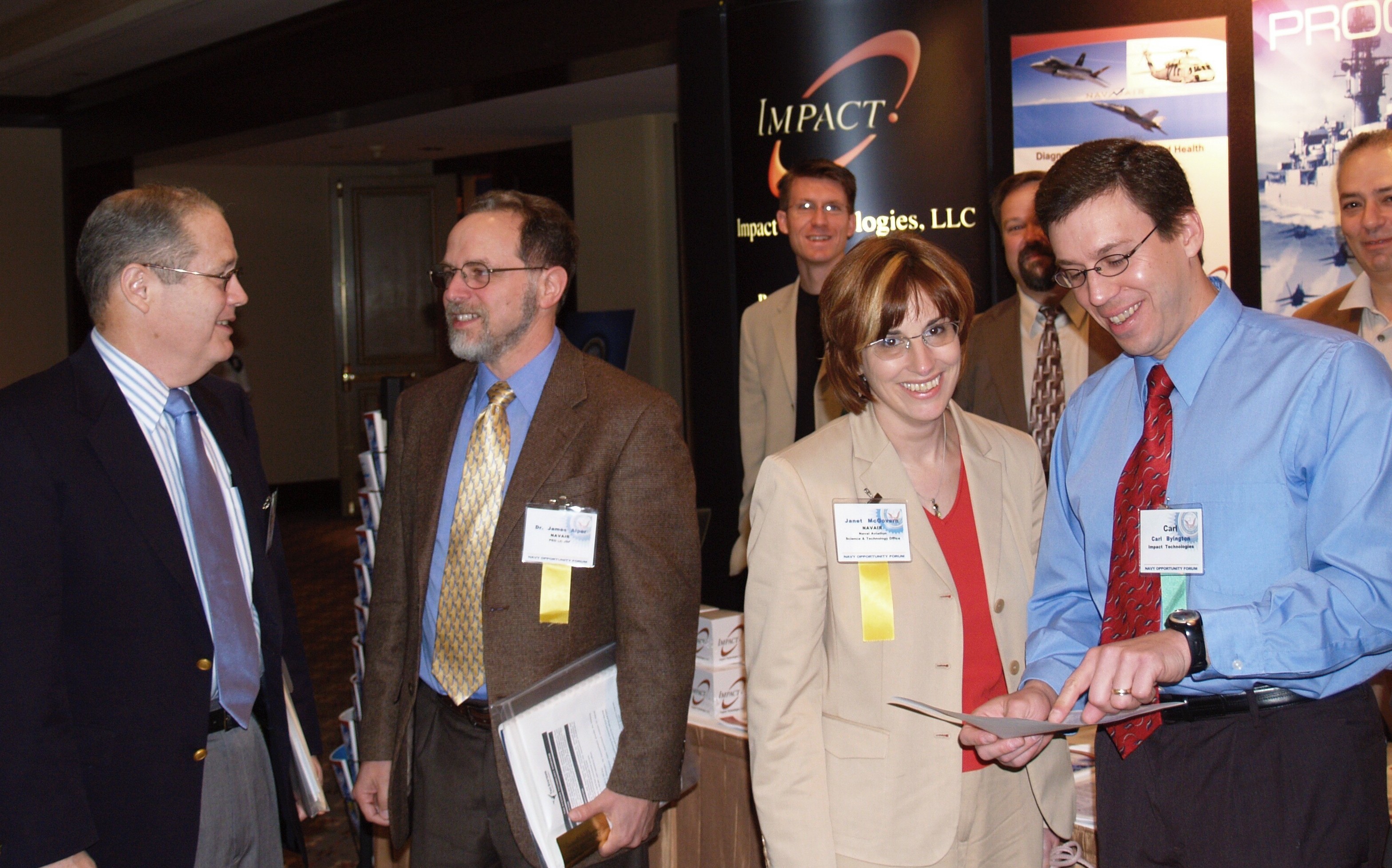
Photo Caption
Prime contractors meet with small business leaders and Navy representatives to discuss promising new technologies and their application to Navy needs. Pictured from left are Dr. Jack Hammond, vice president for technology, Lockheed Martin Corporation; Dr. James Alper, technology transition coordinator, Joint Strike Fighter Program; Janet McGovern, deputy for transitions, NAVAIR Small Business Innovation Research Office; and Carl Byington, director of research and development, Impact Technologies.