Regaining Control: The Patuxent River AIMD AIRSpeed Experience
Submitted by the Aircraft Intermediate Maintenance Department
Jacks are portable tools used to lift and move heavy objects – fundamental gear for the 315 Aircraft Intermediate Maintenance Department (AIMD) personnel who work with them daily at NAS Patuxent River. But the tools also come with their own set of special problems – hence the recent Kaizen event within the AIMD which led to an improved jack maintenance and repair process, as well as more than $100,000 in savings and a nearly 90% reduction in turn-around time.
LCDR Duane L. Decker, the NAS Patuxent River AIMD Officer who sponsored the Aircraft Jack Preventive Maintenance and Repair Process project, describes his department as full of highly motivated people who are anxious to take advantage of AIRSpeed tools. The department falls under the NAVAIR AIRSpeed umbrella as opposed to Enterprise AIRSpeed like other AIMDs.
“We’re unique from other AIMDs in that we are a Navy Working Capital Funded activity and employ a large number of civilians (40% of the command) and we support RDT&E squadron aircraft,” he said.
According to Decker, AIMD conducts 800 jack inspections per year, of which about 25 percent fail inspection and require some maintenance. Most of those jacks that need maintenance require low-cost consumable parts for repairs, he said, adding, “The varieties of jacks at Patuxent River require about 174 different consumable part numbers. Unfortunately, obtaining those parts generally took a waiting period of ten to 21 days.”
“From the start, we naturally migrated toward addressing our awaiting parts supply support because isn’t it true that if we fix supply, all our maintenance problems will be resolved?” said Decker. “Not so fast. We were soon to find out that there were a lot of areas that could be improved, including doing our part to improve the supply support.”
The AIMD team first developed a value stream map to present the maintenance and supply support process flow of jack preventive and corrective maintenance. Next, a brainstorming session was conducted from which 19 potential solutions were discussed. The team consolidated and selected three possible solutions to explore and test.
The three tasks selected included first working with the Aviation Supply Department to develop an onsite pre-expended bin (PRE-X) of consumable parts that would be closer to the work area with a greater variety of parts available. Second, expediting consumable parts became more visible and a higher priority for the Supply Clerk. Third, the open purchase process was improved.
The team created a Responsible/Accountable/Consulted/Informed (RACI) chart from which to evaluate the solutions. Next they created visual controls to maintain these implemented improvements. The new PRE-X system would require a cycle count.
“Today standard rules of high and low limits, re-order points and expediting the restock of consumables have become the norm,” said Decker. “The Supply Clerk uses a daily Equipment Discrepancy Report printed from NALCOMIS (Naval Aviation Command Management Information System) for managing parts expediting, providing visibility of all requisitions by type of equipment and the status of each.”
A new open purchase procedure and board are also being used in the Support Equipment Division and main production control. These provide a clearly defined process to ensure those that need to know are consulted and are aware of and able to monitor open purchase requirements.
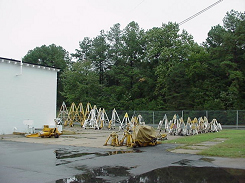
According to Decker, corrosion was one of the tool’s biggest enemies and was being made worse by the outside storage of jacks, both ready for issue (RFI) and Non-RFI.
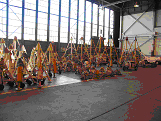
“It was initially thought that there was not enough indoor space available to address this issue,” he said. “However, after some careful thought, the 5-S system (Sort, Set in order, Shine, Standardize, and Sustain) was implemented, and all of the jacks were moved inside the hangar and organized for ease of access and maintenance.”
Significantly less time is required now to get to the jacks; the jacks are close to both the Supply Clerk area (where the PRE-X resides) and the jack load tester.
“In addition,” said Decker, “the technician now knows right where to find the RFI and Non-RFI jacks as opposed to the old method of walking around looking for them.”
As a result of the plan of action and milestones that were developed during the Kaizen event, cycle time for unscheduled repairs has been reduced from 39 days to four days. Preventive maintenance and corrective maintenance cycle times were reduced significantly by varying, or shifting, workload priorities – reducing the number of jacks in backlog waiting for inspection or repair from 53 to zero.
“One or two mechanics are now assigned to jack maintenance, keeping up with preventive maintenance, training other mechanics and other duties,” said Decker.
“This project is projected to provide $100K of Type I savings based on the reduction in inventory by ten percent,” said Decker. “Type II savings will also be realized by reallocating 166 hours of full-time employees.”
Savings in the category of Type I benefits have a direct and certain impact on the Naval Aviation Enterprise (NAE) resources made available to the Navy for recapitalization. Type II savings are actually waste elimination where assets/resources are freed up to be reassigned to other value-added work and/or potential future savings. Type III savings are cost avoidances or savings that are non-quantifiable.
“This project has improved the quality of jacks being issued to using activities and has improved Support Equipment Division mechanic quality of work-life by empowering our employees,” said Decker. “Now we control the induction schedule as opposed to it controlling us.”
Aircraft Jack Preventive Maintenance and Repair Process AIRSpeed team members also include Tracy Wathen, Deployment Champion and Technical Director for the Naval Test Wing Atlantic; Bella Younano, NAVAIR AIRSpeed Black Belt; Joe Fassette, Support Equipment Division Officer; AE1 Varisco, SE Production Control Supervisor; and Herb Moore, NALCOMIS administrator.
Photos: Prior to the AIRSpeed Kaizen event, jacks were left outside in the elements. Jacks are now better organized and stored inside as a result of the AIRSpeed Kaizen event.