Finland celebrates 10 years flying Hornet
Finland celebrates 10 years flying Hornet
by Chuck Wagner
PEO(T) Public Affairs
The Finnish air force marked a decade of flying the American F/A-18 Hornet during a ceremony Nov. 7 on an air base near Tampere, Finland.
U.S. Navy officials and aerospace industry representatives who assisted Finland with delivery of the fighter aircraft starting in 1995 gathered in a hangar at Satakunta air command, in the southern end of the Scandinavian country.
“This is an outstanding success story. We have excellent cooperation and confidence with the U.S. Navy. Over the last decade, you met our expectations for an effective and pilot-friendly fighter. We have raised the fire power and effectiveness of the air force to an entirely new level,” said Maj. Gen. Heikki Lyytinen, commander in chief of the Finnish Air Force. “[We have] all the reason to celebrate our dominance of Finnish skies.”
Finland purchased 64 F-18 Hornet aircraft. This included 57 “C” single-seat models, and seven “D” dual-seat models. The entire country has five million inhabitants, comparable to London’s population. A United Kingdom purchase on the same scale would total 700 aircraft, Finnish officials noted.
“This is part of Finnish transformation, modernization,” said Minister of Defense Juhani Kaskeala, who defined the U.S. as an important international partner. Finland shares an 800-mile border with Russia.
The decision to purchase the aircraft allocated the nation’s entire defense budget for three years, and was agreed to by national referendum. At the time, Finland’s air defense was made up of MIG-21 and Saab J35 Draken aircraft. The Hornet advanced Finland’s air defense by two generations, said Lyytinen. Finland phased out the MIG and Saab aircraft when the last Hornet arrived in 2000.
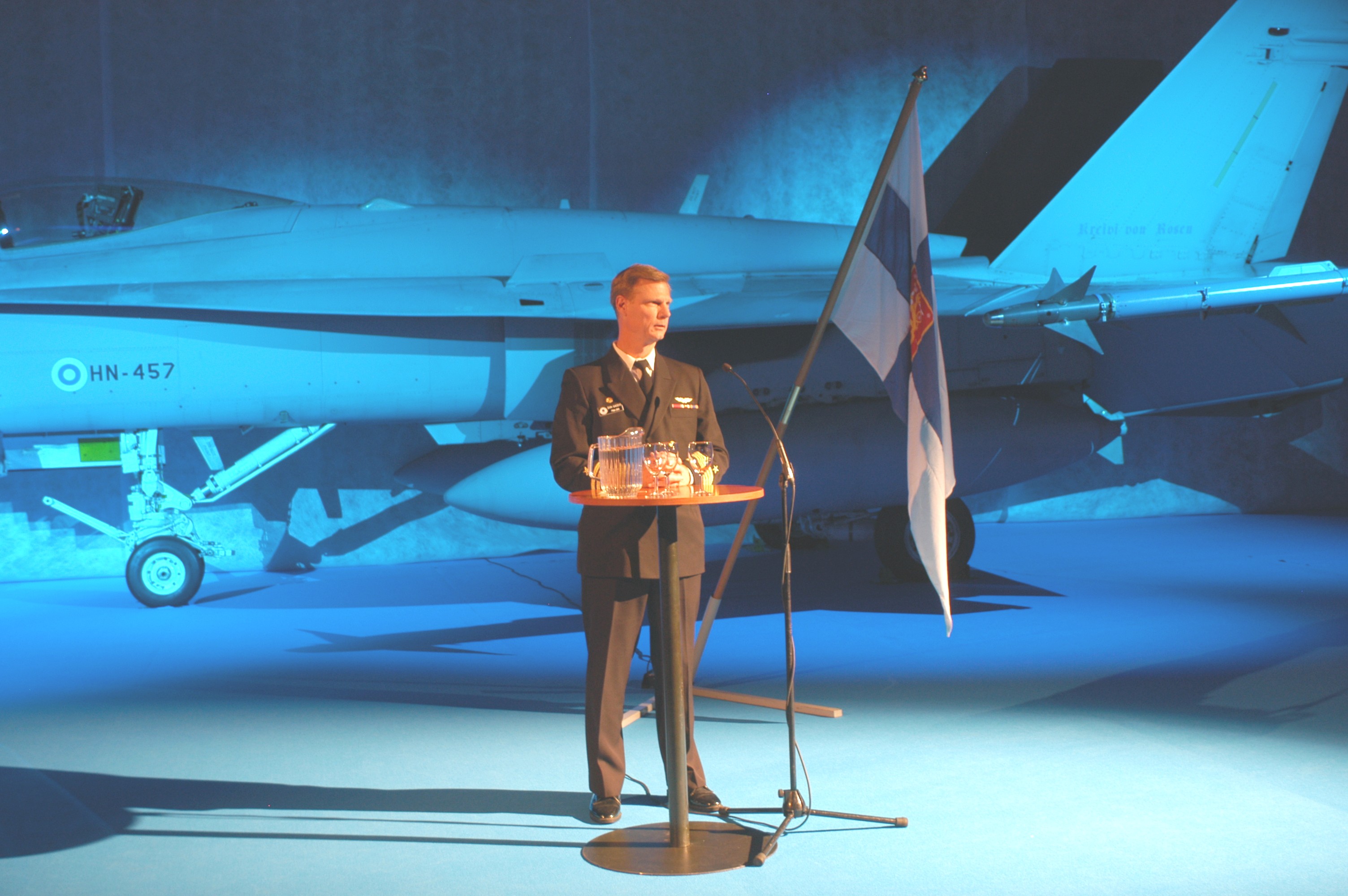
U.S. Navy Capt. Donald Gaddis spoke to a large crowd that included more than a dozen Finnish media representatives.
“What makes the program so successful? I believe it is a culture of success,” Gaddis said.
Communication, cooperation, and a fruitful teaming of government and industry established a continuing environment conducive to reaching the program’s goals, he said.
“The results were aircraft delivered on time and on cost,” said Gaddis, who manages the Navy’s F/A-18 and EA-18G program (PMA 265) at Patuxent River Naval Air Station, Md.
He also congratulated Finnish officials on a wise investment.
“The U.S. Navy is committed to the Hornet, and to those who fly it. In 2009, if you look across a carrier deck, you’ll see nothing but Hornets,” he said, referring to the Navy’s plans to transfer the missions of the S-3 Viking, EA-6B Prowler and F-14 Tomcat to the Hornet family, which includes the Hornet, Super Hornet, and an electronic attack variant of the Super Hornet known as the Growler.
Finnish officials first considered purchasing new aircraft in 1988. Officials accepted offers in 1990 and selected the Hornet in January 1991.
“It was the fastest decision I’ve ever seen of this sort,” said David Beckering of Boeing, the aircraft’s primary builder.
The U.S. Navy maintains a program in Finland dedicated to continuing a working relationship with the Finnish air force. Randy Powell manages the program, which Finnish officials were quick to laud.
“We let them know what we require - they let us know what they can provide. It is working quite well. Teamwork is the key word. We really have a very good team,” said Maj. Juhani Juntti, Finnish air force aircraft weapons systems chief.
One effort on which Powell and his program are concentrated is a mid-life upgrade for the Finnish Hornets. Finland hopes to fly the aircraft well beyond the usual life expectancy of an aircraft, especially when flown under the extreme climate conditions over Finland.
“The Finns have a very ambitious plan, and we are helping them to achieve it. They want to keep the aircraft operational until 2030. They also want capabilities for their aircraft that are unheard of in an F/A-18C/D. It amounts to E/F capabilities in a C/D platform,” said Powell. Capabilities offered by Link 16, Advanced Tactical Forward Looking Infra-Red, advanced tactical radios, next generation radar warning receiver systems, and advanced mission computers would make the Finnish Hornet the most advanced F/A-18C/D aircraft in the world.
Cutline: Navy F/A-18 program manager Capt. Donald Gaddis speaks at a Nov. 7 ceremony near Tampere, Finland, to commemorate the Finnish air force’s flying the Hornet for ten years. U.S. Navy photo