NAVAIR answers Katrina call for help
**Revised October 18, 2005**
By NAVAIR Public Affairs
A call came into the Aircrew Systems Program Office, PMA-202 and the Multi-mission Helicopter Program Office, PMA-299 (H-60) the morning of Sept. 6 from helicopter crews flying search, rescue and relief operations in and around New Orleans after Hurricane Katrina devastated the city and most of the Gulf Coast.
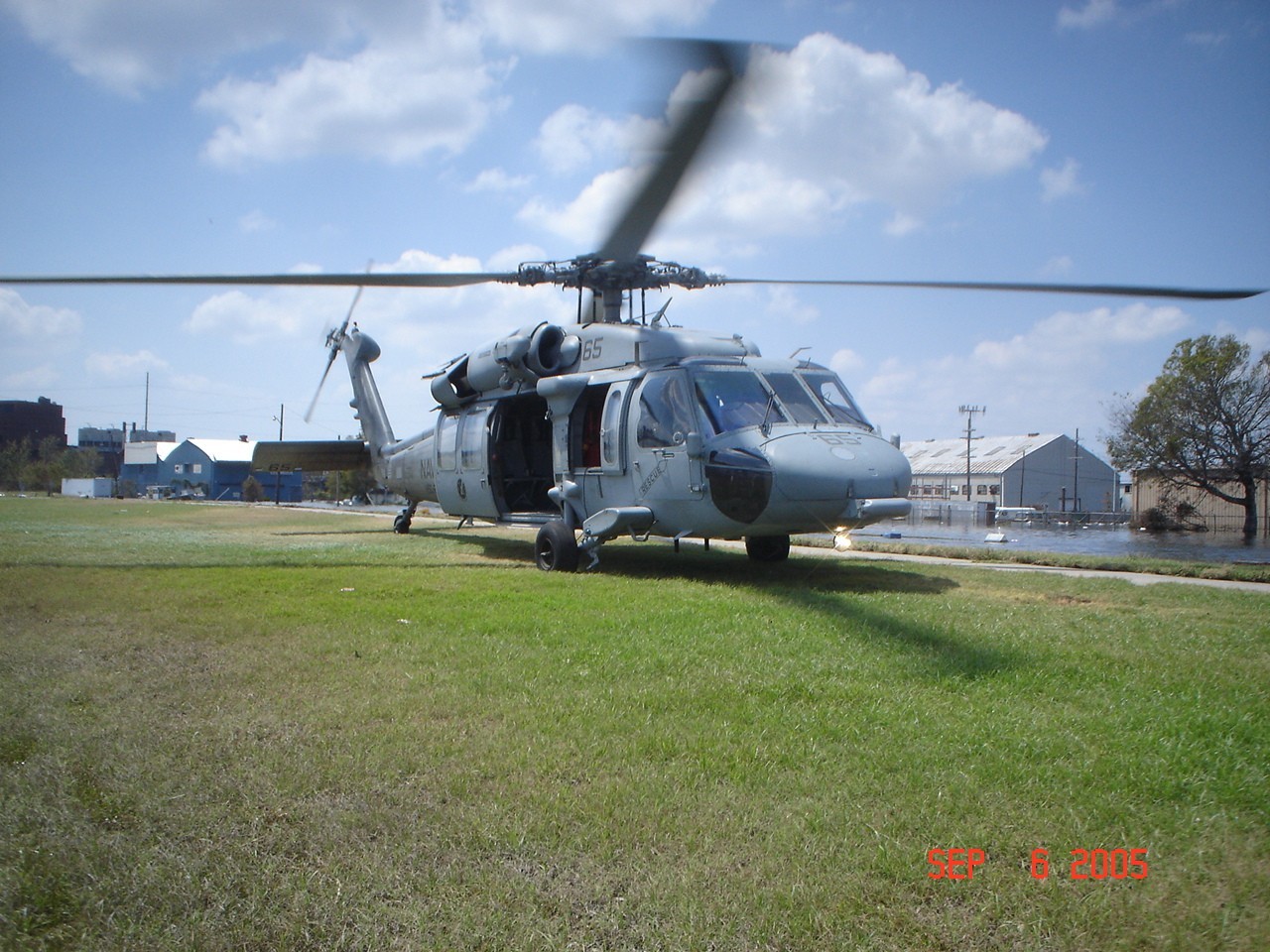
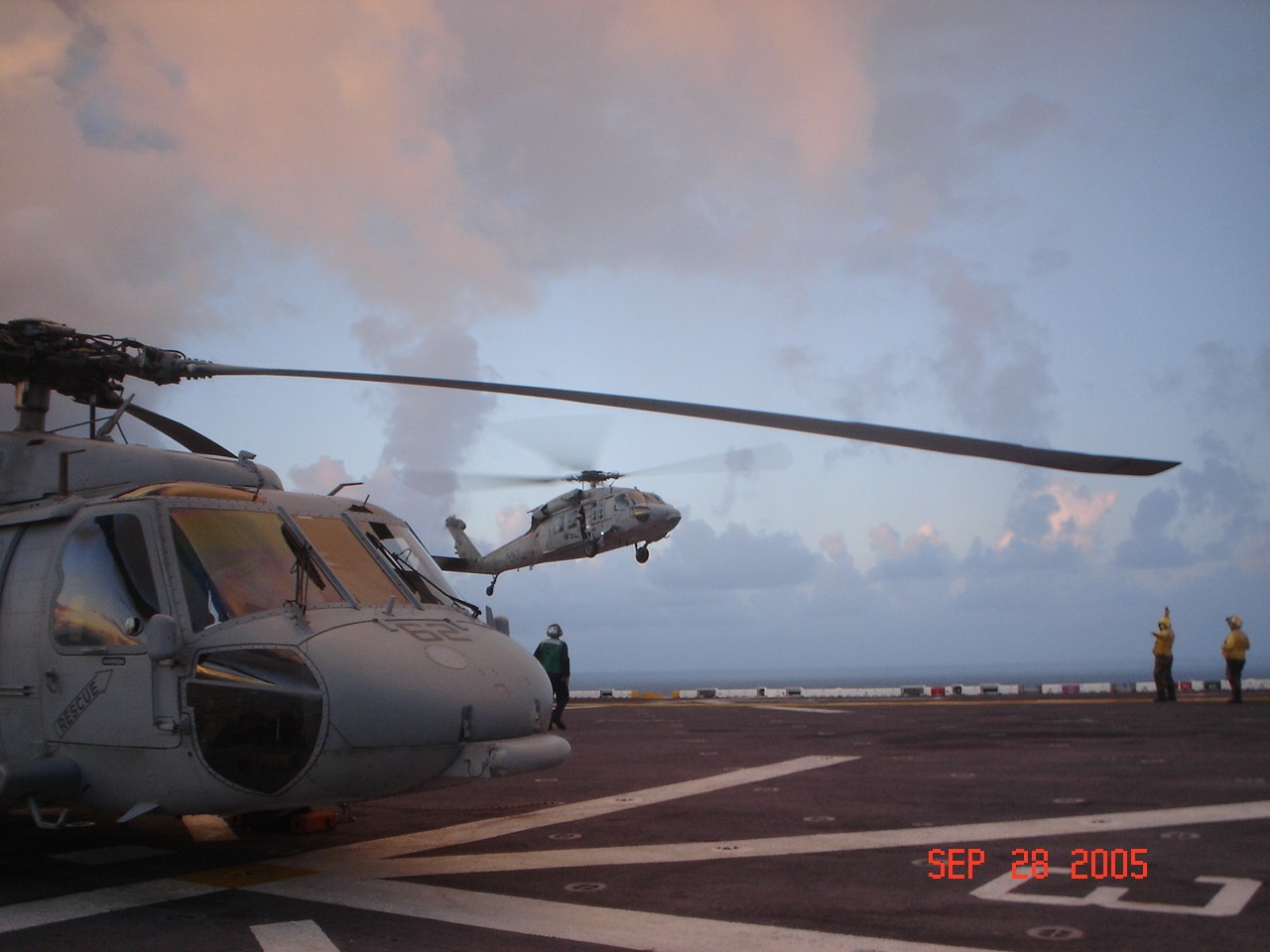
Helicopter Sea Combat Squadron Two Six (HSC-26) based at Naval Air Station, Norfolk, Va., flying the MH-60S Seahawk helicopter, called saying their pilots were flying missions ranging in length from six to more than eight hours. The pilots were experiencing tingling and numbness in their arms and legs as well as severe back pain. Was there anything NAVAIR could do to help?
Cmdr. Tom Wheaton, Aircrew Systems Class Desk Officer, and Cmdr. Steve Labows, Assistant Program Manager for System Engineering for the Seahawk, and other members of the two program offices took up the challenge. They coordinated the effort to determine what could be done.
The H-60 crashworthy cockpit seats are not designed for high-endurance operations, they were designed to protect the aircrew during crashes and are armored to protect the pilots from small arms fire. The existing seat cushions were simply not doing the job of allowing the aircrew to effectively operate for the extended missions that have become typical of today’s Navy.
“You can not just add another cushion on top of the others for the simple reason that it is not designed to fit the crashworthy seat and it could interfere with operating the flight controls,” said Wheaton. “Even seat cushions need to be flight tested and approved for use before they go to the fleet.”
Wheaton and Labows met with Mike Schultz and Vic Katilus, who do engineering for the H-60 crashworthy seat design, including seat cushions. Under the sponsorship of Labows, and John Cardova, Aircrew Escape & Crashworthy Systems Fleet Support Team Leader, Schultz and Katilus were already working on new ergonomic seat cushions designed to increase aircrew mission endurance through the use of advanced materials and fatigue reducing design approaches.
One of these cushions had coincidentally just completed initial flight-testing in a Seahawk at Air Test and Evaluation Squadron Two One (HX-21). This cushion, originally developed for the Army UH-60M Blackhawk helicopter, has air-filled lumbar and thigh supports that can be adjusted by the pilots in-flight to tailor the cushion to individual preferences.
An important safety aspect of this cushion system is that it meets the dynamic crash requirements of the Seahawk crashworthy seat that strokes downward in a crash to protect seat occupants from vertical crash forces. It appeared to be an ideal solution for the pilots serving in the hurricane relief effort, so the team jumped into action.
The new seat cushion was cleared for use on newly built Army Blackhawk helicopters and scheduled for future use in Navy Seahawks. These new seat cushions did not have an Air-worthiness Certificate from NAVAIR for fleet-wide use in Navy H-60 series helicopters. As a result these new seat cushions were cleared for test flights only.
Rapid coordination between NAVAIR engineers and the Flight Clearance Office allowed a fleet-wide "safe-to-fly" certificate to be issued for these Simula cushions -- allowing them to be used on all Navy H-60 series helicopters.
That afternoon a conference call was made to Simula Corporation in Phoenix, Ariz., the manufacturer of the new seat cushions, to see how many they had in stock. Simula Corp had a complete set of the new cushions in stock and were able to manufacture several more sets - - all in less than 24 hours.
Between what they had in stock and what they manufactured, they were also able to pull back seat cushion sets on their way to Sikorsky, the maker of the H-60 series helicopter for all the Services. Sixteen sets of seat cushions were ready to ship by Sept. 9. Fourteen more sets of seat cushions could be delivered within a week. Now the seat cushions needed to be paid for.
The Naval Aviation Enterprise (NAE) War Council met to determine how to pay for the seat cushions. Once a decision was reached, the council immediately called Wheaton and the PMA-202 Aircrew Systems program office contracting team.
Wheaton met with Sharyl Sheftz, Aircrew Systems Financial Manager, to create funding documents. Those were hand carried to Lori Frame, the Aircrew Systems Contracting Specialist. By that afternoon a signed contract was in place allocating $31,500 to buy and ship the new seat cushions.
The money was sent to Simula Corp. which immediately shipped the new seat cushions to NAS Pensacola, Fla., for distribution to the three helicopter combat squadrons, HSC-21, 26, and 28. HSC-21 and 26 received the cushions while they were still supporting Hurricane Katrina relief operations.
Feedback from HSC-26’s Lt. Cmdr. Michael P. “Buck” Buckley said, “The new seat cushions are vastly superior to the cushion they replaced and they have enabled my pilots to fly longer flights and be more focused on the mission. This has been a huge advantage during our support of JTF Katrina, and I couldn’t imagine flying without them.”
“From start to finish, this entire process took only four days. Teamwork between several NAVAIR offices, the Aircrew Systems program office, the H-60 program office, people from NAVAIR engineering, the NAE War Council, Budget and Financial Management specialists and Contracting specialists along with Simula Corp, showed our command’s agility in supporting the fleet,” said Labows.
Photo cutline, “HSC-26 MH-60S helicopters conducting Hurricane Relief operations off of the USS Iwo Jima.”
Photo cutline, “HSC-26 MH-60S helicopter conducting Hurricane Relief operations in and around New Orleans.”