
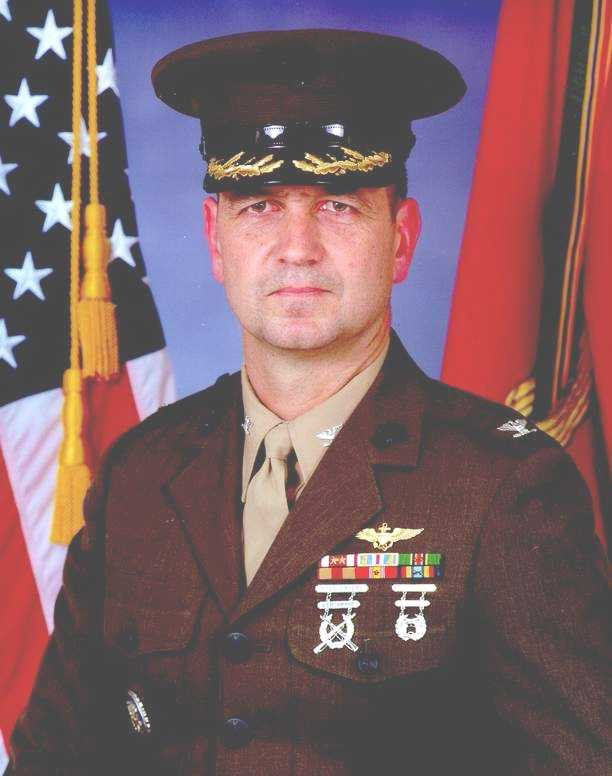
H-1 PM Set to Retire After 28 Years
By John Milliman, H-1 Program Public Affairs
“WEASELS!”
The hoarse, bellowed command/epithet blasts from within the open office door and reverberates off the cubicle walls within PMA-276’s spaces. Throughout the program, selected Marines and senior civilians drop their various tasks, grin knowingly at each other and head to the Colonel’s office, as if summoned by a prayer call from a mineret.
A program leadership meeting has been called.
Or, a new game of dice. With Col. Doug Isleib, retiring program manager of the Marine Corps’ Light and Attack Helicopter Program here, you can’t quite be sure. Either way, though, it will likely be more enjoyable than not.
“He has this amazing and uncanny ability to remotivate you and lift you out of whatever funk you happen to be in,” explains Lt. Col. David Anderson, Isleib’s assistant program manager for Systems Engineering in the H-1 program, “No matter how crappy a day he’s had personally, he doesn’t feed your depression, he just kicks you in the [butt] and gets you back on the horse.”
And after a varied 28-year career in the Marine Corps, Isleib is hanging up his “Chucks” and the flight suit, but certainly not the dice cup.
Friday, in the H-1 Upgrades Integrated Test Team spaces in Hangar 109 here, and among the Marines and civilians he counts almost as family (as well as his actual family), Isleib will relinquish command of the H-1 program to long-time friend and fellow H-1 pilot, Col. Keith Birkholz. And then, he will retire from the Marine Corps.
But not without first telling a few more stories.
His favorite tour? He won’t tell you.
“I CAN’T tell you,” he insists, just before launching into a discourse on the best aspects of ALL his tours...
“I love flying Hueys,” he summarizes as he reflects on a flying career that includes operational assignments flying the UH-1N Huey, first with MAG-39 and then with MAG-29’s HMA-269 -- the second time as its executive officer. “But the best thing is working with young Marines, especially crew chiefs, who work unbelievably long, hard hours for little or no recognition.”
Those young Marines he’s mentored (some of whom aren’t so young anymore) will carry on with him watching, perhaps, rather than participating as the Berkeley Heights, New Jersey and U.S. Naval Academy graduate (1977) ends a varied, and storied career of Mentoring Marines, that among the highlights already listed, perhaps started during a tour as a primary flight instructor at NAS Whiting Field’s VT-3, where he was recognized as the VT-3 Instructor of the Year for 1987.
“That was a particularly rewarding tour,” he explains. “As a primary instructor, I took guys on their first flights and got to watch them figure it out and ‘get it.’ Plus, it was a hell of a lot of fun flying the T-34C.”
Following his tour with VT-3, the Colonel was selected for what many others see as the most prestigious assignment a Marine helicopter pilot can hope for -- assignment to the Marine Corps’ developmental and Presidential transport squadron, HMX-1, where he qualified in a wide array of helicopters such as the VH-3D, VH-60N, CH-46, CH-53 and the MV-22.
His self-depreciating humor and gentle, unassuming ways also belie the skills and experience of a consummate professional, recognized by his selection to join a very select and elite group of Marine Corps helicopter pilots – those who fly the President of the United States.
“My HMX-1 tour was pretty cool,” Isleib explains. “I flew in a lot of interesting places where military pilots don’t often get to fly, and spent a lot of time at the Reagan Ranch and Camp David.
“Combine that with being on the front end of the V-22,” he throws in, almost expecting a listener to personally understand the thrill of being the MV-22 Osprey’s first operational test pilot. That thrill, unfortunately, was cut short after a tragic mishap in Quantico in 1991 temporarily halted the Osprey’s operational testing and ended Isleib’s V-22 test flying career after only one flight.
You wouldn’t know it, though, by his enthusiasm for the tiltrotor.
“I’m a huge believer in that aircraft,” he explains. “It’s really going to be a hit with the Fleet and do great things.”
Even his staff tours, often a bane of Marine Corps existence, found favor with the eternal optimist.
“Going back to the fleet as a senior guy and getting to influence younger Marines is motivational,” Isleib says of his stint as the operations officer for the New River, NC-based MAG-29 staff. That tour led back to flying as HMLA-269’s executive officer – his last fleet assignment.
Even a tour as the air officer for the 4th Marine Regiment at Camp Schwab, Okinawa – a requisite notch on any real Marine’s resume -- couldn’t dim the Marine’s penchant for a good game of dice as well as mentoring younger Marines.
Other staff jobs included being the executive officer of Marine Corps Air Facility at Marine Corps Base Camp Pendleton, Calif.
In 1998, the Colonel returned to the Naval Air Systems Command to be the deputy program manager for the MV-22 Osprey. While in that position, he had the opportunity to serve alongside a Naval Academy classmate, Col. Paul Croisetiere (currently the H-53 heavy lift helicopter program manager here).
Croisetiere agrees with those who take notice of Isleib’s mentoring skills.
“Col. Doug Isleib's service can best be summed up as committed to the fleet, committed to his program office team and committed to his family,” Croisetiere comments. “I can't think of many Naval or Marine Officers who will leave the service who have been as committed to the Marines and Sailors they are chartered to support, the team they work with, and the family that has lived the life of sacrifice and dedication that comes with military service.”
And as with anyone who’s known Isleib longer than 20 minutes, the dice invariably come out...
“I will particularly miss his dry sense of humor and ability to have fun,” Croisetiere adds with a grin of his own. “He has an uncanny ability to make the most mundane events and work requirements interesting and entertaining. Have I ever told you the story about the V-22 symbology design review back in the early 90's?”
Recognizing Isleib’s organizational skills and effective leadership style, the V-22 program’s parent command, the Program Executive Officer for Air ASW and Special Mission Aircraft drafted him to be the PEO operations officer and then sent him on to be the KC-130J program manager before he assumed his last active duty assignment as the H-1 program manager.
Here, the 4,000 hour plus pilot really hit his leadership stride, stewarding a program that had recently experienced such cost overruns and schedule slips that it had breached the Nunn-McCurdy Act limits and was in danger of cancellation.
“Colonel Isleib led his team through some of the most tortuous acquisition terrain ever encountered, and now has the H-1 Upgrades program well-positioned for a successful Operational Evaluation and then Initial Operational Capability,” explains Isleib’s own boss, Tom Laux, the Program Executive Officer for Air ASW and Special Mission Programs. “Marine aviators will be thrilled when they are first exposed to the tremendous advances that the new aircraft bring to them, thanks to his program stewardship.”
Closer to “home,” his own team agrees -- “Slob” Isleib was the man who brought the program back from the brink.
“He was the right man at the right time,” sums up Col. David Smith, Isleib’s deputy program manager for H-1 Upgrades production. “And he ensured the AH-1Z and UH-1Y meet future warfighting requirements.”
And even in the darkest of hours, concurs Jay Stratakes, Isleib’s principle deputy on the H-1 program.
“Doug always had a way of putting things into perspective, keeping the team focused on the right things at the right time,” Stratakes explains.
Once more, the dice...
“Having a sense of humor didn’t hurt, either,” he quickly adds with a wink. “Especially on THIS program!”
So, if he was the primary motivator for his team, from whence came his motivation? Isleib eagerly explains.
“Especially during the dark times, my motivation not only comes from knowing that the Marines in the field in Iraq, Afghanistan and the other remote and dangerous places we’ve asked them to go really need these things we’re working on here, but that the skills, experience, talent and common sense of the professionals I feel blessed and privileged to lead would prevail,” he says with a rare demeanor of seriousness coming over him.
He quickly dismisses any claims of success as far as his own leadership and technical talents are concerned.
“It’s all the team,” the seriousness in his tone underscored by the direct, steady gaze out the door toward his Operations section and beyond to the rest of the H-1 program office. “I get so much more from them then they ever did from me. My role here has been greatly overstated.
“The really cool part about being a program manager is leading a really good and diverse team,” he continues. “My job has been to provide focus and motivation, and then let them do their stuff to solve the problems.”
With a moving catch in his voice, he moves on to the source of his greatest motivation and inspiration as if summing up his entire career and experience throughout his 28 years and more than 4,000 hours of flying with a sort of bookend – the love of his life for nearly 30 years, his wife Cindy.
“The thing that consistently kept me going was knowing I was coming home to her,” he says with an engaging earnestness. “She has been my primary guiding and motivating force in my life.”
The impish, cockeyed grin returns in an instant when his plans for the immediate future come up.
“Play dice, drink beer, not get my butt chewed as often and ...” he grins even bigger, “lots of other things that are none of your weasel-lipped business!”