
2nd MAW Marines share mission, AIRSpeed successes
By Eddie Riley
NAVRIIP Communications Team
The NAVRIIP leadership contingent paid its first visit to a Marine Corps wing April 27-28. The Marines shared their successes and challenges with the AIRSpeed journey of applying best practices to supply and maintenance to deliver cost-wise readiness to meet operational requirements.
Senior military and civilian leaders of the Naval Aviation Readiness Integrated Improvement Program visited Marine Corps Air Stations Cherry Point and New River. The flag officers, program managers and resource sponsors got a close-up look at the efficiencies gained at the squadron level through the implementation of Enterprise AIRSpeed components – Basic Theory of Constraints (BTOC)/Relevant Information for Leaders (RIFLe) and Lean Management.
“The unfolding story of Marine Corps Aviation’s participation in the Global War on Terrorism was a continuous theme throughout the BOG visit to 2MAW,” said Maj. Gen. John G. Castellaw, 2nd Marine Aircraft Wing commander and host of the visit. “I believe that every leader in attendance got an “up close and personal” view of how Marine Aviation is fully participating in support of the Global War on Terrorism (GWOT),” he added to highlight the operations that drive 2nd MAW requirements.
Navy and Marine Corps leaders agree that the introduction of AIRSpeed at the organizational, intermediate and depot-level maintenance and supply departments has contributed to improved and increased readiness. Now, they are currently defining the operational requirements on which to base the infrastructure and processes for maintenance and supply to meet readiness goals.
“The Navy is doing top-down sortie-based training with entitlement and the Marine Corps is doing bottom-up sortie-based training,” said Vice Adm. Wally Massenburg, commander of the Naval Air Systems Command and NAVRIIP chief operating officer. This means the Navy wants operational commanders to set the requirements for Naval aviation support and adjust maintenance and supply provisions accordingly. Marine Corps leadership says they have to be ready to respond rapidly to any and all requirements from operational commanders and prefer to set support provision based on that high state of readiness.
“Marine aviation squadrons are held to readiness levels that must support deployment within days of receiving an operational tasking and we are seeing this type of short notice taskings coming much more frequently these days,” Castellaw said. “The deployment of a detachment from HMLA-269 this month is the most recent example. They were packed up and on their way within three days time following receipt of a deployment order to support the crisis in Haiti.”
“The bottom line is that our mission today and tomorrow will be to provide combat ready squadrons for deployment and at the same time sustain a robust capability to continue training ready aircrews and to produce viable aircraft for follow-on contingencies,” Castellaw added.
To help meet these increasing readiness requirements, the 2nd MAW began to embrace two components of AIRSpeed during the last year. The Marines instituted BTOC/RIFLe and Lean Management in two Marine aviation logistics squadrons. They also implemented BTOC/RIFLe in a third squadron. For example, in MALS-31 at MCAS Beaufort, S.C., Lean processes have been implemented in several production work centers including power plants, ground support equipment, intermediate maintenance requirements list, ordnance and airframes.
Castellaw said squadrons are experiencing “significant improvements in repair rates and in production cycle times while saving hundreds of man hours in processing time” across the board where Lean has been implemented. He added that the MALS-31 Power Plants shop provides a good snapshot of how much Lean has helped their intermediate maintenance effort as AIRSpeed takes hold in other 2nd MAW squadrons.
“They’ve (MALS 31 Power Plants) improved engine cycle time by 20 percent, reduced the time it takes to build stator cases by 30 percent and have decreased non-value travel time within the work center by a whopping 45 percent,” Castellaw said.
The wing has also reaped benefits to people and operations in MALS-26 at MCAS New River, despite the challenge of understanding, training and implementing BTOC/RIFLe over the last year, according to the general. He said the process “has been a challenge but the results have been well worth the effort.”
In addition to the morale boost, empowerment and ownership the general has noticed in the Marines as they implement BTOC/RIFLe, the methods have “resulted in some dramatic achievements in material availability,” which have helped to increase MAG-26’s aircraft mission capable rate by 8 percent.
This connection between improvements to material availability and increases in operational capability is one that Massenburg stresses often. During the visit to MALS-26 where the supply and maintenance Marines were discussing their metrics, the admiral summoned the MAG commanding officer to come get involved with the metrics that support his mission capability.
“Demand should be generated based on operator requirements, not self-generated by maintenance and supply goals that are independent of a warfighter need,” Massenburg said.
For clarity, the admiral added, “In order to preload the supply system (to exploit constraints), we need a requirement to buy to. The system will react to a demand pull.”
This supply-versus-demand discussion is related to the process for balancing the definition of requirements and targeting the appropriate level of availability that the Navy and Marine Corps leaders continue to work out as AIRSpeed spreads across the Naval Aviation Enterprise. Massenburg said, “Cost-conscience trade-offs will have to be made and risks will have to be taken in defining and pursuing availability or we will just keep building a support footprint big enough to provide any level of desired availability.”
As requirements, levels of support and availability are defined, all involved with AIRSpeed implementation agree that the concept is paying in dividends that contribute to balancing current and future readiness.
“There’s no question that we are on the right track with AIRSpeed. AIRSpeed provides us the tools to understand and improve our business processes and thus optimize readiness in the most cost smart ways,” Castellaw said.
In addition to the specific comments on AIRSpeed’s impact on 2nd MAW resources, the general issued the following parting challenge to leaders across the Naval Aviation Enterprise.
“It’s important too that aviation commanders at all levels understand AIRSpeed and its relevance to the goal of cost-wise readiness and that they lead the way building AIRSpeed into our squadrons and into the mindsets of our Sailors and Marines.”
For more information on NAVRIIP or AIRSpeed call 301.757.1487, or link to http://www.airpac.navy.mil/navriip/.
Photo by Lance Cpl. Wil Acosta.
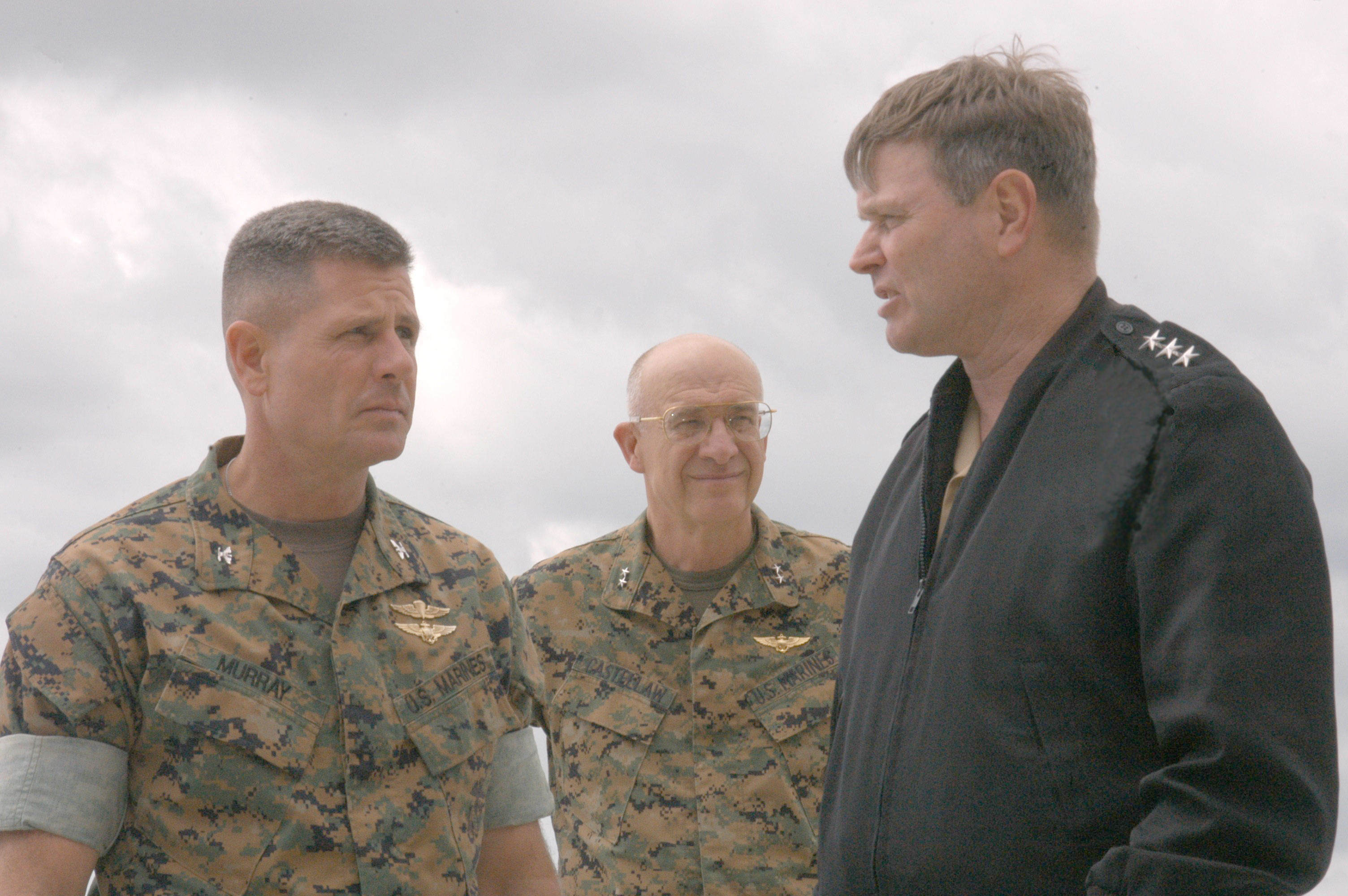
Photo Caption: Col. Thomas Murray, MAG 26 commanding officer, welcomes Maj. Gen. John G. Castellaw and Vice Adm. Wally Massenburg to MCAS New River and the group facilities.