
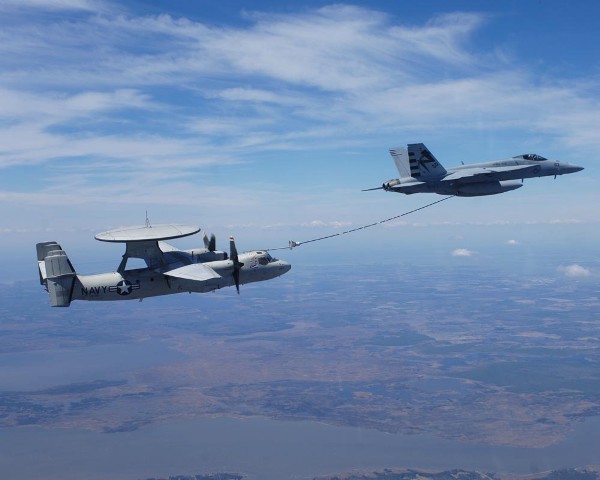
Hawkeye begins second round of IFR testing
NAVAL AIR STATION PATUXENT RIVER, Md. -- A second round of flight testing for in-flight refueling capabilities, or IFR, for the E-2C Hawkeye and E-2D Advanced Hawkeye is under way at Air Test and Evaluation Squadron (VX) 20, NAS Patuxent River, Md.
This additional testing is designed to identify and develop a Hawkeye IFR technique and mitigate concerns related to the aircraft’s structural distinction, the rotodome.
“The Hawkeye was not initially designed for in-flight refueling. However, there is a proven need for it and it is up to us to figure out what works and what doesn’t so we can incorporate these capabilities into Fleet aircraft,” said Diane Wathen, Hawkeye Greyhound program office (PMA-231), IFR lead.
During the 2004-2005 initial flight testing, the integrated test team at VX-20 identified that aircraft handling qualities, pilot field of view for tanking maneuvering, structural impacts and crew system impacts were among areas of potential risk for an IFR-capable Hawkeye.
“A major concern being addressed during this period of testing is crew fatigue,” said Chris Gay, Hawkeye integrated test team lead flight-test engineer. “We are assessing compatible envelopes between the E-2C and the available tankers, as well as how to reduce fatigue during extended flights.”
According to Wathen, testing will help determine what type of modifications may need to be made to current flight control systems in order to address handling quality issues.
Overall testing will function under a build-up process, with initial emphasis placed on identifying low-risk obstacles, followed by identifying high-risk areas. The flight crew will explore different air speeds and altitudes to find the ideal method for the Hawkeye to plug its refueling probe to the tanker’s drouge.
Five potential fuel tankers including the commercially owned Omega tankers, the Air Force’s KC-10 and KC-135, US Navy KC-130 and the F/A-18, will be considered for compatibility with the modified Hawkeye.
“Refueling from an F/A-18 would be very beneficial for fleet Hawkeyes,” said Gay. “Having an organic tanker asset would be extremely effective for the carrier battle group.”
Upon completion of all testing requirements, VX-20’s IFR project officer, Lt. Wessley Turbeville, will train Hawkeye instructors at the Fleet Readiness Squadron, Carrier Airborne Early Warning Squadron (VAW) 120 at Naval Air Station Norfolk, Va., where current and future-generation Hawkeye aviators will learn IFR procedures.
¬¬“Our task will be to help develop the training curriculum for the Fleet Readiness Squadron once testing has concluded,” said VX-20 test pilot, Lt. Cmdr. Mike Newton. “What we learn during this assessment will have a direct impact on how the Fleet will maneuver a refueling Hawkeye.”
The IFR program is scheduled to enter the preliminary design phase in fiscal year 2010 followed by the system development and demonstration phase, ensuring the system’s capability and operability, scheduled to continue through fiscal year 2013.
“If we can successfully retrofit the Hawkeye Fleet with IFR and implement it on the Advanced Hawkeye, we can prolong our mission of providing continuous information to the warfighter depending on it,” said Capt. Shane Gahagan, Hawkeye Greyhound program manager.
-- 30 --
Cutline: An F/A-18 Hornet provides in-flight refueling to an E-2C Hawkeye during initial testing at NAS Patuxent River in 2006. (U.S. Navy Photo)