
Newest Hawkeye comes home
NAVAL AIR STATION PATUXENT RIVER, Md. – The latest aircraft variant of the E-2 platform, the E-2D Advanced Hawkeye, arrived here May 30 to begin the next phase of testing in preparation for Initial Operational Test & Evaluation.
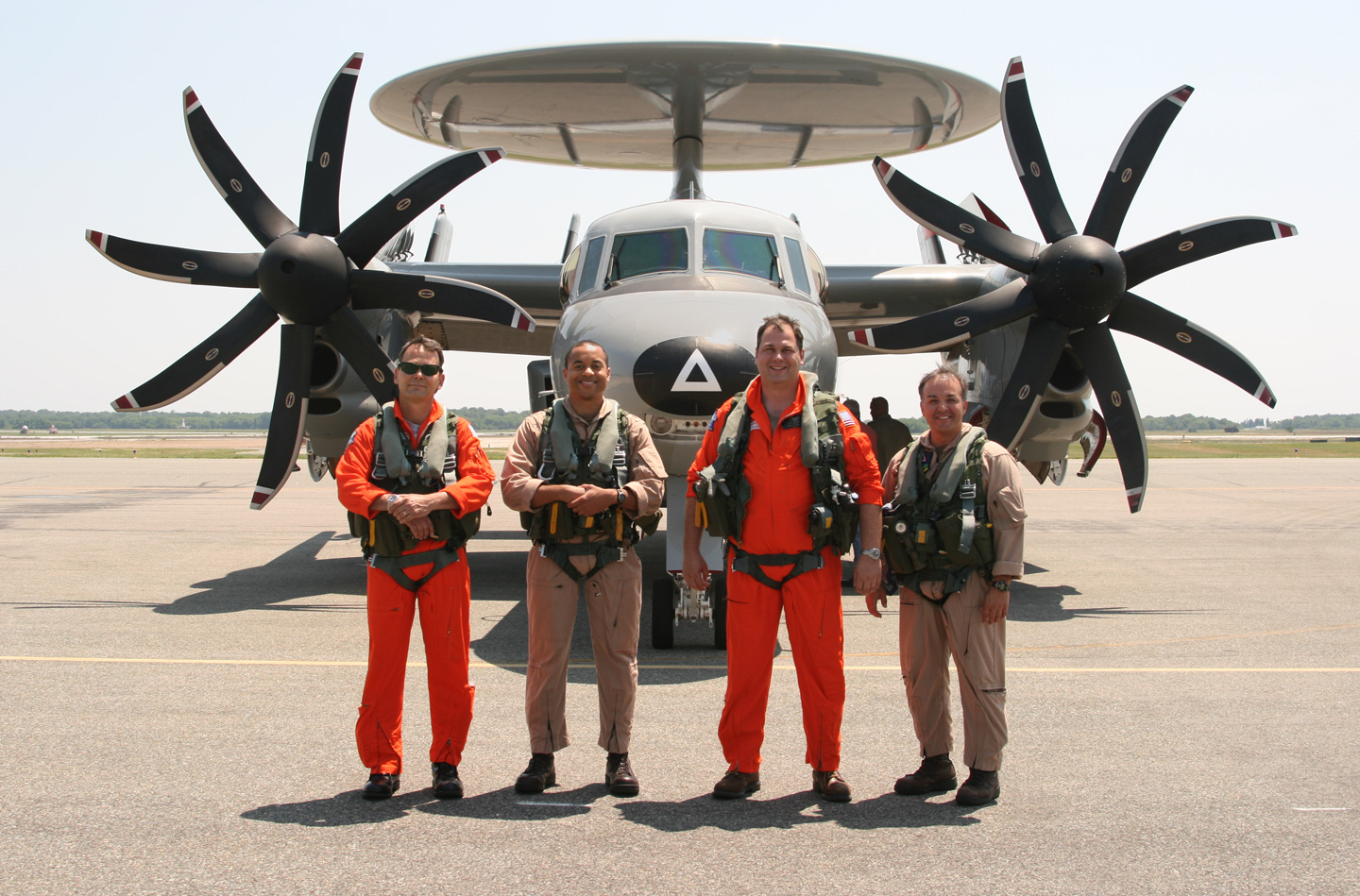
The aircraft known as Delta One, recently assigned to Air Test and Evaluation Squadron (VX) 20, made the 2.5-hour flight from the Northrop Grumman St. Augustine Manufacturing Center, St. Augustine, Fla. The ferry-flight crew of four included VX-20 flight test pilot, Lt. Cmdr. Lawrence Nance, integrated test team members from Northrop Grumman, Tom Boutin and Bill Zegarski, and Wyle’s Ray Collazo.
Delta One made its maiden flight Aug. 2007 and has spent the last 21 months executing initial flight testing at the center.
“I'm very excited to continue developmental testing of the E-2D at VX-20,” said VX-20 Commanding Officer, Cmdr. John Lemmon. “The entire integrated test team has done a phenomenal job so far testing the aircraft at the contractor's facility. The aircraft and test team are arriving at Pax River after safely executing more than 1,000 flight test hours - a true testament to the professionalism with which the E-2D ITT conducts business.”
The E-2D will undergo shore-based carrier suitability testing to evaluate the systems’ handling of catapult shots and arrested landings, and the interoperability between the aircraft and the carrier. Tests will be conducted at the shore-based TC-7 catapult and the MK-7 arresting gear facilities here.
The E-2D is the Navy's replacement for the E-2C as it enters its fifth decade of service next year.
“For over 40 years, the E-2 has been the Navy’s linchpin of airborne early warning, and command and control,” said Capt. Shane Gahagan, Hawkeye Greyhound program manager. “We are eager to continue testing the aircraft here at Pax and providing the warfighter with this advanced capability to remain that linchpin well into late this century.”
The E-2D features a state-of-the-art radar with a two-generation leap in capability and upgraded aircraft systems that allow the aircraft the ability to work in the littoral and over land.
Using the E-2C Hawkeye 2000 configuration as a baseline, the E-2D will provide advance warning of approaching enemy surface units, cruise missiles and aircraft, to vector interceptors or strike aircraft to attack, as well as provide area surveillance, communications relay, search and rescue coordination and air traffic control.
Beyond the battle group, the E-2D’s command and control capability makes it a multi-mission platform through its ability to coordinate concurrent missions that may arise during a single flight, to include: airborne strike, land force support, rescue operations, managing a reliable communications network between widely dispersed nodes and support for drug interdiction operations.
The use of the new glass cockpit and tactical fourth operator display allows the five-person crew more flexibility in fulfilling these diverse missions.
“The capability that the Hawkeye and Advanced Hawkeye bring to the Navy is imperative to the support of the warfighter and to the multi-faceted missions this aircraft executes around the world,” said Rear Adm. W. Mark Skinner, Program Executive Officer for Tactical Aircraft.
Delta One will remain here for the duration of its lifetime serving as an E-2D test asset for future system and air vehicle upgrades. The second E-2D System Development and Demonstration aircraft known as Delta Two, will arrive here later this summer.
“This first of two E-2D test assets to join VX-20's stable of aircraft will continue executing the flight test program during an exciting time of increased flight test activity on numerous programs here,” said Lemmon.
-- 30 --
Cutline: E-2D Advanced Hawkeye test crew, Tom Boutin, Lt. Cmdr. Lawrence Nance, Bill Zegarski and Ray Collazo, arrive at NAS Pax River, Md., after their 2.5-hour flight from St. Augustine, Fla., May 30. (U.S. Navy Photo)