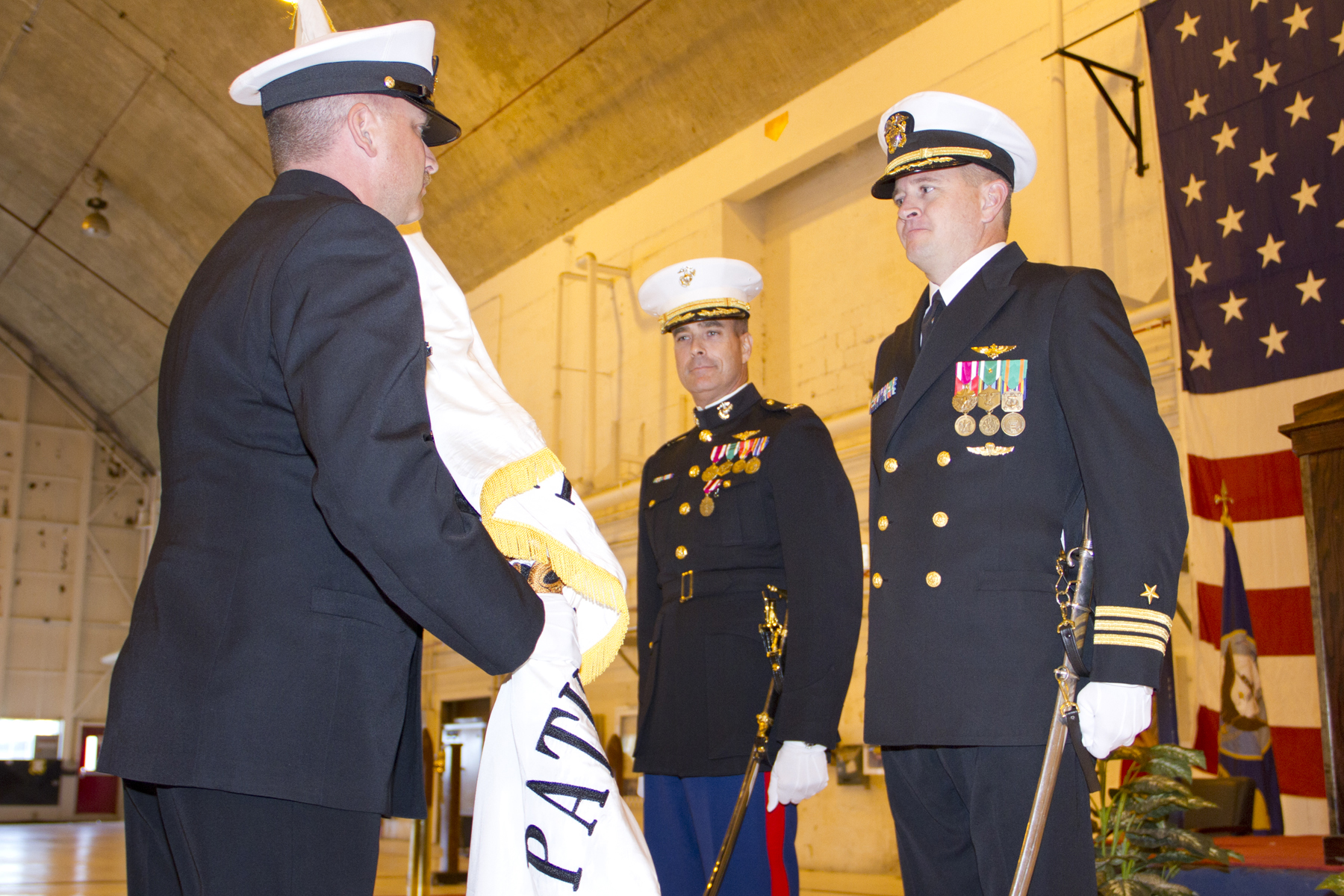
ATCS Jack Carlsen, U.S. Naval Test Pilot School Command Senior Chief, passed the USNTPS colors from Col. Roger L. Cordell, the outgoing commanding officer to Cmdr. Andrew C. Lynch, the incoming commanding officer. (U.S. Navy photo)
Test Pilot School welcomes new commanding officer
NAWCAD, NAS PATUXENT RIVER, Md. – Cmdr. Andrew C. Lynch received the colors and assumed the responsibilities as commanding officer for the U.S. Naval Test Pilot School from U.S. Marine Corps Col. Roger L. Cordell during official change of command ceremonies here, Friday, October 15, 2010.
Commander Naval Test Wing Atlantic, Capt. Thomas Huff, himself a former commanding officer of the Test Pilot School, was the guest speaker for the ceremony. During his remarks, he gave historical highlights of the school, pointing out that USNTPS is what he called a “truly joint institution.”
“Every service is represented on the staff or student body,” Huff said. Fourteen countries are represented in the students who attend the school. And, since the 60s, the U.S. Naval Test Pilot School (USNTPS) has been the sole source for the Army’s test pilots.
USNTPS provides instruction to experienced pilots, flight officers, and engineers in the processes and techniques of aircraft and systems test and evaluation. The school investigates and develops new flight test techniques, publishes manuals for use of the aviation test community for standardization of flight test techniques and project reporting, and conducts special projects. USNTPS maintains its staff as a focal point of expertise providing the aviation test community with engineering and training consultation.
Cordell leaves USNTPS to join the F-35 Joint Strike Fighter test team here at Patuxent River.
Prior to assuming command of USNTPS, Lynch served as the executive officer for the school. Operationally, he served his initial sear tour with helicopter Combat Support Squadron Eleven flying the venerable H-46D Sea Knight. While assigned to the Gunbearers, he deployed in USS Rainier and USS Tarawa and served as Night Vision Device program manager and assistant maintenance officer. He was subsequently assigned to Helicopter Combat Support Squadron Three as a Fleet Replacement Squadron instructor where he was returned to the fleet to fly the MH-60S at Helicopter Combat Support Squadron Five. There, he deployed in USNS Niagara Falls, USNS Concord, and USNS San Jose as Detachment Three officer in charge. He also served as the squadron safety officer, Detachment Six officer in charge, and maintenance officer.
Within NAVAIR, Lynch has been assigned to the Naval Rotary Wing Aircraft Test Squadron (HX-21), Avionics Department (AIR 4.5), Systems Engineering Department (AIR 4.1) and USNTPS. While assigned to HX-21, he participated in the Instrument Meteorological Conditions (IMC) certification for the MH-60S and shipboard integration tests aboard landing helicopter dock (LHD), combat stores (T-AFS), auxiliary support (T-AE) and High Speed Vessel Joint Venture (HSV-X1) class ships. As the assistant program manager for Systems Engineering (Class Desk) for the MH-60S helicopter program, his team supervised the repair and redesign of major sections for the MH-60S structure and delivered the armed helicopter systems upgrade to the fleet.
His personal decorations include the Meritorious Service, Navy and Marine Corps Commendation and Navy and Marine Corps Achievement Medals. He was recognized as the Test Wing Atlantic Test Pilot of the Year for 2002 and is a member of the Society of Experimental Test Pilots. He has accumulated more than 2,800 mishap-free flight hours and has flown 28 different military aircraft.