ASE Team deploys to keep aircrews safe
JACKSONVILLE, Fla. — Insurgents using heat-seeking missiles pose the primary threat to U.S. aircraft operating in combat zones. To reduce aircrew risk, aircraft are equipped with advanced defensive systems that must be kept in peak operating condition.
Four civilians on the PMA-272 Common Aircraft Survivability Equipment (ASE) Functional Check and Confidence Team from the In-Service Support Center Jacksonville deployed to Iraq in April to inspect and repair ASE Suite systems on military aircraft.
Since the terrorist attacks of Sept. 11, 2001, the use of ASE has significantly increased due to the enemy’s ever-improving combat strategies. Rebels in Iraq and Afghanistan are using Man-Portable Air-Defense Systems (MANPADS), typically shoulder-launched missiles for destroying low-flying aircraft, especially helicopters.
The ASE Suite is made up of three systems working in tandem to provide the aircrew with optimal capability to defend against the threat of MANPADS. ASE Team Leader and Logistics Management Specialist Tom Trivette said, “Our ASE systems provide defense against incoming missiles and decoy them away from the aircraft.”
The APR-39 Digital Threat Warning System detects pulsed radar signals and alerts the aircrew to take evasive maneuvers or deploy countermeasures. Electronics Engineer Michael Lee performed the system’s integrity checks in Iraq. He said, “Different threats get different functions.”
Electronics Engineer Saeed “Si” Sooudi, who traveled with the team to support this system, said he knows the importance of its split-second timing. The AAR-47 Missile Warning System works hand-in-hand with the APR-39 and signals the aircrew of approaching infrared and laser guided missiles.
"The system sends a direct flare eject command to the Countermeasures Dispensing Set for missile diversion,” he said. “It would be impossible for the aircrew to visually spot an incoming missile and then react in time to manually expend countermeasures."
The third system to make up the ASE Suite is the ALE-47 Countermeasures Dispensing System. It uses information from the integrated electronic warfare sensors to control the threat situation.
The advanced technology allows the pilot to program the onboard computer. The system automatically dispenses electronic and infrared decoys to drastically reduce the likelihood of a direct hit.
Electronics Engineer Tom Lovelace who maintains this system knows it provides an added measure of security. “Successful deployment of flares to a MANPADS threat means the pilot and aircrew will return to fly another day,” he said. “The flares or chaff pull the missile away from the aircraft. All these ASE systems work together to protect the crew.”
The ASE team also provided one-on-one aircrew training on these sophisticated systems. The team was very impressed with the troops’ professionalism and exceptional work ethic, especially the Marines who worked 12-hour shifts in harsh conditions.
Keeping these vital systems operating at full capacity not only enhances aircraft survivability but also reduces aircrew workload, improves threat assessment and improves mission effectiveness.
The ASE team received the Global War on Terror medal Oct. 27 for its outstanding support to combat troops in Iraq from April 29 to May 15.
//USN//
Photo Captions:
10-15A:
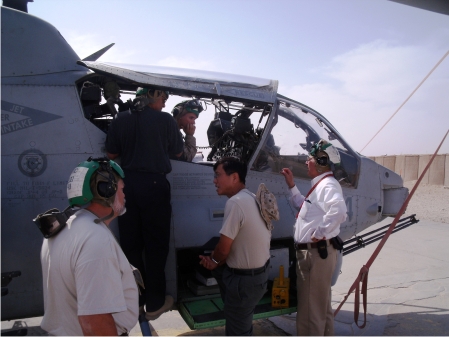
FRCSE Logistics Management Specialist and team leader Tom Trivette (from left), Si Sooudi, Mike Lee and Chris Dibble inspect the AAR-47 System in an AH1-W Cobra Helicopter during an Iraqi deployment from April to May 2009. (Photo courtesy Tom Lovelace)
10-15B:
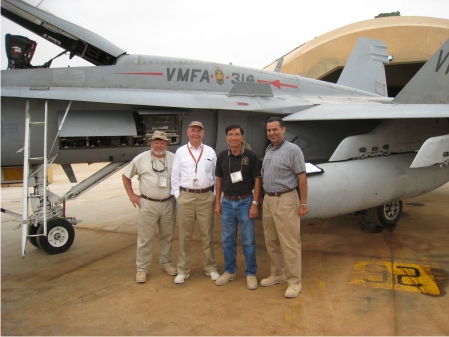
ASE Team Leader Tom Trivette (from left), Chris Dibble, Mike Lee and Si Sooudi deployed to Iraq in April to inspect and repair ASE systems on fixed and rotary winged military aircraft. (Photo courtesy Tom Lovelace)
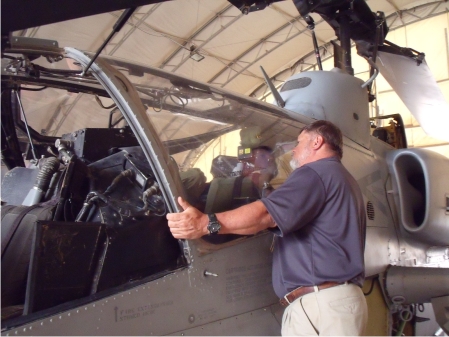
10-15C: FRCSE Logistics Management Specialist Tom Trivette does a visual inspection through the canopy of an AH-1 Cobra during a trip to Iraq in April 2009 to assess Aircraft Survivability Equipment installed on military aircraft. (Photo courtesy Tom Lovelace)
10-15D:
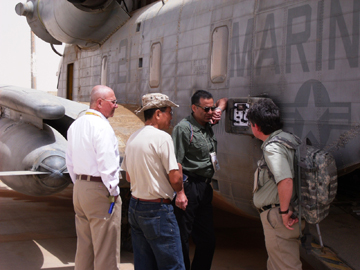
Naval Air Technical Data & Engineering Service Command (NATEC) Representative Chris Dibble (from left) and Electronics Engineers Mike Lee, Si Sooudi and Tom Lovelace perform release and control checks of an ALE-47 system on a CH-53 Sea Stallion Helicopter. (Photo courtesy Tom Lovelace)
10-15E:
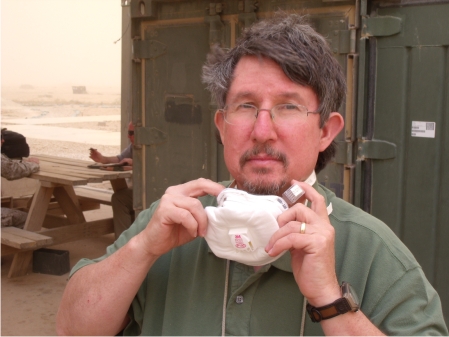
FRCSE Electronics Engineer Tom Lovelace dons a dust mask in Iraq to guard against a sandstorm. Moderate storms lock down flights and severe ones prevent aircraft maintenance. (Photo courtesy Tom Lovelace)