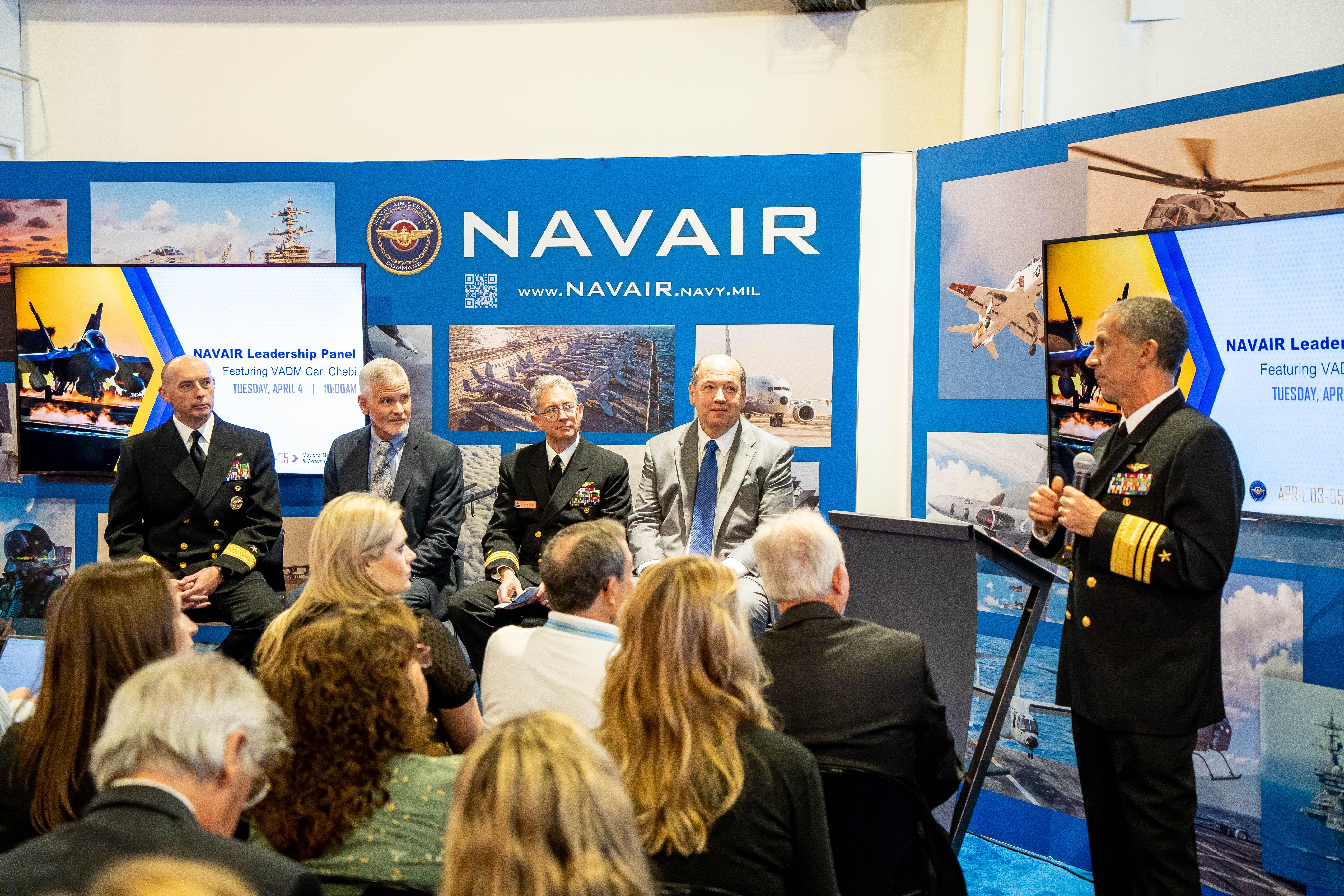
NAVAIR Leadership panel at Sea Air Space (U.S. Navy photo)
NAVAIR Leadership Panel, NAWC Updates Mark Second Day of Sea-Air-Space Expo
Vice Adm. Carl Chebi, Commander, Naval Air Systems Command (NAVAIR), opened the second day of NAVAIR presentations at the Sea-Air-Space Expo 2023, hosted by the Navy League, with a leadership panel addressing the current challenges the organization is facing in continuing to meet its North Star goals, as well as engaging industry and retaining and adapting the workforce to meet emerging technologies.
Chebi was joined by NAVAIR Deputy Commander Tom Rudowsky; Executive Director, Naval Air Warfare Center Aircraft Division (NAWCAD) Webster Outlying Field Christian Utara; Naval Air Warfare Center Weapons Division (NAWCWD) Commander Rear Adm. Keith Hash; and Fleet Readiness Centers Commander Rear Adm. Joseph Hornbuckle.
“I was asked a couple years ago by a close family member what NAVAIR does,” Chebi said. “I answered succinctly NAVAIR is in the business of Naval Aviation. It is our business to deliver the warfighting capability the fleet needs when they need it at a cost we can afford. The panel members will walk you through what they're doing to achieve the outcomes that matter to the warfighter so that our sons and daughters can go execute their mission successfully and return home safe. NAVAIR doesn’t deliver warfighting capability alone. We work with industry, our partners, our stakeholders to deliver it.”
Rudowsky outlined the tenets that make up NAVAIR’s “North Star:” Capability, Availability, Reliability and Affordability. Rudowsky said NAVAIR has been analyzing ways to make “Get Real, Get Better” a reality while moving forward to remain relevant now and into the future. He pointed to the 2018 directive from then-Secretary of Defense Gen. Jim Mattis ordering the Navy to achieve an 80-percent mission capable rate of F/A-18 Super Hornets by the end of 2019. Due to dedicated efforts, that capability was met and exceeded before the end of the set timeframe, and Rudowsky said the lessons learned from reorganizing and rethinking to meet that goal continue to flourish today.
Hornbuckle gave an overview of the Fleet Readiness Center maintenance depots and how they are integral to the readiness and capability mission that NAVAIR performs.
“Each year we overhaul about 500 aircraft a year. That’s about 3,000 engines and modules and 50,000 components for Naval Aviation,” Hornbuckle said. “We do it in a very collaborative manner with our industry partners. What we’re doing differently started with what Mr. Rudowsky described. We have scaled that learning, those industry best practices, across our product lines.”
Utara echoed the success of the “Get Real, Get Better” mantra, stating that it has opened better lines of communication, “with incredibly important, authentic conversations where we can get to the root cause and just get to what we need to talk about.”
“It’s not just a program, it’s not just training; it’s a change in culture and the way we do business. And it’s propagating throughout the entire civilian and military workforce, but it also needs to include all our industry partners.”
Hash touched on how NAWCs are aligning to be more collaborative and integrate digital transformations. He said by devising a business strategy, NAWCWD is focusing on four main areas to address and improve including weapons system development transformation; integrated spectrum
warfare; Airwing of the Future integration and interoperability; and advance live virtual constructive capabilities.
Rudowsky addressed a question from the audience regarding how NAVAIR is looking to best equip the workforce to meet evolving challenges and transformations by noting NAVAIR has been breaking away from a status quo system by engaging the workforce directly with his “Deputy Notes” series as well as meeting with the executive board to address behaviors that need to evolve and change from the top down.
Utara highlighted NAWCAD’s community outreach program of Industry Days as a great way to begin cultivating a relationship with NAVAIR, as well being involved in local Science Technology Engineering and Math (STEM) and Artisan programs with high school students to help grow relationships and interest in what NAVAIR does from an early age.
“As we go after the behaviors and the culture at NAVAIR, we need the industry to come along with us,” Chebi said. “We’re changing behaviors. It’s hard. My ask to industry is to come along with us.”
Capt. Dan Covelli, Commanding Officer of Naval Air Warfare Center Training Systems Division (NAWCTSD), began the afternoon presentations with a reason as to why he believes the Navy is still very relevant today, noting 70 percent of the Earth is covered in water, 80 percent of the Earth’s population lives near the sea and 90 percent of goods are shipped over water. He cited the explosion of Internet commerce as the reason for exponential growth in overseas shipping and commerce.
“The supply chain and the flow of information is dependent on the sea, so I am going to argue that it is more important now than ever that we have a strong Navy to protect our and our allies’ interests overseas,” Covelli said.
Covelli said with the current state of other areas of the world including conflicts in Europe and Asia, the sense of urgency to develop weapons and defense systems in a rapid fashion should be felt by everyone. Cavelli said to stay ahead of near peer threats, the Navy needed to bend the curve and raise the bar to produce a higher quality Marine, Sailor and Soldier in the same amount of time.
“In order to do that, we need more accessible training and our devices [in all branches of the service] have to be interoperable so we can train like we would with the battle group and with our joint partners and coalitions,” Covelli said.
NAWCTSD is based in Orlando, Florida, and Cavelli said the Army, Navy, Air Force and Marine Corps all collaborate to replicate and improve approaches to aviation training. Cavelli said the area was perfect for the forces to collaborate, but that there were also schools, and the gaming industry has headquarters there, which has developed flight simulation software that has been used for training simulators, which NAWCTSD develops and deploys around the nation.
Leading a presentation about NAWCAD AIRWorks was Director Jerry Swift and Christa Rodewald-Franz, deputy director. Swift explained the role of the NAWCAD in developing capabilities to fleet.
“Within the Warfare Center, we build, enable and optimize” systems for the warfighter, he said.
A leading government Lead Systems Integrator (LSI), AIRWorks provides rapid acquisition and development of aerospace technologies and integrates the effective use of state-of-the-market and state-of-the-art technologies that allow our warfighters to win against pacing threats.
Rodewald-Franz explained how AIRWorks is delivering capabilities to the warfighter by partnering with business, industry, laboratories and academia and drive them together into one ecosystem.
“We are a government lead system integrator; together we work to bring this capability to the fleet,” she said.
She stated that the facilities provided at the various NAWC locations can bring engineering, fabrication, testing and prototyping abilities to industry when collaborating on projects.
Dan Carreño, NAWCWD executive director, closed out the day’s talks with a discussion of NAWCWD’s current state and the need for building and leveraging strong partnerships with other government entities, academia, industry and partner nations to develop creative, integrated and interoperable solutions for the warfighter.
Carreño said getting weapons out to the warfighter has, for decades, taken too long and cost too much and often, once those capabilities are fielded, they are only somewhat effective due to the amount of time it took to develop, test and deliver.
“That’s what we want to change, and I believe that industry partnerships are a critical part of that,” he said.
He said that by partnering, NAWCWD can provide services to industry that it doesn’t have the ability to perform, or that “it would just be more effective just to hire us to do it, such as range testing or missile assembly or disassembly.”
“We want to expand our relationships with industry. We want industry healthy. What we want are the flexibility, flexibility for our program managers and for fleet to be able to have a wide a variety of solutions as possible. And so, we're going to continue to expand these partnerships.”
Sea-Air-Space brings the U.S. defense industry and key military decision-makers together for three days of informative educational sessions, important policy discussions and a dynamic exhibit hall floor. Owned and produced by the Navy League of the United States, Sea-Air-Space attracts maritime leaders from sea services around the globe. The event is taking place at the National Harbor, Md.