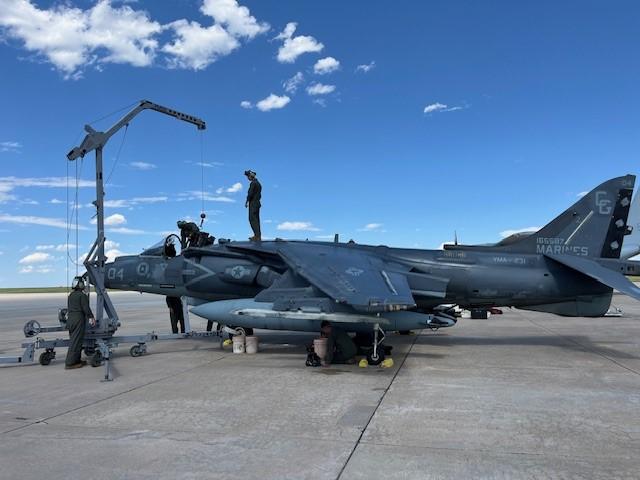
Marines with the demilitarization team prepare an AV-8B+ Harrier for its final destination as a display at the Wings Over the Rockies Air & Space Museum in Denver.
Vertical Legacy: Retired US Marine Corps Harrier lands at Wings Over the Rockies
After more than three decades of combat sorties, carrier launches, and forward-deployed missions, one of the U.S. Marine Corps’ most iconic jets has made its final landing as a public museum piece.
On June 10, a retired AV-8B Harrier II+ became the latest addition to the Wings Over the Rockies Air & Space Museum in Denver arriving with fanfare, rich history, and a legacy of innovation that continues to captivate aviation lovers of all ages.
“We are beyond honored to welcome this combat-proven aircraft to Wings Over the Rockies,” said Marcus A. Harshaw, Jr., CEO and President of at Wings Over the Rockies. “The Harrier is not just a remarkable engineering feat, it’s a story of Marines, mission, and legacy. Watching the Marine team work with such professionalism and pride was truly inspiring.”
Its journey from active service to museum centerpiece was made possible through a multi-agency collaboration among the AV-8B Weapons System Program Office (PMA-257), Headquarters, U.S. Marine Corps, Marine Aircraft Group (MAG) 14, and Marines from Marine Attack Squadron 231 (VMA-231) as the squadron transitions to the F-35B Lightning II platform.
The Harrier, bureau number (BuNo) 165587, was piloted across the country by Capt. Ryan “MRV” Gettinger, who departed from Marine Corps Air Station Cherry Point, North Carolina, June 10. After two aerial refuelings and a sweeping fly-by over the observation area, the Harrier touched down at Buckley Space Force Base near Denver the same day.
A C-130 loaded with tools and Marines arrived just hours later. With practiced precision, the Marine Corps demilitarization team got to work transforming a front-line fighter jet into a safe, striking museum exhibit. By June 12, the Harrier had completed its transformation and taxied into Colorado aviation history.
This Harrier tells a rich and storied tale. It began its career in 1987 as a Day Attack variant before being remanufactured into a Harrier II+ in December 2000. Over the course of its service, it flew with VMAs 211, 214, 513, 311, and finally 231, amassing over 8,900 flight hours, including 1,436 hours in combat in support of Operation Iraqi Freedom, Operation Enduring Freedom, humanitarian missions, and Marine Expeditionary Unit deployments.
“This aircraft may no longer take to the skies,” said Pablo “Louie” Sanchez, PMA-257 logistics assistant program manager and museum task force lead, “but it will continue to serve by educating, inspiring, and reminding us all of the innovation and grit at the heart of U.S. Marine Corps aviation.”
Wings Over the Rockies draws more than 160,000 visitors annually to its two locations, offering immersive exhibits and STEM-focused programs that inspire a new generation of aerospace visionaries. The addition of this Harrier is expected to be a major attraction, especially for students, veterans, and aviation enthusiasts seeking a closer look at the legacy of vertical-lift airpower.
The AV-8B Harrier II+, used by the U.S. Marine Corps as well as the Italian and Spanish navies, was the first successful Vertical/Short Takeoff and Landing attack aircraft in frontline service. Designed to operate in austere environments, it has supported expeditionary air operations for over 40 years.
Its mission set ranges from close air support and armed reconnaissance to defensive counter-air and interdiction. The Harrier’s flexibility to launch from amphibious assault ships, tactical landing zones, and expeditionary strips allows Marines to apply combat air power where others couldn’t.