
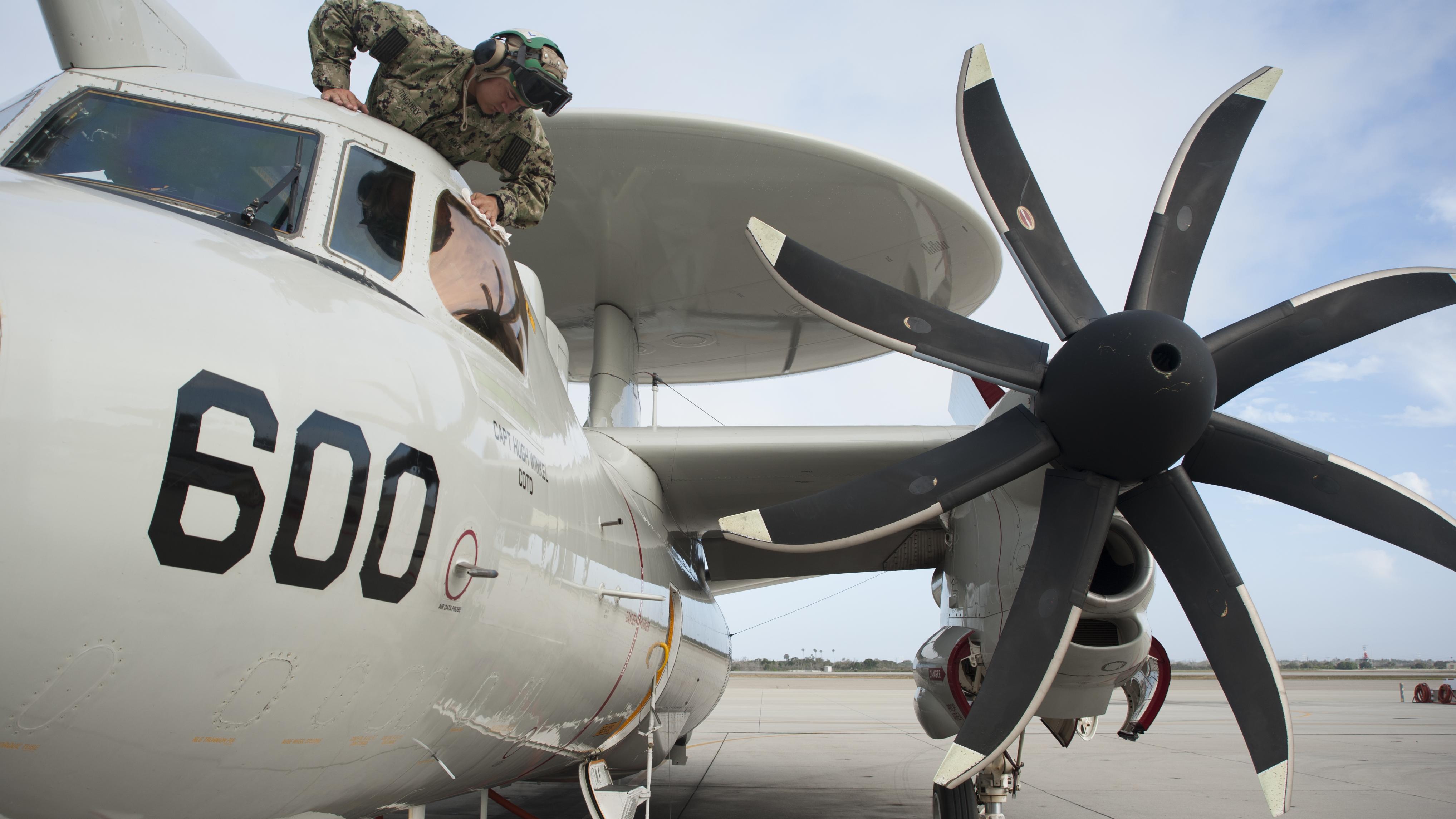
The Department of Navy launched the first Sustainment Program Baseline pilot for the E-2D Advanced Hawkeye focused on improving the sustainment of weapon systems such as the E-2D.
U.S. Navy photo by Mass Communication Specialist 2nd Class Victoria Kinney
Navy launches new Sustainment Pilot Program for E-2D
Navy leaders took a bold step in establishing an enduring and disciplined sustainment management process by launching the first sustainment program baseline (SPB) pilot for the E-2D Advanced Hawkeye in fiscal 2020.
Achieving and maintaining predictable and affordable readiness across the fleet requires a disciplined performance driven sustainment process.
“We are implementing new processes to bring more rigor into our sustainment efforts, and therefore increasing our output to the fleet,” said Sean Burke, Deputy Assistant Secretary of the Navy (Sustainment). “This sustainment pilot will improve the accuracy of our requirements, funding, performance and governance of weapon system sustainment.”
While the Navy achieved the Secretary of Defense’s Super Hornet mission capable rate at the end of fiscal 2019, maintaining those readiness levels remains at the forefront. To do this, the Navy looks to improve the sustainment of weapon systems such as the E-2D Advanced Hawkeye, through a rigorous and disciplined process with improved requirements, funding and performance controls and governance – the SPB.
Sustainment is the management of everything required to enable future readiness; it reaches back through the enterprise from the flightline, across multiple organizations and disciplines, and consumes more than half of the Navy’s budget. To maintain mission capable rates across the fleet, a highly complex naval sustainment “system of systems” must manage tens of thousands of parts from thousands of suppliers, truckloads of ever-changing technical data, millions of software lines of code, and billions in funding must be aligned, finely tuned and actively managed.
Capt. Keith Hash, E-2/C-2 Airborne Command and Control Systems program manager, and Capt. Matthew Duffy, E-2 Wing Commander, have worked closely together to address readiness issues. The E-2D SPB takes their partnership to a new level, with a weapon system focused sustainment document submitted by the fleet commander and the program manager.
“We welcome the SPB and its processes of setting specific comprehensive requirements and regularly measuring performance across the span of product support providers,” Duffy said. “This will ultimately generate more readiness and provide additional [full mission capable] Advanced Hawkeyes ready for the high-end fight.”
A key component of the pilot process is specific performance requirements for supply, repair, support equipment, engineering, trainers, maintenance and technical data unique for the E-2D that enable fleet squadrons to achieve readiness. The SPB identifies and governs complex interdependencies and refines resource allocation risks across the sustainment system.
Traditionally, the fleet has reported mission capability, but under SPB, Duffy and Hash will also report quarterly on the performance of the sustainment system to their approved requirements directly to the Vice Chief of Naval Operations, Assistant Secretary of the Navy Research, Development and Acquisition (ASN(RD&A)), and Commander, Naval Air Forces.
The SPB concept should evolve as the process is matured and refined and the use of SPBs is expanded. The Marine Corps has developed and submitted their first SPB pilot for the H-1 program.

The Department of Navy launched the first Sustainment Program Baseline pilot for the E-2D Advanced Hawkeye focused on improving the sustainment of weapon systems such as the E-2D.
U.S. Navy photo by Mass Communication Specialist 2nd Class Victoria Kinney