
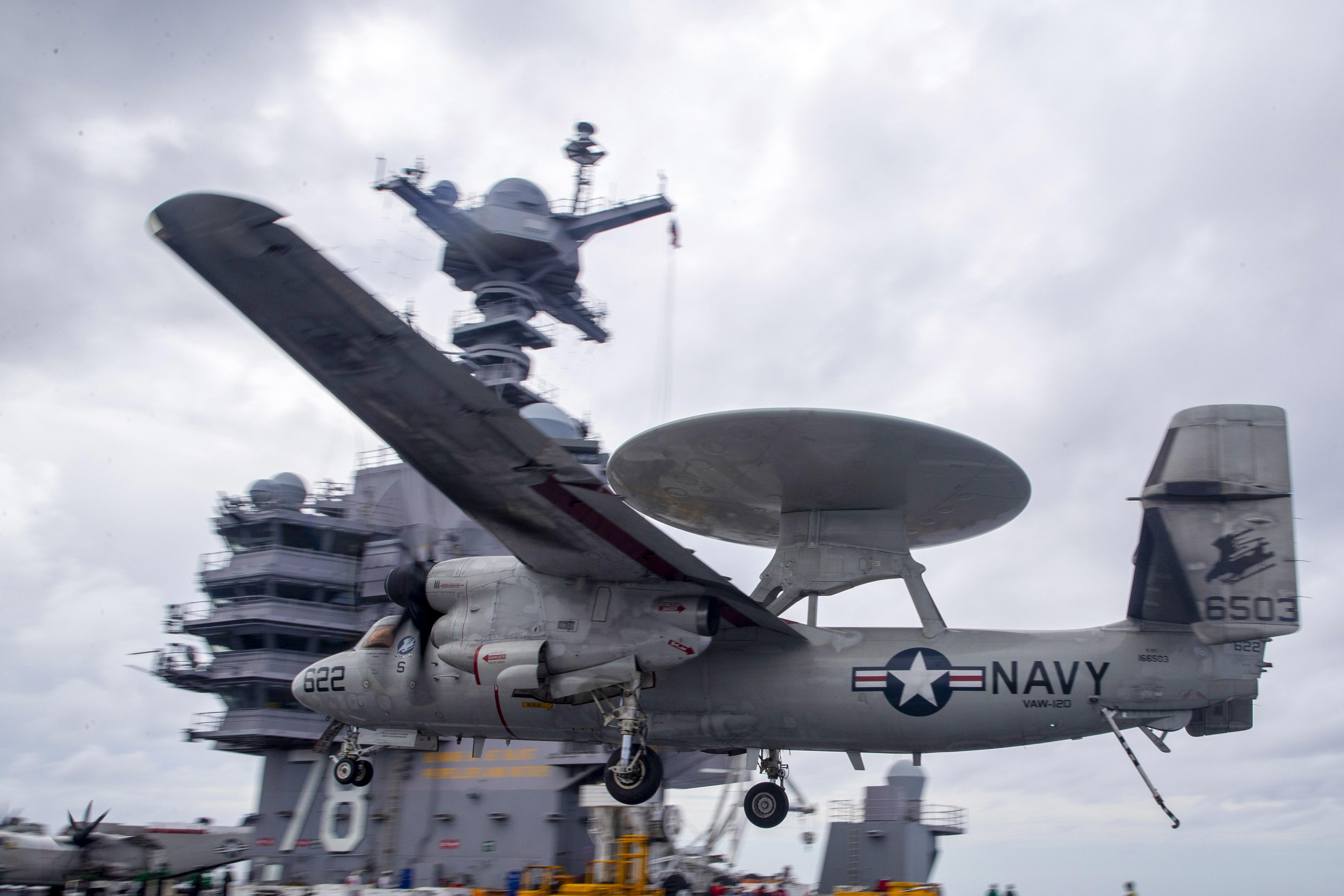
An E-2D Advanced Hawkeye, attached to Airbourne Command and Control Squadron (VAW) 120, approaches USS Gerald R. Ford's (CVN 78) flight deck during flight operations Aug. 4, 2020. The E-2/C-2 Airborne Command and Control Systems Program Office (PMA-231) recently awarded a contract for the requirements phase of the engineering, manufacturing and development of the E-2D Hawkeye Cockpit Technical Refresh.
HECTR brings E-2D cockpit tech refresh
The E-2/C-2 Airborne Command and Control Systems Program Office (PMA-231) awarded a $34 million contract to Northrop Grumman Aerospace Systems, Aug. 3, for the requirements phase of the engineering, manufacturing and development of the E-2D Hawkeye Cockpit Technical Refresh, referred to as HECTR.
“HECTR is an essential upgrade that brings the E-2D Hawkeye Cockpit into the 21st century,” said Capt. Michael France, the Airborne Command and Control and Logistics Wing commodore. “The fleet is very excited to be a part of the development of HECTR. It is a welcome addition to the Advanced Hawkeye and one that will improve our combat readiness and flexibility.”
HECTR redesigns hardware and software components of the current E-2D Integration Navigation, Controls and Displays System (INCDS) as well as an integration of the cockpit solution into the weapon system.
For decades, the Advanced Hawkeye has improved its weapon system, but the cockpit has remained largely unchanged. The cockpit had many of the platform’s top readiness degraders, obsolete components and architecture that would not support the E-2D’s Delta System Software Configuration (DSSC) 6 timeframe. HECTR will solve some of these issues with a concentrated focus on new reliability parameters and architecture redesign to a more modular, application-based software one that will enable the program to sustain mission readiness and execution with DSSC-6 and beyond. HECTR will also bring new navigation and communication capability.
HECTR program goals will also substantially change the pilot and co-pilot experience in the cockpit. With the addition of the E-2D's aerial refueling capability, aircrew will experience greater workload and fatigue; however, HECTR will bring increased safety, decreased pilot workload and increased sustainability to the world’s only carrier based airborne command and control platform.
"With the [aerial refueling] variant of the E-2D as our new baseline, HECTR makes it safer for our crews who must land on the aircraft carrier after many hours of being on station," France said.
As the last fixed-wing carrier-based aircraft that lands on the aircraft carrier without a heads-up display (HUD), landing an E-2D can be a difficult task. HECTR will integrate a HUD capability to increase safety and decrease pilot workload for generations of Hawkeye pilots by providing horizon reference and increased visual scan speed for carrier landings; especially beneficial at night and during adverse weather conditions.
The period of performance for this contract began Aug. 3 and runs through January 2022. HECTR is scheduled to field with DSSC-6 in fiscal year 2027.
“This program demonstrates outstanding teamwork between the program office, industry and our fleet operators,” France said.
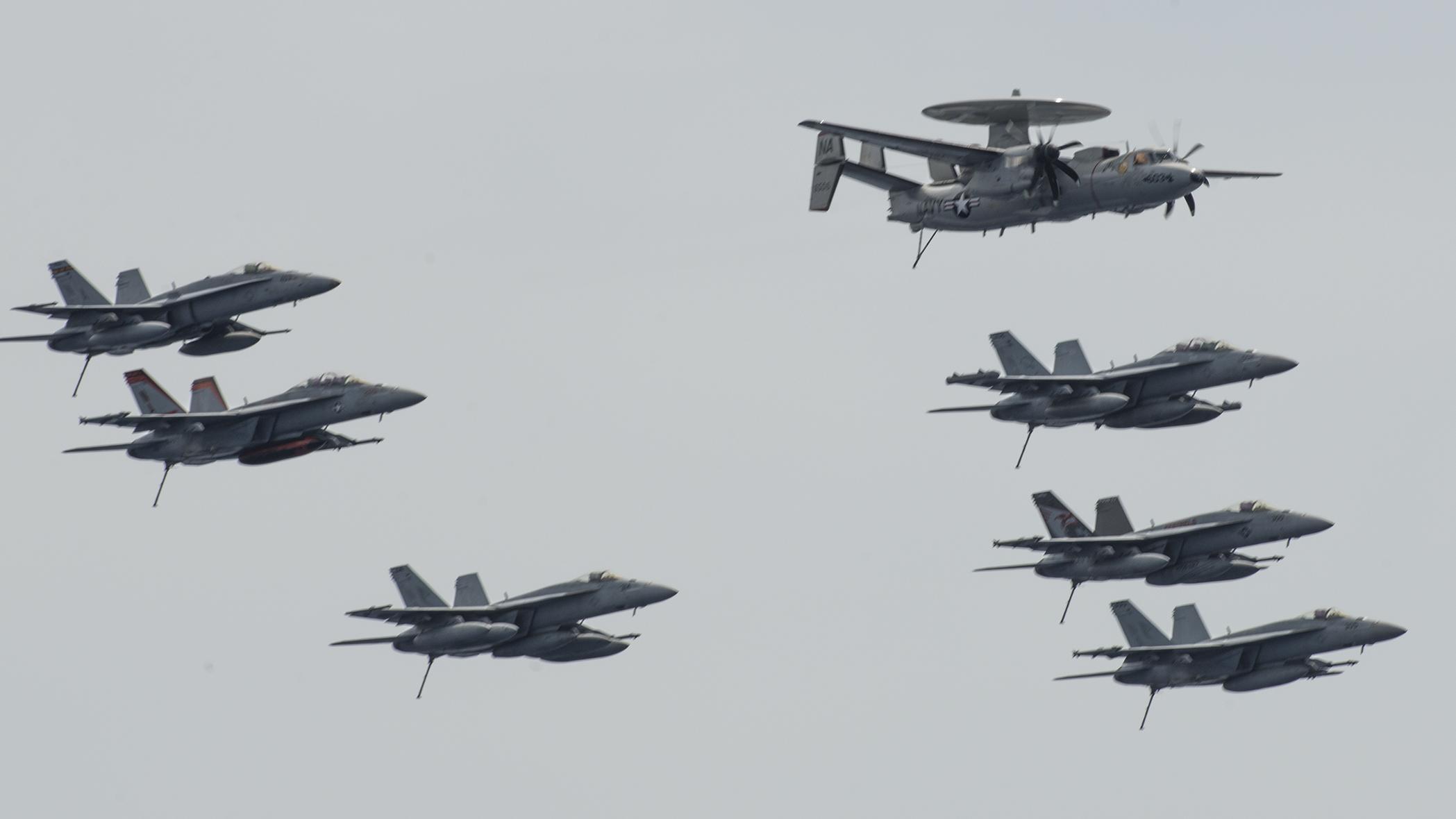
SOUTH CHINA SEA (July 6, 2020) Aircraft from Carrier Air Wing (CVW) 11 fly over the Nimitz Carrier Strike Force (CSF) during dual-carrier operations with USS Nimitz (CVN 68) and USS Ronald Reagan (CVN 76) Carrier Strike Groups. The E-2/C-2 Airborne Command & Control Systems Program Office (PMA-231) recently awarded a contract for the requirements phase of the engineering, manufacturing and development of the E-2D Hawkeye Cockpit Technical Refresh.
U.S. Navy photo