
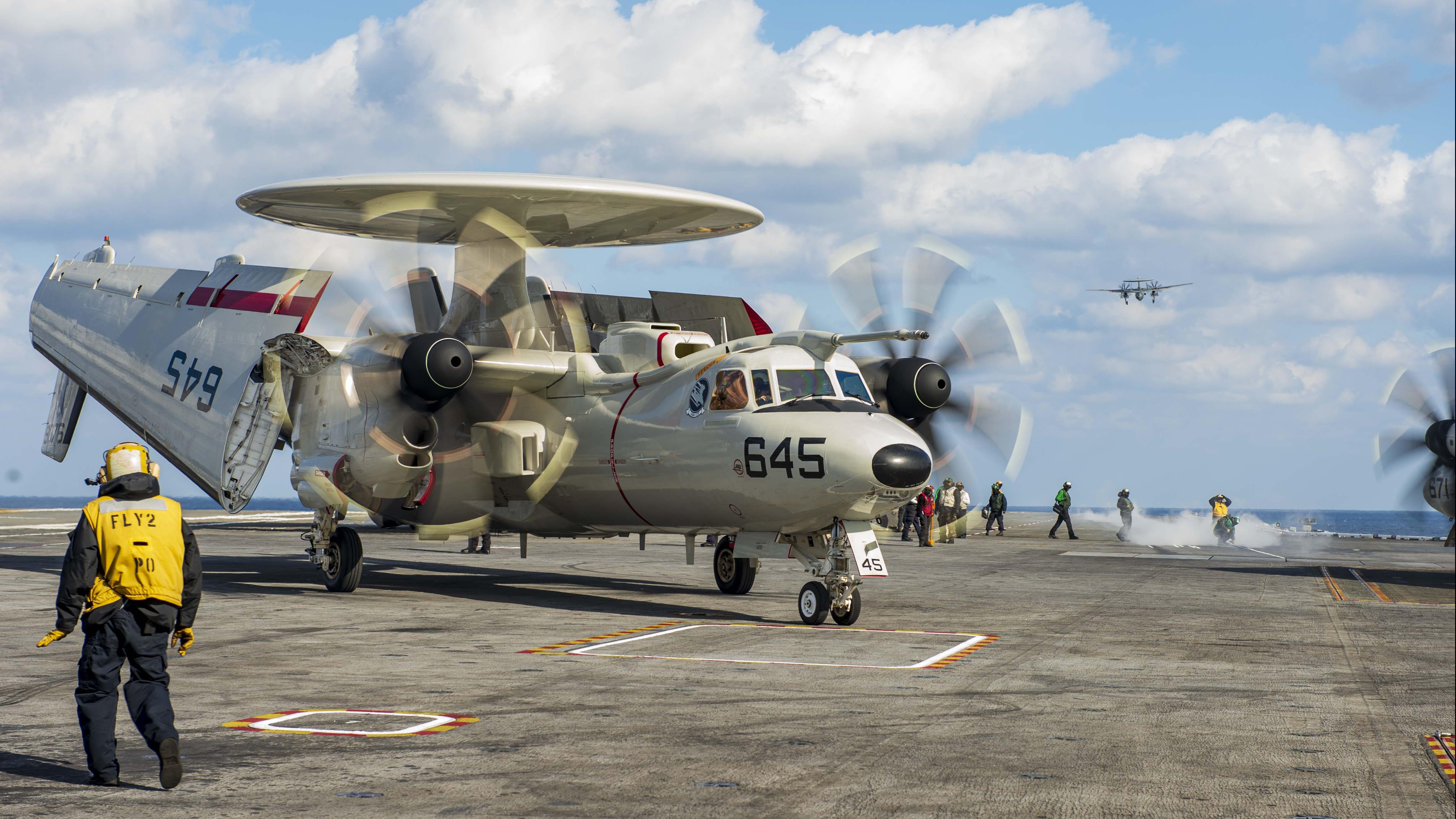
An E-2D Hawkeye, assigned to the "Greyhawks" of Carrier Airborne Command and Control Squadron (VAW) 120, taxis on the flight deck of the Nimitz-class aircraft carrier USS Dwight D. Eisenhower (CVN 69) while operating in the Atlantic Ocean. The E-2D community reached its mission capable goal ahead of schedule with all-hands-on-deck focused on sustaining and surpassing that goal, while reaching its fully mission capable goal.
U.S. Navy photo
E-2D achieves mission capable goal ahead of target
The E-2D community reached its mission capable goal five months ahead of schedule recently thanks to efforts made by the E-2/C-2 Airborne Command and Control Systems Program Office (PMA-231) and the Airborne Command and Control Logistics Wing (ACCLOGWING).
“The F/A-18 and EA-18G have been a major focus of the Navy to significantly increase mission capability in the last several years. Now it’s time for the E-2D to step into the spotlight and take lessons learned from these other successful programs and the NSS-A [Naval Sustainment System-Aviation] and integrate them into our own mission capable aircraft campaign,” said Capt. Pete Arrobio, PMA-231 program manager.
PMA-231 and ACCLOGWING launched Naval Sustainment System-Aviation (NSS-A) efforts in 2020 to improve E-2D aircraft readiness with a goal to sustain over 25% mission capable (MC) and fully mission capable (FMC) aircraft. The first objective of MC E-2Ds was met for the first time Feb. 3, five months ahead the planned target completion of July 1.
“This is an all-hands-on-deck effort across our community to reach, sustain and surpass 28 MC while, at the same time, getting after FMC,” said Arrobio.
The mission capable effort is structured around the six pillars of the NSS-A. NSS-A is an integrated approach to a data-informed and analytic-driven framework. It leverages industry's best practices to increase spare parts, enhance capability and maintain aircraft to support the warfighter. It also involves reforming organizational-level efforts, maintenance operation center aircraft on ground, fleet readiness centers, supply chains, engineering and maintenance, as well as establishing a single point of accountability for governance and accountability.
Over the last month, more than 25% MC E-2Ds were available on average, which represents a significant accomplishment, said Arrobio, adding that they are moving towards sustaining and having sufficient amounts of spares on the shelf to meet the fleet’s need.
To sustain MC aircraft, the program office is focused on ensuring there are 80% E-2D aircraft available out of the total inventory. This number excludes aircraft in planned maintenance intervals one and two, aerial refueling modifications and additional planned modifications for the E-2D aircraft.
Concurrently, while focusing on MC, the program office and ACCLOGWING are aggressively moving towards achieving the need for multiple FMC E-2Ds.
“The Navy invested in the E-2D because of the unique and critical warfighting capabilities it brings to the Navy and the Joint Force,” said Capt. Mike France, Airborne Command and Control and Logistics Wing commander. “Persistently maintaining MC is an important milestone, but achieving FMC E-2Ds sets the stage for us to win against adversaries. This is the critical number that supports deployed squadrons and high-end training.”
Arrobio and France said the program office and ACCLOGWING have already made significant progress towards the FMC objective by consolidating parts across prioritized aircraft, working with Naval Supply Systems Command Weapon Systems Support and industry to accelerate spares and repairs, making reliability improvements, as well as numerous other initiatives that systemically attack FMC readiness degraders.