
WD scientists invent new material for testing on space station
By Renee Hatcher
NAWCWD Public Affairs
NAWCWD China Lake research scientists Dr. Andrew Guenthner and Dr. Michael Wright invented several new space-survivable materials that were launched aboard the space shuttle Endeavour and installed on the International Space Station in March as part of a yearlong experiment.
“If these new materials work, then it could make a big difference in improving space-based platforms,” Guenthner said. “Someday, this work could make a major difference for our warfighters.”
Related work began in 2005 when the Air Force Research Lab at Edwards Air Force Base asked NAWCWD scientists for help with creating new chemical compounds for space-survivable polymer-based materials. The research focused on finding a way to prevent atomic oxygen from degrading polymers, which normally happens very quickly in low Earth orbit.
“As research scientists, we are always interested in helping someone with a problem find a solution if it will benefit the warfighter,” Wright said.
The China Lake and Edwards scientists had jointly published research papers describing their work with thin, flexible type materials. On a separate project, a team led by Guenthner and Wright had been working with more rigid composite resin panels, though not for space-survivable structures. The Air Force heard about this work and contacted the China Lake researchers on a Thursday afternoon before a flex Friday and asked for samples by Monday in order to meet the NASA imposed deadline and make it on the scheduled shuttle mission.
“They wanted a space-survivable composite resin instead of a film like we already had; we didn’t have what they were looking for,” said Guenthner, who didn’t want to pass up this opportunity to send something into space. “We had been thinking about creating something like it during the last few years but did not have anything ready.”
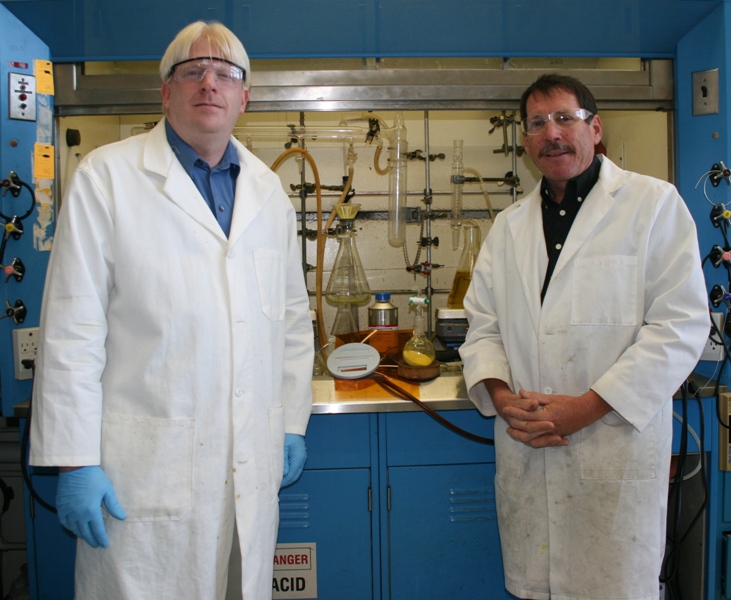
Guenthner and Wright, both of the NAWCWD Chemistry Division, worked day and night to invent a series of new materials based on some key “ingredients” already created at China Lake. The challenge was to be able to mix two liquid components and have them stay together in order to form homogeneous solid materials. Using their combined knowledge of both chemistry and materials engineering, they came up with a solution and met the deadline.
“Usually, when you come up with a new composite resin, it takes months and months to get it just right,” Wright said. “Luckily we came up with something that worked right the first time.”
Wright came up with a method for synthesizing polymerizable nanoparticles and monomers, while Guenthner developed techniques for processing them into various resin and polymer materials. Student trainee Jessica Cash, and Engineer and Scientist Development Program participant Tara Cross also contributed to the success of the project.
Four different sample materials, each having a duplicate, were mounted into specially machined holders that measured ½ inch wide and 3 inches long. These sample holders were directly bolted into a briefcase-like module containing many other samples from research labs around the world. The total compilation of samples that included the eight China Lake specimens made up NASA’s Materials International Space Station Experiment (MISSE 6). During a space walk on March 17, astronauts mounted the MISSE 6 sample tray outside the European Space Agency’s Columbus Lab Module that is part of the International Space Station. The plan is for the module to remain in space for a year before it is retrieved.
Once back on Earth, the eight samples will return to China Lake for mechanical testing and chemical analysis. The researchers said these findings may help design the next generation of space-survivable materials.
“Being able to work on new technology like this is one of the things that make China Lake so great,” Guenthner said. “As a scientist, it’s really rewarding, especially if it can make a difference for our warfighters by improving satellite technology.”
Photo by Renee Hatcher
Research scientists Dr. Andrew Guenthner, left, and Dr. Michael Wright, both of the NAWCWD Chemistry Division at China Lake, worked day and night to invent several new space-survivable materials that were launched aboard the space shuttle Endeavour in March.