NAVAIR team assists in USS Kitty Hawk decommissioning
*** Please discard the previous version and use this instead ***
NAVAIR team assists in USS Kitty Hawk decommissioning
NAVAL AIR SYSTEMS COMMAND, PATUXENT RIVER, Md. – A three-person team from the Aviation Support Equipment program office here organized and led the removal and redistribution of more than 8,500 pieces of aviation support equipment from the USS Kitty Hawk late last summer in San Diego, Calif., and Bremerton, Wash.
The team, consisted of Bill Fennimore, Shawn Durand and Chief Petty Officer Don Beck, New Construction Ship Outfitting Program Coordinator, Nuclear Aircraft Carrier, was equipped with years of experience in managing the removal and redistribution of aviation support equipment during aircraft carrier decommissionings.
“The Kitty Hawk was a very unique situation because this was the first carrier we did in two different shipyards, San Diego, Calif., and Bremerton, Wash.,” said Fennimore, Fleet Integration Support deputy program manager, PMA-260.
Planning the aviation support equipment removal for the Kitty Hawk decommissioning had a unique scheduling challenge for the team.
“We had a plan on what equipment would be removed in San Diego and what would be removed in Bremerton. But one of the challenges we faced was that we didn’t know how long we would be in San Diego because of the fire on the George Washington,” added Fennimore. “That fire delayed the Kitty Hawk decommissioning by almost two months.”
Fennimore said the team had about two weeks notice to begin and even then didn’t have a solid schedule.
“We didn’t know if we would spend a few days in San Diego, a few weeks or if they were just going to skip San Diego totally and go directly to Bremerton,” he said.
Once the schedule was finalized, the team could start removing the equipment.
“We first spent three weeks in San Diego where the majority of the rolling stock, the weapons support equipment and equipment destined for local area bases such as Marine Corps Air Station Miramar, Fleet Readiness Center North Island and Naval Air Station North Island, was offloaded first, as well as equipment destined for other ships that are home ported in San Diego,” said Fennimore.
In San Diego, the team was faced with an additional challenge when they discovered all of the job orders for cutting bulkheads and moving the larger pieces of aviation support equipment were not in the shipyards computer system.
“When I found out the job orders were not in the computer, I asked several Kitty Hawk Sailors to help me enter all of the missing job orders,” said Durand, Aviation Maintenance Material Readiness List, New Construction Ship Outfitting Program coordinator.
Durand and five Kitty Hawk Sailors spearheaded the effort to input more than 80 job orders.
“This was a massive effort and Shawn and his volunteer team completed the job in a week, which is amazing,” said Fennimore. “It usually takes three to four months to input that many job orders. Shawn also helped with escorting the cutting and rigging crews to the spaces on the ship for the start and completion of their work.”
Durand’s’ efforts paid off and the equipment removal process continued.
“One of the major tasks we have is scheduling the craning requirements with the individual shipyard and in this case, 8,500 items took approximately 1,200 lifts total, but that number can vary widely since it depends on the size, type and amount of the equipment coming off the carrier,” said Fennimore.
He also added that the group was responsible for arranging trucking services because once the team got the equipment off the carrier, it needed to be shipped to its final destination.
“We worked with the Support Equipment Rework Facility Solomons, to arrange space at NAS North Island to stage the offloaded equipment before it was loaded on trucks for shipment to both local Navy and Marine Corps bases and to bases around the country.”
The team unloaded almost 7,500 aviation support equipment items from the Kitty Hawk while in San Diego and did it with two days to spare
When the Kitty Hawk departed San Diego for its final destination, Bremerton, Wash., equipment packing continued. During the six-day transit, Chief Beck led the team that packed up the equipment destined for NAS Whidbey Island and two other ships home ported in Bremerton, said Fennimore.
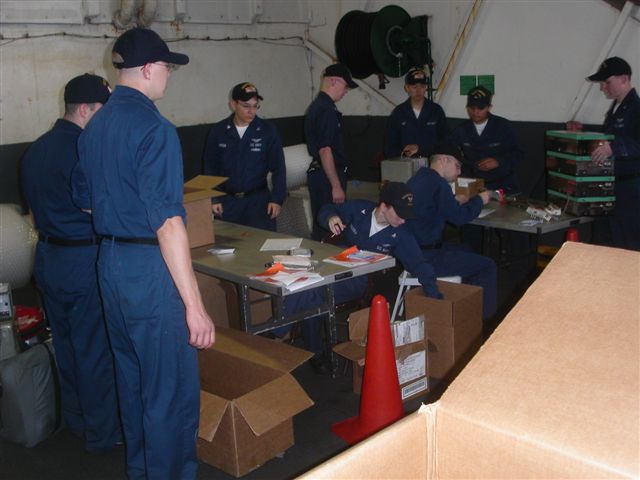
“During the off-load in San Diego, Chief Beck saw that the flow of equipment coming off the ship was not very smooth, so he organized and set up a packing station so as equipment was gathered together. It was sorted, documented, and packed like an assembly line and it really worked out well,” said Fennimore.
Chief Beck said this gave the Sailors a goal.
“They knew what they were supposed to do and how to do it. It was not a case of just bring stuff off the ship and wait until you’re told to do something else,” he said.
According to the team, the packing station proved its worth. In Bremerton, there was no space on shore to stage the offloaded equipment so organization was critical. It came off the ship, was loaded directly on a truck and that shipment left the base on its way to its final destination.
The USS Kitty Hawk (CV-63), the Navy’s last conventionally powered aircraft carrier, was forward deployed to the port of Yokosuka, Japan. Commissioned on April 29, 1961, the Kitty Hawk served the Navy for 48 years and departed Yokosuka for the last time on May 28, 2008. The Kitty Hawk will decommission later this spring when the USS George H.W. Bush is expected to deliver.
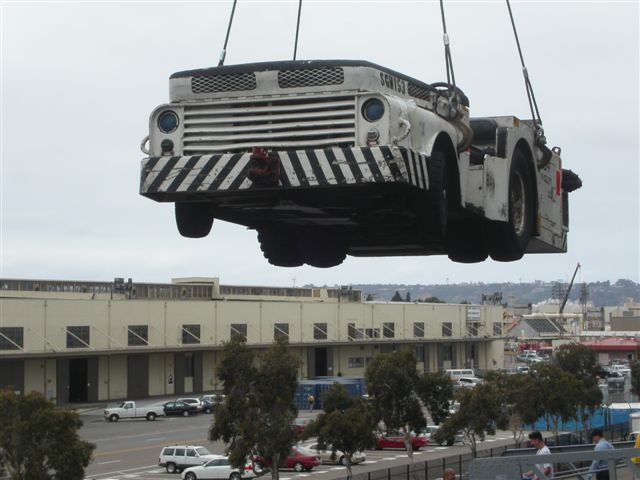
Photo: “The first aircraft tow tractor is offloaded from the USS Kitty Hawk in San Diego, Calif., during the first decommissioning port visit.” U.S. Navy photo.
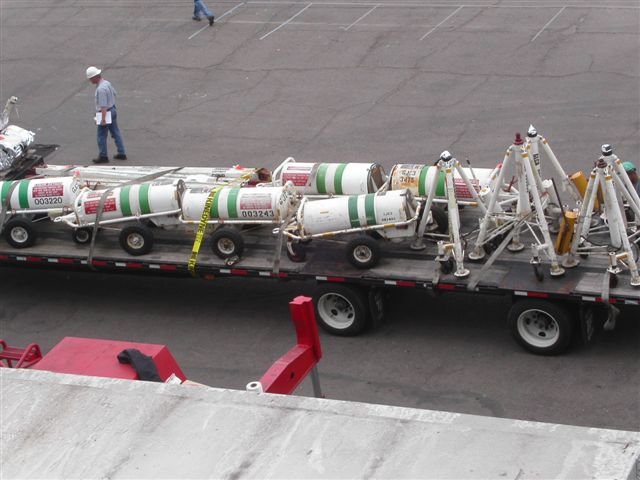
Photo: “Aircraft jacks and oxygen servicing carts from the USS Kitty Hawk loaded on a trailer ready for delivery during the first decommissioning port visit in San Diego, Calif.” U.S. Navy photo.
Photo: “Sailors working at the aviation support equipment packing stations on-board the USS Kitty Hawk preparing the carrier for its decommissioning.” U.S. Navy photo.