Plan for service-disabled vets presented at 2007 NAVAIR Small Business Conference
Plan for service-disabled vets presented at 2007 NAVAIR Small Business Conference
The Naval Air Systems Command unveiled a plan to help service-disabled veterans do business with NAVAIR as prime contractors and subcontractors Nov. 8 during the 2007 NAVAIR Small Business Aviation Technology Conference in Solomons, Md.
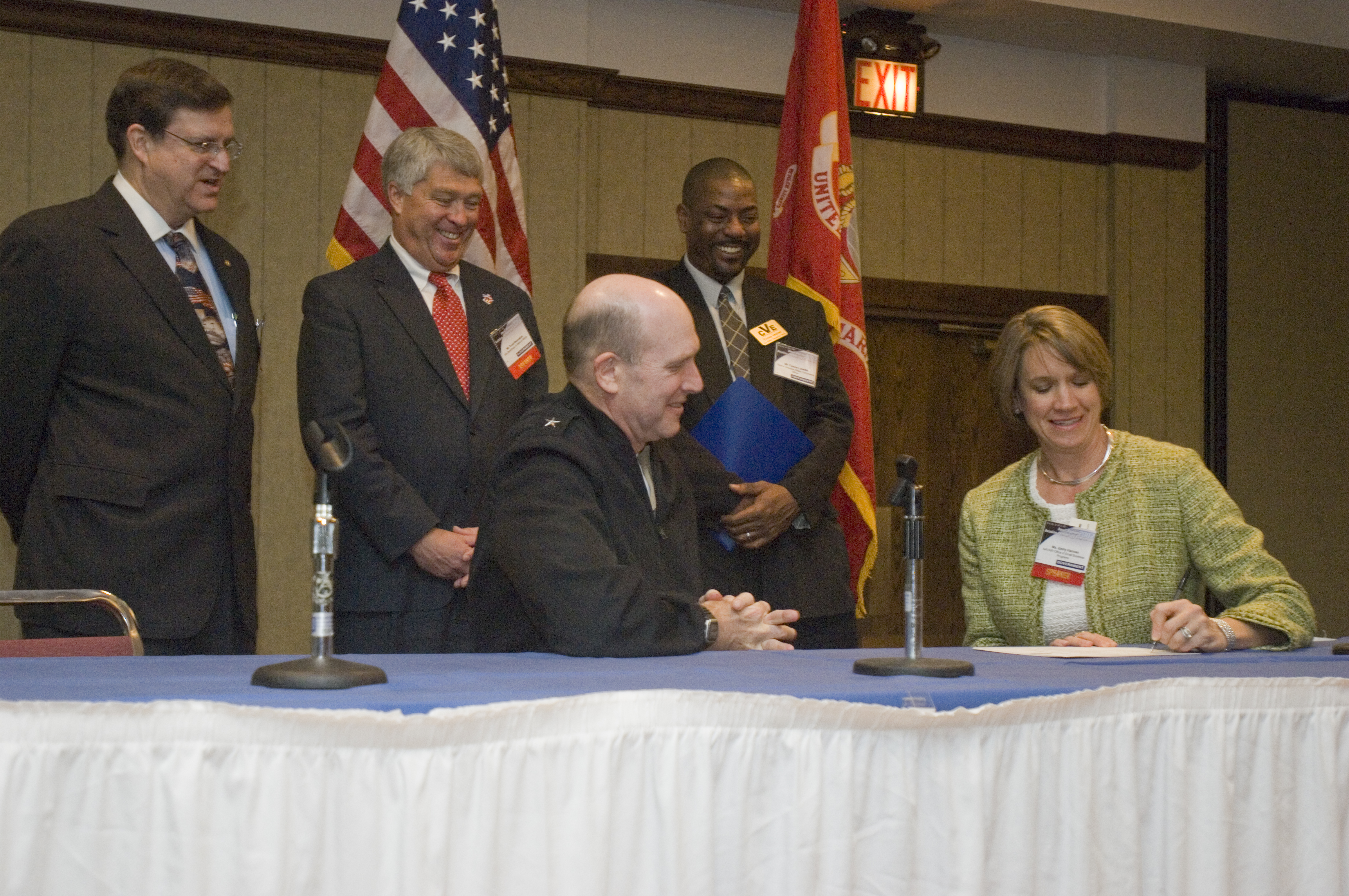
The plan, signed by NAVAIR Vice Commander Rear Adm. William Shannon and Emily Harman, director of the Office of Small Business Programs, documents NAVAIR’s commitment to service-disabled vets.
During the signing ceremony Timothy Foreman, director of the Navy Office of Small Business Programs formally presented the plan to Scott Denniston, director of the Veterans Affairs Office of Small and Disadvantaged Business Utilization.
Denniston said his office has “people in every agency” in the government and a “corporate desk” to help vets looking to do business with prime contractors.
“We have a memorandum of understanding with SAIC and one coming up with BAE on outreach to help service-disabled vets,” he noted.
Denniston also heads the Center for Veterans Enterprise, which lists opportunities for veteran-owned businesses in the form of trending data posted on its “Vet Biz” Web site, “All trends are going up,” he told conference participants.
The two-day conference, which attracted some 300 industry members and 100 government representatives, met its objectives, Harman said. “I’ve had several emails praising it. One person told me, ‘I’ve been doing business with the government since 1986 and this was the best such conference I’ve ever attended’.”
Business representative Ravi Raman, of Intelligent Automation, Inc. agreed. He said he was “very excited” about the opportunities available at the conference. His company has done $8 million in research work for NAVAIR, and he was meeting with officials to discuss moving his technologies into the fleet.
“We have a lot of innovations that we want to transition from prototype to program,” he said.
A prime objective of the conference was to help industry make those sorts of transitions, Harman said. “We want them to understand what NAVAIR buys, what we need, how best to approach NAVAIR and where they fit in,” Harman said.
The conference organizers took a two-pronged approach educating small businesses about NAVAIR. Speakers at the morning plenary sessions presented the big picture of NAVAIR organizational structure and function. “The speakers used consistent organization charts to make it easier for contractors to understand the NAVAIR organization and identify where they fit in,” Harman said.
“We took the organization chart approach on purpose,” said Janet McGovern, Program Manager, NAVAIR Small Business Innovative Research (SBIR), which co-sponsored the conference with Harman’s Office of Small Business Programs. “A lot of people get confused,” she said. “But if you’re going to sell to NAVAIR, it’s important to know who you’re selling to.”
“Pay a lot of attention to our priorities,” Rear Adm. Steven Eastburg told conference participants. “What’s really important to us is science and technology.”
Following the plenary overview sessions, the organizers scheduled smaller breakout sessions and one-on-one meetings with program managers and prime contractors to fill in the details of specific contracting opportunities and strategies.
“All of NAVAIR was represented in the breakout sessions,” McGovern said, “department heads, and all PEOs and competencies, along with prime contractors Lockeheed Martin, Raytheon, Bell, BAE and Wyle Laboratories.”
An attendee whose once-small business was now mentoring several smaller firms said, “There’s more information here than I’ve ever seen. You get to talk directly to the program managers and they’re clearly laying out their requirements.”
Rear Adm. Shannon illustrated Naval Aviation’s primary challenge with a slide of a tiny aircraft carrier superimposed on a far larger land airfield. “Our challenges are at sea, day and night,” he said.
Specific challenges facing the current fleet, he said, are maintaining a global presence, aging equipment, and utilization rates that are much higher than originally planned.
For the future fleet, confronting the “the age-old challenge” of delivery on time and at original cost is “objective number one,” he said. Objective number two is “maximizing the return on science and technology.”
Small business reps were eager to help do that. “I’m very excited,” said Raman of Intelligent Automation. His company makes air traffic control simulation systems and non-destructive testing equipment.
“It’s my first visit,” he said. “It’s been very helpful.”
The need for responsibility and initiative from small businesses themselves was a recurrent theme during the conference.
“Nothing is a gift,” said Skip Jones of Disk Enterprise Solutions. “The doors are open to potential partnerships if you’re interested.”
Upbeat appraisals were common from government officials speaking at the conference, and small business representatives appeared to agree. “The feedback I’ve gotten from companies has been extremely positive,” McGovern said.
Presentations made at the conference will be posted soon at
www.navair.navy.mil/osbp/atc
For further information contact:
NAVAIR Office of Small Business Programs
(301)757-9083
www.navair.navy.mil/osbp
NAVAIR Office of Small Business Innovative Research
(301) 342-0215
www.navair.navy.mil/sbir
Cutline: NAVAIR Officials sign Strategic Plan for Service Disabled Veteran Owned Small Businesses.
Seated. (L-R) RDML William Shannon, NAVAIR Vice-commander; Emily Harman, Director, NAVAIR Office of Small Business Programs
Standing (L-R)
Timothy Foreman, Navy Director, Office of Small Business Programs; Scott Denniston, Veterans Affairs Director, Office of Small and Disadvantaged Business Utilization;
Tyrone Lassiter, Veterans Affairs Executive Order 13360 Compliance Officer