FRCSW wins Closing the Circle Award
Cutline:
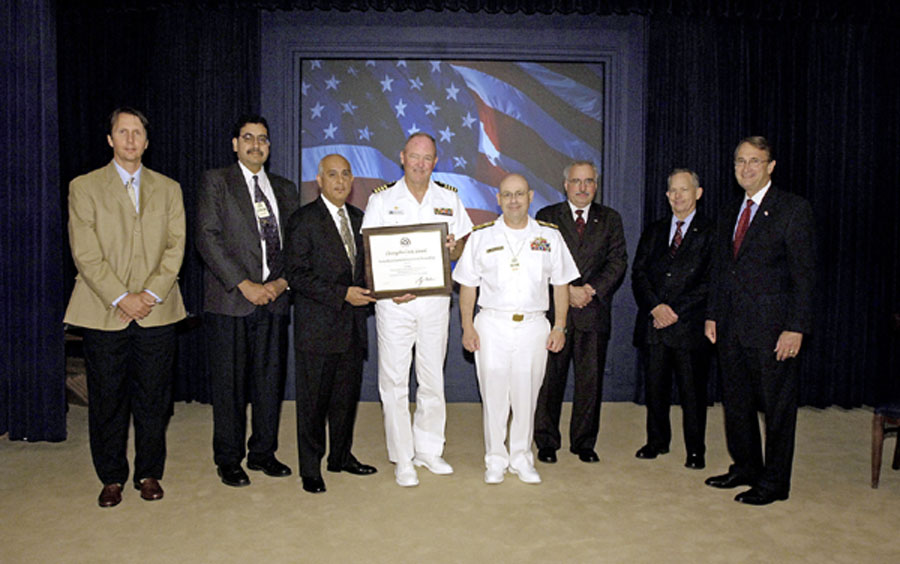
Fleet Readiness Center Southwest (FRCSW) Commanding Officer Capt. Fred Cleveland holds the Closing the Circle Award and is joined by Commander, Fleet Readiness Centers Rear Adm. Michel Hardee. FRCSW attending staff (from left) is environmental engineer Raymond Paulson, environmental planning and Compliance Office Supervisor Bob Espinosa and Environmental Engineer Industrial Operations Compliance Department Director Jose Jimenez. Award presenters (from right) are Deputy Assistant Secretary of the Navy (Installations and Facilities) Mr. Wayne Arny, Assistant Deputy Undersecretary of Defense (Installations) Mr. John Williams, and Federal Environmental Executive Ed Piñero. Photo by Robert Turtil
White House Award Honors FRCSW Environmental Efforts
By Raymond Paulson
FRCSW Environmental Protection Office
In a White House ceremony June 12, Fleet Readiness Center Southwest (FRCSW) earned the applause of the Office of the Federal Environmental Executive as the command received the 2007 White House Closing the Circle Award for its environmental accomplishments.
The Closing the Circle awards recognize the efforts of federal facilities which generate significant contributions or accomplishments in environmental stewardship.
FRCSW was one of 17 winners from a field of nearly 200 nominations covering a myriad of environmental issues including Environmental Management System, energy conservation, green procurement, pollution prevention, and recycling. The award category presented to FRCSW was for EMS at a Department of Defense (DoD) facility. The command was specifically cited for “continuous environmental improvement for sustainability.”
FRCSW was the first federal facility to register to the International Organization for Standardization (ISO). ISO 14000 promotes the development and implementation of international standards for products and environmental management issues. ISO 14000 is a series of voluntary standards in the environmental field.
The “Plan, Do, Check, Act” principles of the ISO 14001 EMS creates strategic business units which evaluate and identify environmental impacts in the context of the unit’s objectives. In turn, their findings are reviewed by an Environmental Improvement Team (EIT) comprised of subject matter experts who forward their recommendations to the Environmental Program Office (EPO) and upper management for budgetary decisions. Project plans are stored in a shared database and made available to all departments involved. The EPO also uses the EIT as a process action team to identify and address pollution prevention initiatives.
To achieve the desired environmental improvement goals, FRCSW used the EMS approach, “Zero Discharge” Pollution Prevention focus categories for sustainability which are applicable to any process, equipment, building, governmental or commercial organization. These categories may be applied to any Life Cycle Assessment stage (cradle to grave) for various projects including materials acquisition, manufacturing, in-use, reuse and treatment, recycling and disposal.
FRCSW’s environmental program merges energy conservation with pollution prevention measures in an effort to maximize energy conservation and renewable energy use while reducing pollution. Those initiatives include using existing monies for “green procurement” (environmentally-friendly products) for office and industrial supplies where feasible; recycling to reduce costs; adapting ISO 14001 concepts; and reviewing all solutions with an EIT. The goal is zero discharge for all pollution.
“Being proactive is the key to our successful environmental program. The strategic location of FRCSW means our industrial processes are collocated with the five-star resort community of Coronado. We plan well in advance to deploy the best processes and technology to safeguard the environment. It’s good business, and for me it’s also personal – my family lives right outside the gate,” said FRCSW Commanding Officer Capt. Fred Cleveland.
Between 2003 and 2006, the FRCSW Environmental Protection Office implemented $6.19 million worth of energy and pollution prevention projects generating an annual savings of $1.19 million. FRCSW received energy grants to fund those projects.
FRCSW participates in the Environmental Protection Agency’s (EPA) performance track program which provides goals for annual reductions in containerized waste, industrial waste, hazardous air pollutants, energy use, and increases in solid waste recycling. To date, all EPA performance track goals have been met or exceeded.