
Composite repair partnership with fleet growing
COMP5 CUTLINE
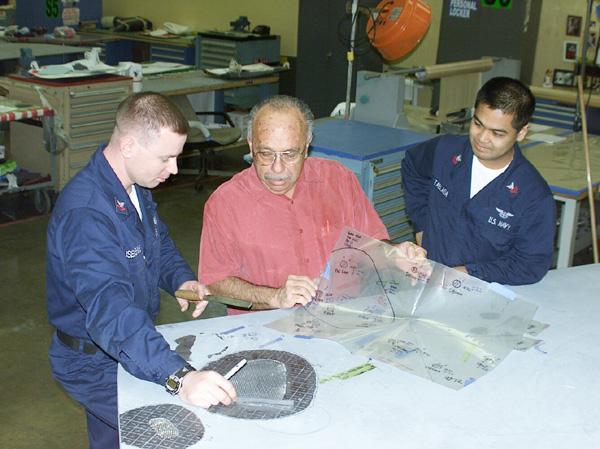
AM1 Christopher Busenlehner (left) and composite work leader John Ruiz discuss a repair made to the wing of a damaged F/A-18 as AM1 Manual Tablada looks on. Joe Feliciano
COMPOSITE REPAIR PARTNERSHIP WITH FLEET GROWING
By Jim Markle
AM1 Christopher Busenlehner and AM1 Manuel Tablada, two Sailors from USS Nimitz (CVN 68), recently spent two weeks with the artisans of Fleet Readiness Center Southwest’s (FRCSW) Composite Repair Program gaining valuable insight into the mechanics of their trade.
“This experience takes us to a higher level than what we actually deal with in the fleet, which is primarily small dings and scratches on the aircraft,” said Busenlehner.
Honing the skills of aviation mechanics (AM) is the latest move by the Composite Program to improve immediate services and repairs to fleet aircraft. The informal, on-the-job training is possible because aviation maintenance workload onboard moored ships is typically lower than when deployed.
“This is an irregular thing which we hope to become more of a regular thing,” said LCDR Cristal Caler, FRCSW Components Program Maintenance Officer. “Because we have them here on the waterfront, we’d like to increase our time together. We’ve learned that when we had artisans in the field working with the sailors, the sailors’ skills greatly increased. And that’s what we want to do with the sailors here in port as it’s a great opportunity for them.”
Through their apprentice and journeyman schools, Sailors learn the essentials of composite repair. Caler said FRCSW’s goal is not to serve as a training command, but to provide a higher level of exposure to the field than what is offered in a classroom.
“It’s not formal training. We’re providing in-depth composite exposure for the Sailors involved with composite repair,” added Jim Compagnon, Composite Production Supervisor.
“What we’re doing is to enhance their skill,” said Caler. “They may not take what they’ve done here out in the field because the specific chemicals or tools are not available. But they will have gone through different trouble-shooting skills with the artisans and they may use those skills in a different way to repair something they should be able to repair, but just didn’t know they could. You can’t get the experience that this shop has to offer from a school,” she said.
AMs in the fleet follow the Standard Repair Manual which limits their repair capabilities according to object size and type of repair. When repairs exceed the manual’s limits, are too complicated or cannot be done locally for any other reason, a Rapid Repair Request is generated and the damaged part is sent to an FRC for repair.
“Some work we get here is a result of inadvertent damage that occurred in the fleet. Using a woven cloth to repair a damaged F/A-18 wing as opposed to the 6-ply graphite-based pre-preg would be an example of what we might see,” explained John Ruiz, FRCSW composite work leader.
But by exposing fleet AMs to the experience and knowledge of FRCSW artisans, the Sailors’ knowledge base increases reducing the number of repair requests.
“Because of our time and the hands-on instruction here, we will become more comfortable with what we’re doing in terms of repairing and getting things done in the fleet. That’s a real potential to save the fleet some money,” commented Tablada.
According to Compagnon, maintaining a mentor-type relationship between the Sailor and artisan is a goal of the Composite Program. “After they leave here and return to the fleet we want to make sure there’s nothing to prevent them from contacting the artisan for help on a problem they may encounter out there,” he said.
“And building not just a relationship with the individual Sailors, but with their command, as well, is something we think is beneficial,” Caler noted. “We actually have a very good relationship with the ships already. But we’d like to expand on that and want them to feel comfortable coming to us with other issues -- maybe not composite, but metal bending, or avionics, for example.”