JATO Team Plays Major Role in Counter Terror Success
Released by Naval Air Warfare Center Weapons Division, China Lake, Calif. Public Affairs Office --
The NAVAIR Jamming Techniques Optimization (JATO) Team at Point Mugu recently received high recognition for their stellar performance providing real-time support for the global war on terror, by maximizing the effectiveness of the EA-6B’s Electronic Attack (EA), an offensive electronic jamming capability that protects our troops and allies in the battlespace.
The JATO team earned the Marine Corps’ annual “Semper Fi” award for fielding an essential new jamming capability for the Marine Corps (EA-6B ALQ-99 TJS Band 2E/4L) in record time.
The Semper Fi award states, “The JATO team designed, developed, tested, and fielded a unique and extremely critical electronic warfare capability that had an immediate and powerful impact on both the tactical situation on the ground and the overall strategic condition of the global war on terror.”
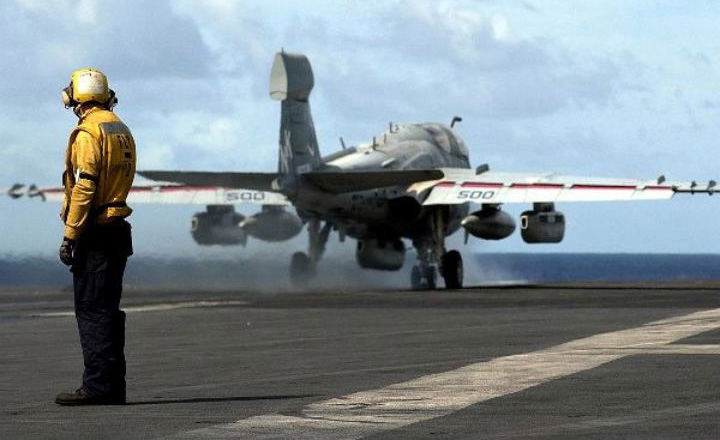
The EA-6B EA platform, the Prowler, supports our forces across the battle space. The system is ultimately designed for precision targeting, jamming, and destruction of enemy land-based, shipborne, and airborne command, control and communications (C3), and radars associated with early warning, target acquisition surveillance, anti-aircraft artillery, air-to-surface, surface-to-surface, and surface-to-air missiles. In this capacity, the Prowler supports both carrier-based tactical aircraft strike group operations, and joint forces, in dense radar controlled environments.
Although the JATO team works essentially behind the scenes, their impact is often both immediate and direct. The Point Mugu team was responsible for field-testing the effectiveness of the new jamming system. In fact, all of the jamming strategy techniques that exist on the Prowler originate at Point Mugu. Additionally, inputs from the Point Mugu team are reflected in the mission planning databases of the Prowler.
Jeff Anderson is the JATO Integrated Product Team Level III Deputy at NAVAIR Point Mugu, said he and members of his team are constantly on call since the terror threat can change daily. “We have to be ready to meet the challenge,” he said. “Our newest modification was done quickly because the support is in place across the country to make it happen, and because the expertise is there to make it work.”
“This new capability will save lives, no doubt about it,” said Anderson. “And it only took from June 14 to Sept. 19, 2005 to take the new capability concept through design, development, test and evaluation, and introduce it to the Fleet.”
The JATO team brings years of hands-on expertise to get the job done. “In the Operator’s Advisory Group (where the Fleet decides on their most important requirements), JATO is consistently ranked in the top five programs in importance,” said Jose Tristan, NAVAIR Weapons Division JATO lead for the test phase.
Although busy around the clock supporting EA-6B EA, the JATO team is also working toward the future. They are actively transitioning the electronic jamming mission to an F/A-18 platform, the EA-18G, or Growler.
Anderson said, “My work is important to me. I am driven to support the War on Terror. What we do directly saves lives, without a doubt.” Moreover, for the Fleet, the new jamming technique was developed and implemented rapidly and the positive impact was immediate. The Semper Fi award further acknowledged the team’s results. A group of highly-skilled Marines, Sailors, engineers, civilian contractors, and civil ser employees performed the tasks of identifying various requirements and modifying existing technology to match the continually evolving enemy threat. Navy and Marine Corps squadrons fielded the new capabilities in only a few weeks — an unprecedented feat when compared to the years it has historically taken to field similar capabilities. The immediate consequence of the systems fielded by the JATO team no doubt saved the lives of many American service members and Iraqi and Afghan citizens.”
########
PHOTO CUTLINE: JATO Aircraft carrier takoff.
PHOTO CREDIT: U.S. Navy photo