New arresting system operational while saving $2.4 million
October 10, 2006: LAKEHURST, NJ – The development of the M31 Marine Corps Expeditionary Arresting Gear System (MCEAG) is a resounding success story for the Expeditionary Airfield (EAF) program of the United States Marine Corps. The program pooled the talents of both Naval Air Systems Command (NAVAIR) and Industry engineers to provide the Marines with a state of the art mobile arresting gear system that provides excellent performance at an affordable cost.
The M31 MCEAG program used the Integrated Product Team (IPT) management approach to combine the expertise of the engineers, along with the operational experience of the Marines with existing systems to design and create the new arresting gear system. Marine representatives had hands-on involvement from the start of the program through the delivery of the final of the twenty-eight (28) systems on 15 June 2006.
The full M31 IPT included personnel from NAVAIR PMA 251, NAVAIR Lakehurst, Engineered Arresting Systems Corporation (ESCO), M&T Company, NDI Company and the Marines. The initial lead design responsibilities for specific portions of the system were divided between NAVAIR and Industry team members, but all final decisions required the approval of the entire team. The team established targets for performance, system weight and manufacturing cost.
Once the Preliminary Design Review was completed, the detail design phase began and was followed by the Critical Design Review (CDR) held at Lakehurst, where senior NAVAIR leaders carefully reviewed the details of the entire system design. The resulting system consists of two trailers, each containing an energy absorber, that when staked into position on each side of a suitable landing area, and connected by an arresting cable can safely arrest Navy and Marine Corps tactical aircraft. Each trailer contains an independent power source and all required tools and anchoring equipment to allow installation in a variety of locations. Additionally, the system is required to meet strict environmental and mobility requirements.
Following extensive testing, which included over 500 arrestments, full environmental tests and a 1,500-mile road test, a Production Contract Award was given in April 2001. With this production go-ahead, the Marines attained an Initial Operational Capability (IOC) in April 2003 at Marine Corps Air Station (MCAS) Beaufort, SC.
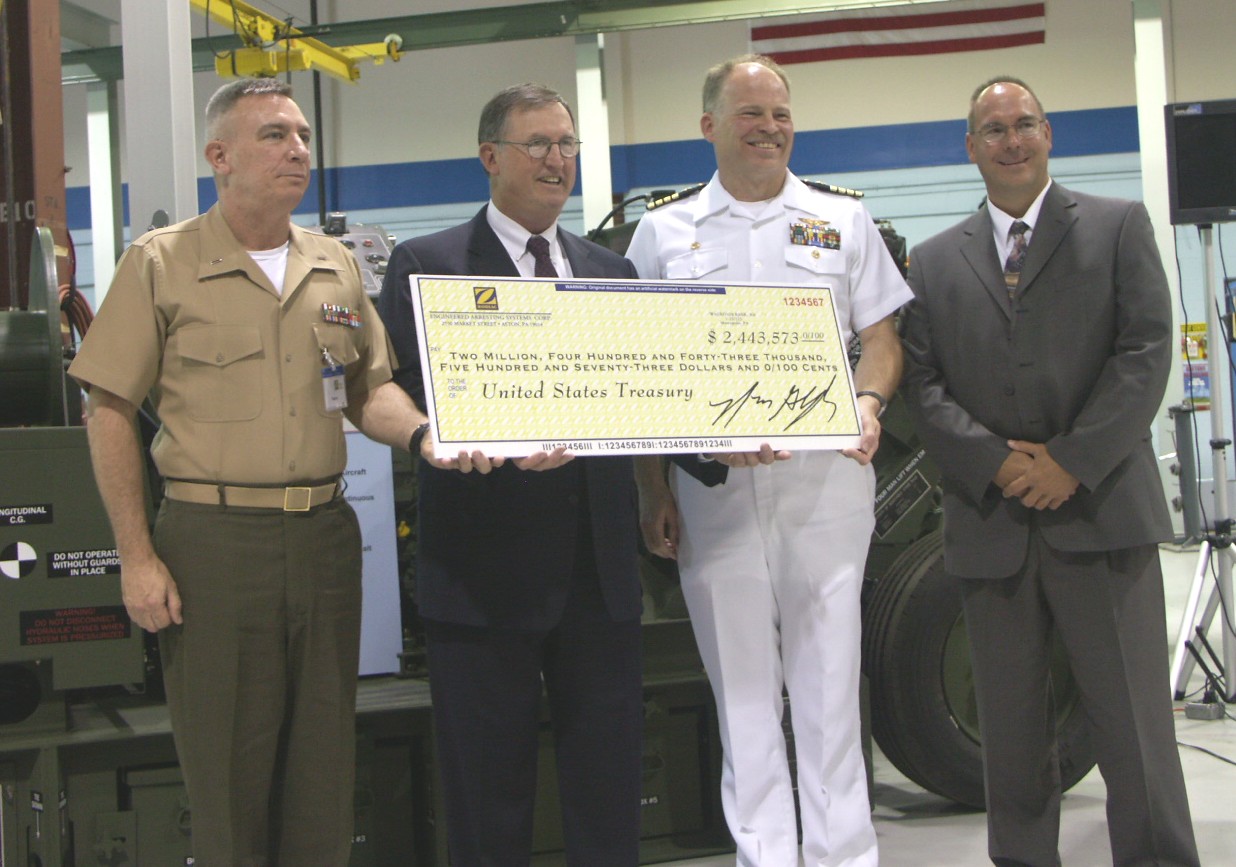
After successful completion of all qualification tests, ESCO was cleared to manufacture twenty-six (26) full rate production M31 Systems, over a four (4) year period. When the last system was delivered, and achievement of Full Operational Capability (FOC) announced, ESCO President Spencer Hoos presented a check back to the government in the amount of $2,443,573 for under run costs.
The check was presented to CWO5 Mike Cernoch, Headquarters, Marine Corps; Captain Stephen Rorke, PMA 251; and Mr. Paul Reiff, NAVAIR Lakehurst Team Leader.
M31 Systems are now deployed at Marine Facilities around the world and the system has performed exceptionally well in service at Al Asad Air Base, Iraq.
The IPT continues to provide support to the M31 MCEAGS and ESCO operates a web-based supply system that insures the Marines receive prompt delivery of spare parts. Technical data is maintained and updated periodically and advanced training is provided to Marine operators.
Caption:
Ceremonial check is passed: (left to right) CWO5 Mike Cernoch, USMC, looks on as Spencer Hoos, Engineered Arresting Systems Corporation president, presents "large check" to him, CAPT Steven Rorke, USN, PMA 251 and Paul Reiff, NAVAIR Lakehurst Team Leader.