First combat Hornet returned to service
Famous Hornet 1
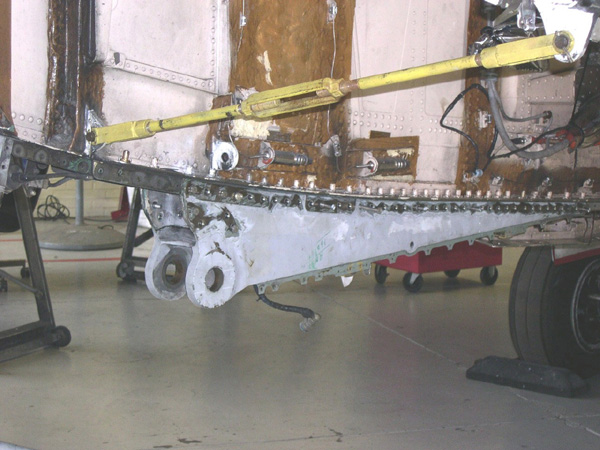
The aft keel assembly shows ground damage to the tail hook housing. Courtesy photo
Famous Hornet 3
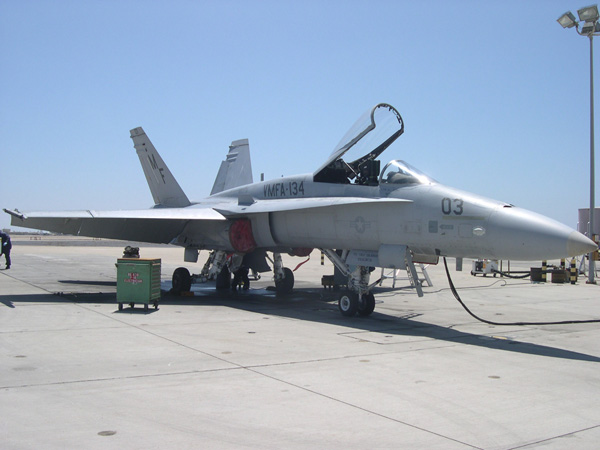
The damaged Hornet now looks like new and is back in the fleet. Courtesy photo
FIRST COMBAT HORNET RETURNED TO SERVICE
By Bill Bartkus
NAVAIR Depot North Island
A 21-year-old F/A-18A Hornet with a significant past – once destined for an early retirement due to a landing mishap – was returned to fleet service thanks to the ingenuity and skill of NAVAIR Depot North Island engineers and artisans. This aircraft is historically significant because it was among the first F/A-18’s ever to see combat operations.
“RO-55/Buno 162417” as the aircraft was known to NAVAIR Depot North Island employees – completed in service repairs on Aug. 23 and was delivered to the Marines and Sailors of Marine Fighter Attack Training Squadron 101 (VMFAT-10) at Marine Corps Air Station Miramar by Depot Chief Test Pilot CDR John Mawhinney.
In April 1986, in response to state sponsored terrorism and an attack on U.S. servicemen in Berlin, West Germany – President Ronald Reagan ordered a retaliatory strike against Libya. U.S. Navy 6th Fleet units responded to the task and among the Navy and Marine Corps aircraft destined to participate on the raid was an F/A-18A Hornet - 162417 side model number “407”. This aircraft was assigned to the “Death-rattlers” of VMFA-323 with Carrier Air Wing 13 aboard USS Coral Sea (CV 43). In the late night darkness of April 15, 1986, Coral Sea launched her strike aircraft including “407” and shortly after midnight she fired two AGM-88 HARM missiles at Libyan air defense radar sites in support of A-6E Intruder aircraft attacking other targets.
Last year the historical tactical fighter – now assigned to VMFAT-101 was involved in a landing mishap while deployed to Poland. “The aircraft landed gear-up and sustained damage to the center keel section of the airframe,” stated Dave Kelly, F/A-18 In-Service Repair Program Manager.
“Commander Naval Air Forces (CNAF) was seriously considering striking the aircraft as beyond economical repair and then asked the Depot to evaluate it to determine the extent of the damage and how much and how long any potential repair would take,” he said.
An Air Force C-5 Galaxy flew the aircraft to the Depot where engineering examined and evaluated the damage. “We really wanted to take a detailed look at the airplane because from photos it didn’t appear that the damage was all that severe,” said Kelly. “Once we disassembled and evaluated the damage, we came to the conclusion that we could repair her at relatively low cost. All we needed to do was to convince the command with the money – namely CNAF – that repairing the airplane was a worthy endeavor,” he said.
“Depot engineers put together a repair scenario and CNAF agreed to the plan. When the aircraft arrived at the Depot late last year, the Depot put together a Rough Order of Magnitude (ROM), funding was received in February (2006), and work started as soon as the fighter was inducted in April,” stated Kelly.
Charlie Niergarth, ISR Program supervisor, said that although on the surface, repairing the aircraft did not look exceedingly difficult once work began our ability to repair this aircraft was initially questionable.
“After looking at the damage and assessing the parts that were required to fix this airplane, we were extremely fortunate that the Depot had three stricken aircraft from which we could cannibalize parts from. If we had to procure new parts for this aircraft, the cost and long lead times would have been prohibitive,” he said.
“We repaired one damaged engine bay access door through an Engineering 3R (Rapid Reply Request); however, another engine bay access door was completely demolished and had to be replaced. Fortunately, we located a salvaged door and my ISR artisans were able to make it fit perfectly,” Niergarth said.
He said that our Depot planning and estimating department estimated that the work would take 4,000 hours. “We completed the job and got the aircraft up and flying in 3,600 hours, but more importantly we were able to do it in only 100 days after induction.” said Niergarth. “The aircraft also flew very well on its first flight which was a plus and quite an exciting event for the team.”
Kelly summarized the effort in an email to CNAF. “She (162417) has a new lease on life and will continue to serve the fleet as a training aircraft up at VMFAT-101 and will be tossed about by fledgling aviators who know not of her combat history and who were only children that fateful night in 1986. I am personally gratified as a member of this command, that we took the initiative and effort to return her to fleet service vice allowing her to meet an ambiguous and impersonal end, that of being struck and cut up as scrap metal as many F/A-18 A’s have already been or soon will be,” he said.
“Today, she continues to serve as she did that night…although maybe just a little older but perhaps just a bit more proud as well.”
Kelly has fond memories of “407”. He was a young Marine Corps First Lieutenant assigned to Marine Fighter Attack Squadron 323 (VMFA 323) aboard Coral Sea on that fateful night in April 1986.