
Wasting energy is a waste of dollar$
Energy cutline
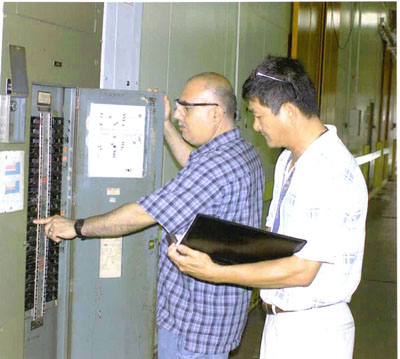
Carlos Alarid shows Kham Thai the panel of light switches in Building 472 that Alarid shuts off at the end of the day. Joe Feliciano
WASTING ENERGY IS A WASTE OF DOLLAR$
Bill Bartkus
NAVAIR Depot North Island
NAS NORTH ISLAND – Would you leave on the lights in all of the rooms in your homes when they’re not needed? Of course not! This is obviously a waste of your precious dollars. For many of us, our electric bills are high enough as it is. So why leave the lights in and around your workstations on when you leave for the day? I am sure the reasons are many, i.e. we forget. But another reason that is also lurking in the back of our minds is that we do not think that we have to pay the electric bill so we just do not give such things much attention. But the fact of the matter is that you do in fact ultimately help pay the bill by way of the taxes you pay!
If this isn’t incentive enough to urge you to conserve energy, think about the next time Southern California experiences another hot or cold spell, when the demand on the energy grid that supplies our region is pushed to its limits. This past June and July, no one argued that California experienced an unusual hot spell – the temperatures were sweltering – and sadly, some people in our community did lose power.
So what does this have to do with conserving energy at your place of work?
If you think about it, NAVAIR Depot North Island is on the same regional “energy grid” that powers the rest of the community. Whatever energy can be saved through everyone’s combined efforts – whether it’s making sure you turn off your computer when you leave for the day, or securing a workstation at the end of a shift – makes that amount of saved energy available elsewhere and at home where it is much appreciated or needed.
So what about the Depot? Would we likely be one of the businesses that lose power if blackouts were to occur?
“No, the Depot most likely would not lose power due to rolling blackouts,” said Lucia Sapien, an environmental engineer in the Depot’s Industrial Operations Compliance Department. “The Department of the Navy is on the top of the list for energy security along with hospitals and emergency services, but it is not impossible. But again, the fact that we do not directly pay for the energy we use, or the fact that our industrial energy supplies are relatively secure, is not a reason to rest on our laurels. If nothing else, energy conservation is simply smart business.”
Employees often complain to the Energy Management Team that when they arrive at work early in the morning – even on weekends and holidays – they see a building “lit up like a Christmas tree”, when they ultimately investigate by going inside. Often, the building turns out to be empty. This is unfortunately an all too common occurrence around the Depot. Employees all too often frequently leave overhead and workstation lights on as well as computers, monitors, and fans. A waste of both energy and money.
Building 472 is a very large building and uses a considerable amount of energy. Employees working there have been very energy conscious and have been putting their best foot forward to cut down on wasted energy.
David Hess is a second shift supervisor in the building. Sapien noted that he is one of the most energy-conscious employees on the second shift. “At the end of his assigned shift, he routinely walks around the entire building to secure any equipment unnecessarily left on. Then before going home, he will even email the offending shop or responsible person letting them know that certain pieces of energy draining was left on,” Sapien said.
Hess said that he regularly sends emails to his day shift counterparts, urging them to conserve energy. As a result, “the Manufacturing Machine Shop has managed to maintain 100 percent compliance by turning off lights and fans at the end of their shift,” he said. “Other shops are getting better as well.”
Sapien and Hess give special kudos to Janet Sanchez and her crew for their efforts in conserving energy in Building 472. In fact, Hess feels that Sanchez sets the example for the entire building. When urgent notices from the Independent Service Operator (ISO) went out to businesses and to the community to conserve energy, Sanchez and her team took extra effort to efficiently shut down unnecessary equipment.
Her team still manages to meet the Depot’s production schedule without sacrificing their safety or workload.
Hess also credits Kham Thai, Sapien’s counterpart in the Environmental Office, with getting the lighting in Building 472 adjusted to reflect current requirements.
“We asked Kham to come to the shop and listen to what the artisans had to say. In less than five minutes, he heard what the shop needs were,” Hess said. “Since his first visit, the schedule adjustment has been forwarded to the appropriate organization for correction. With luck, we will get the building adjusted for all which will not only make the building more economical to operate but also safer.”
Hess, Sanchez, and Thai are driving home the need to conserve energy, save the command money, and make Building 472 a safer place to work. Simply put, the practice of good business on display.
Note: October is Energy Awareness Month. Let’s all make a conscientious effort to turn off lights, fans, computers and monitors, and whatever other equipment we don’t use when we go home for the day. Remember, we each can make a significant dent in our energy cost.