Upgraded Prowler transforming warfare
By Chuck Wagner
PEO Tactical Aircraft public affairs
With Advanced Capabilities III upgrades, the Navy’s EA-6B Prowler is transforming the traditional combat role for electronic warfare aircraft.
No longer is the Prowler predominantly a search-and-destroy weapon against enemy air defenses. The ICAP III Prowler has demonstrated on two recent squadron deployments that it can serve as a command-and-control node in the Navy’s quickly expanding universe of network-centric warfare. Perhaps most transformational is the Prowler’s new power to directly support troops on the ground by dominating a new sphere of unconventional warfare – the airwaves.
“We still fill the traditional role. That hasn’t changed, except that we can fill that role better than in the past,” said Capt. Kenneth Smolana, manager for the Navy’s EA-6B program (PMA 234) at Naval Air Station Patuxent River, Md. “But there is a huge paradigm shift away from simply controlling air defenses. We can now support troops on the ground by better providing radio frequency domination.”
Dominating these bandwidths – with what Smolana calls “information supremacy” - provides an inestimable advantage to U.S. and friendly ground troops. Information supremacy determines whose forces can communicate using electronic technology and which must fight on mute. The latter can be crippling in modern combat where command decisions can be calculated in seconds.
The first squadron to deploy with ICAP III, VAQ 139 of Whidbey Island, Wash., returned this month from a tour aboard the USS Ronald Reagan. The second, VAQ-137, also of Whidbey Island, recently completed a deployment aboard the USS Enterprise. Both squadrons had dual basing aboard the carriers in the Persian Gulf and in AL Assad, Iraq. Between them, eight ICAP III Prowlers made an indelible impression on air and maintenance crews.
Aviators using the system are reporting that the ICAP III Prowler is capable of new missions, especially helping identify vessels around carrier groups - a mission defined as sea control. The new system can distinguish commercial from military vessels, and potentially its friend-or-foe status. The Prowler could previously play only a limited reconnaissance role.
“The accuracy of the geo-location has put us in the lead of the sea-control neutralization tactics and given us much better situational awareness on actual threats - assisting the E-2 (Hawkeye) in some cases,” said Cmdr. Charles Luttrell, VAQ-139 commanding officer.
The introduction of Link 16 and Blue Force Tracker in the Block II upgrade for ICAP III has effectively transformed the Prowler into a command-and-control platform not unlike the Navy’s E-2 and Air Forces’ AWACS aircraft. In some ways, the EA-6B ICAP III can provide better situational awareness than these traditional command-and-control aircraft. For instance, aircrew can overlay radar sensor data with the ALQ-218 electronic warfare sensor data, which provides a more intricate picture of the battlespace.
“The ICAP III Prowler can better protect and manage our resources. The increased situational awareness is a huge force multiplier,” said Smolana.
The Prowler’s traditional role in radar and communications jamming is also improved. ICAP III upgrade is centered on the ALQ-218 electronic receiver suite that allows the EA-6B to more effectively jam hostile radar and communication signals as well as detect and locate them.
The new system allows selective-reactive jamming, which means it can more effectively concentrate jamming power on multiple specific radar frequencies. Previous technologies worked by attempting to jam across larger bandwidths, which dispersed the aircraft's jamming power. ICAP III’s complex software algorithms can perform emitter geo-location and classification in a high-density electronic battlefield, which allows the Prowler's weapon systems to continue to scan and monitor radio frequencies during jamming operations.
The earlier receiver can only provide a "sector bearing" to the target emitter, which often is little more than a compass direction. Prowler aircrew can now confidently pinpoint the geo-location of any emission the new system detects, point and shoot.
So far, 10 of the Navy’s 111 Prowlers are upgraded with ICAP III. With additional upgrade kits on the way and the program’s intention to convert one test aircraft for fleet use, Smolana expects 15 ICAP III Prowlers to be available to the fleet by 2008.
“A majority of leadership may not fully appreciate what they have yet,” Smolana said. As word trickles back from recent deployments in theater, he expects leadership will more fully understand that ICAP III has not only improved electronic warfare, but that it has opened new and perhaps untapped warfare capabilities.
Those in the fleet who have witnessed the Prowler’s improved status already seem convinced.
As Luttrell humorously put it, “I hear daily comments on how thankful our aircrew are that we have the ICAP III . . . I think the biggest compliment in the world is the Junior Officers in VAQ-139 said they would give up their daily naps on the ship before they would give up ICAP III.”
As Naval Aviation moves forward to the next generation of electronic attack, the ALQ-218 will be the core of the EA-18G Growler’s electronic suite. The Growler integrates the ALQ-218, the ALQ-227 communications countermeasures set and other improvements into the F/A-18F Super Hornet airframe. The Navy will begin to retire the EA-6B Prowler in 2009, when the electronic attack mission will be performed from this new, more lethal platform.
“This success is part of our team’s continuing contribution to the Navy-wide goal of delivering the right force, with the right readiness, and at the right cost,” said Rear Adm. David Venlet, Program Executive Officer for Tactical Aircraft Programs. Venlet oversees the efforts of PMA 234. “You’ll see much more of this as the Naval Aviation Enterprise continues to streamline development and procurement of the systems we send forward to our fleet warfighters.”
The Naval Aviation Enterprise is a partnership among Naval leadership to optimize processes that maintain current readiness while investing in future readiness.
The enterprise concept focuses Naval aviation on the single fleet-driven metric of producing aircraft ready for tasking at reduced cost.
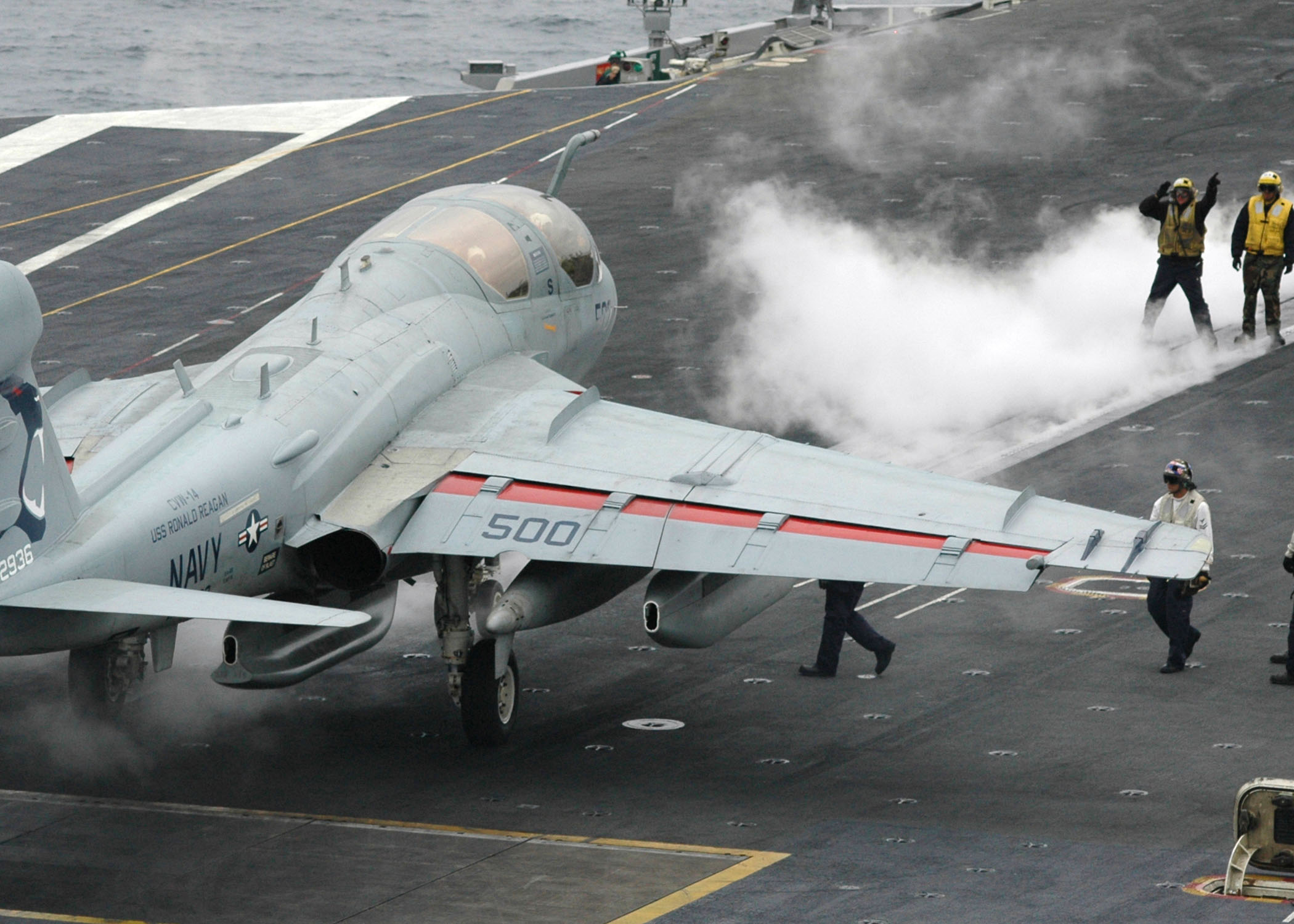
PHOTO CAPTION:
An EA-6B Prowler from the "Cougars" of Electronic Attack Squadron One Three Nine
(VAQ-139) is directed onto catapult number two in preparation for launch from the flight
deck of the USS Ronald Reagan (CVN 76).
The Cougars are the first EA-6B squadron to be outfitted with the Improved
Capability Version Three (ICAP III) computer system at sea.