NAWCWD Employees Participate in Michelson Celebration
NAWCWD employees participate in Michelson celebration
By Staci Mathews
NAWCWD Public Affairs
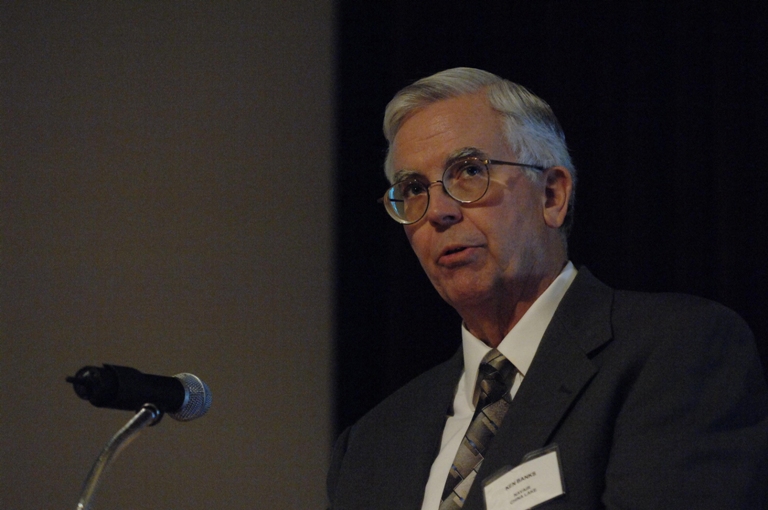
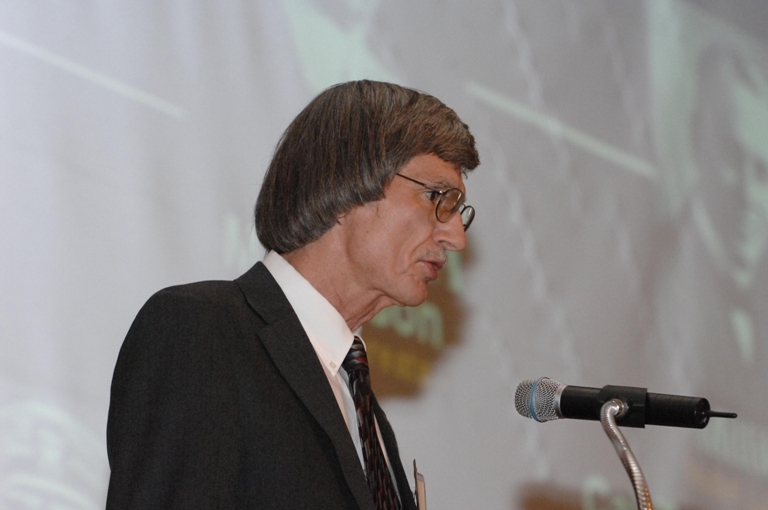
NAWCWD’s Dr. Bob Smith and Ken Banks of the Weapons and Energetics Department gave a presentation at the Centennial Symposium celebrating the 100th anniversary of Albert A. Michelson’s Nobel Prize. The symposium was held at the United States Naval Academy in Annapolis, Md., on Oct. 22, and was sponsored by the Office of Naval Research.
The Symposium featured lectures by prominent physicists and authors including Robert Wilson, Nobel Laureate credited with finding evidence that confirmed the big bang theory, Walter Isaacson, author of “Einstein, His Life and Universe,” and Lawrence Kraus, Chairman of the Physics Department at Case Western Reserve University and noted cosmology author. The presentation by Smith and Banks traced the relationship of Michelson to China Lake and the laboratory named in his honor, the significance of Michelson’s technical contributions to weapons and warfare, and an overview of China Lake, past, present and future.
“This was not your ordinary brief, it was more like a History Channel show,” Smith said.
Michelson grew up in the Gold Rush era and was the first American to win a Nobel Prize. He graduated from the Naval Academy, taught at the Naval Academy, and was the chairman of the physics department at the University of Chicago where he spent most of his career.
Michelson’s two primary connections to China Lake were through Robert Milliken, a long time associate of Michelson’s at the University of Chicago, and James Duncan, a physics instructor at the Naval Academy who had taken classes from Michelson.
Milliken left the University of Chicago to become the first unofficial president of California Institute of Technology. The WWII rocket program was developed at Cal Tech under the leadership of Dr. Lauritsen, who earned his doctorate under Milliken. The desire to expand the Cal Tech rocket program and encroachment issues at Cal Tech’s Eaton Canyon facility near Pasadena eventually lead to the establishment of the Naval Ordnance Test Station (NOTS) at China Lake.
Duncan left his teaching position at the Naval Academy in search of more challenging work directly related to the war. He become the first Laboratory Officer at NOTS, and is credited with suggesting that the new laboratory at China Lake be named for Albert Michelson.
“Michelson’s science and his experiments are important to our heritage at China Lake,” Banks said. “Modern weapons technology takes advantage of both the understanding of fundamental physics his experiments enabled and the measurement technology he pioneered.”
“We sent 200 light sticks each with a label reading ‘LIGHTING THE WAY, CHINA LAKE, TECHNOLOGY TRANSFER’ to the academy as advertising souvenirs,” Smith said. “The light sticks were part of a NAWCWD tabletop display set up in the lobby of the auditorium. The sign ‘Take One’ worked well, and the light sticks were gone in a heartbeat.”
The presentation was a team effort. Members included Mark Pahuta, video production specialist, Bill Stephenson, artwork, graphics and presentation technology, and Barry McDonald and Rose Thyne, script development and editing. Stephenson accompanied Smith and Banks to Annapolis to provide audio/visual support for the presentation. Many others also contributed to this unique effort. “They made us look good,” Smith said.
“The opportunity to give this presentation at the Naval Academy was rewarding and a wonderful experience,” Banks said. “The audience was made up primarily of midshipman, and they were very complimentary about the presentation.”
PHOTO CUTLINES
[one cutline for two photos of Dr. Bob Smith & Ken Banks]
Dr. Bob Smith and Ken Banks of the Weapons and Energetics Department trace the relationship of Albert A. Michelson to China Lake during a Centennial Symposium held at the United States Naval Academy celebrating the 100th anniversary of Michelson’s Nobel Prize.
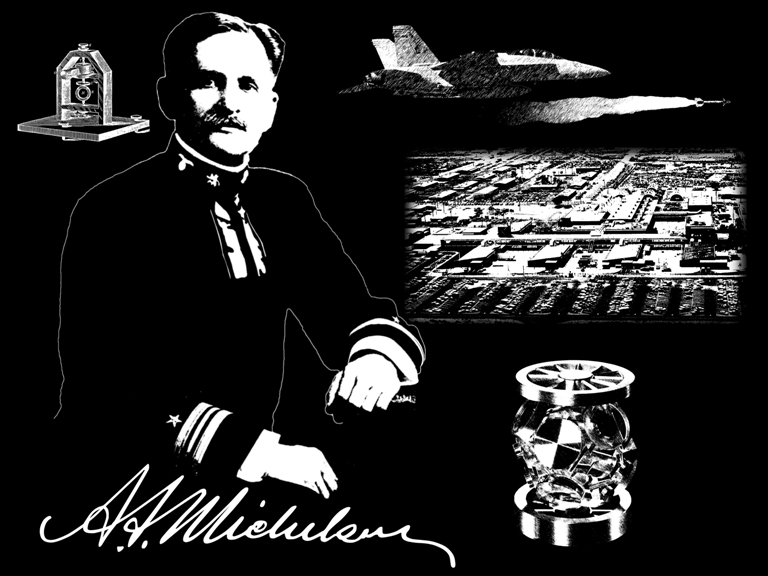
Photo 2: Michelson Montage
Photo Montage by Bill Stephenson
Albert A. Michelson is featured here with some of his early experiments, which were significant to his technical contributions to weapons development at China Lake.