
Naval Academy classes tour
Naval Academy Firstclassmen glimpse their future during NAVAIR facilities tour
“I want to be back there with them,” lamented retired Rear Admiral Gus Eggert, U.S. Naval Academy Class of ‘52 as he watched the last of the Class of ’08 board the bus back to Annapolis.
Eggert, president of the Patuxent River Naval Air Museum Association, had just taken two aeronautical engineering classes of Naval Academy Firstclassmen on a tour of the museum at NAS Patuxent River.
“It brings back memories,” he said. “Every one I talked to said, ‘I want to be an aviator’.”
The museum tour was the culmination of a day-long visit to Pax sponsored by the Naval Air Systems Command (NAVAIR) Propulsion and Power Division, Air 4.4, and Captain Robert Niewoehner, director of the Academy’s Aeronautics Department.
The visit is an annual event for his senior students, Niewoehner explained.
“They’re aeronautical engineers who are going to flight school when they graduate,” he said.
According to Niewoehner, the trip gives the students an idea of the types of engineering work they can look forward to later in their careers with the degrees they’ve earned and their experience as Naval aviators.
The 50 students started the day off with a tour of the V-22 Osprey hangar, the VX-23 “Strike” flight Test Squadron and the US Naval Test Pilot School (TPS).
“I really enjoyed TPS,” said Firstclassman Flannery Woodward. “Listening to them talk about what they do really appealed to a lot of us.”
Woodward said she hopes to fly the E/A-18G Growler, the new electronic warfare aircraft based on the F/A-18 Super Hornet platform. Woodward’s home town is Beaufort, S.C., also home to a Marine Corps Air Station.
“I got to see a lot of Hornets when I was growing up,” she said.
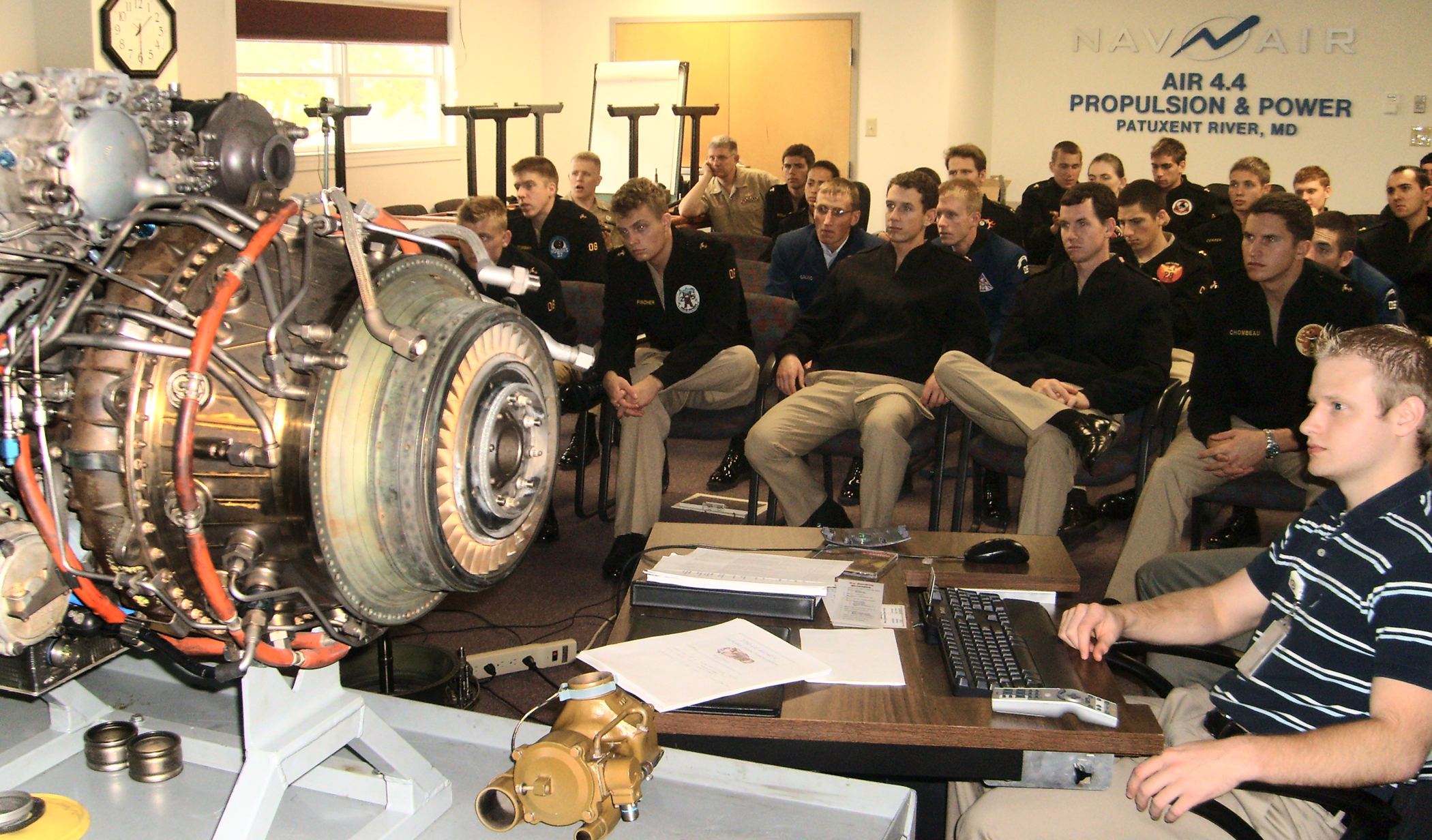
In the afternoon the students went on a tour of the jet engine test equipment at the Propulsion Systems Evaluation Facility. There they got a chance to help tear down the T-700 engine, which powers the MH-60 helicopter, and engineer Andrew Pinaire explained how it worked.
One aspect of his talk that especially caught students’ attention was a discussion of engine failure modes. Pinaire described an engine that had experienced an internal shaft rub severe enough to cause a compressor tie rod failure. He emphasized the importance of investigating failures and resolving deficiencies so Fleet safety is maintained
“It was pretty impressive,” said Firstclassman John Leone. “A lot of what we get in class is very technical – text books and equations. We don’t hear much about failures.”
Electronics engineer Justin Doyle took the students through laboratories including an oil test lab, where lubricants critical to jet engines are analyzed, a rotor burst chamber, where compressor and turbine rotors are deliberately damaged and spun until they fly apart, and an environmental test chamber where engines can be run hard in 125° F air with a salt water mist blown in.
Later at the Patuxent River Naval Air Museum the students got to see 21 past and future Naval aircraft – from a Korean War-era F9 Cougar to the winning and losing prototypes for the J-35 Joint Strike Fighter. Admiral Eggert beamed as he discussed an M-61 Vulcan “Gatling gun” like the one he fired as an A-7 pilot in Vietnam.
Students also saw turbojet and turboprop engines that had been cut away to display the internal components, as well as the Navy’s first aircraft radar unit built with vacuum tubes, a video of sonobuoy deployment from a P-3, and the Pioneer and X-47B unmanned aerial vehicles.
After the tour, Eggert reflected on the Firstclassmen’s future.
“They’re coming into naval aviation at a very interesting time,” he said. “Unmanned vehicles are a reality. Aviators are not a dying breed, but they’re going to have a different role. I think these young people will accommodate to it with the same enthusiasm I felt.”
-USN-
Cutline: Naval Academy students learn engineering details of turboshaft engine test and operation