
Paint Shop improving business the AIRSpeed Way
PAINT 1 CUTLINE
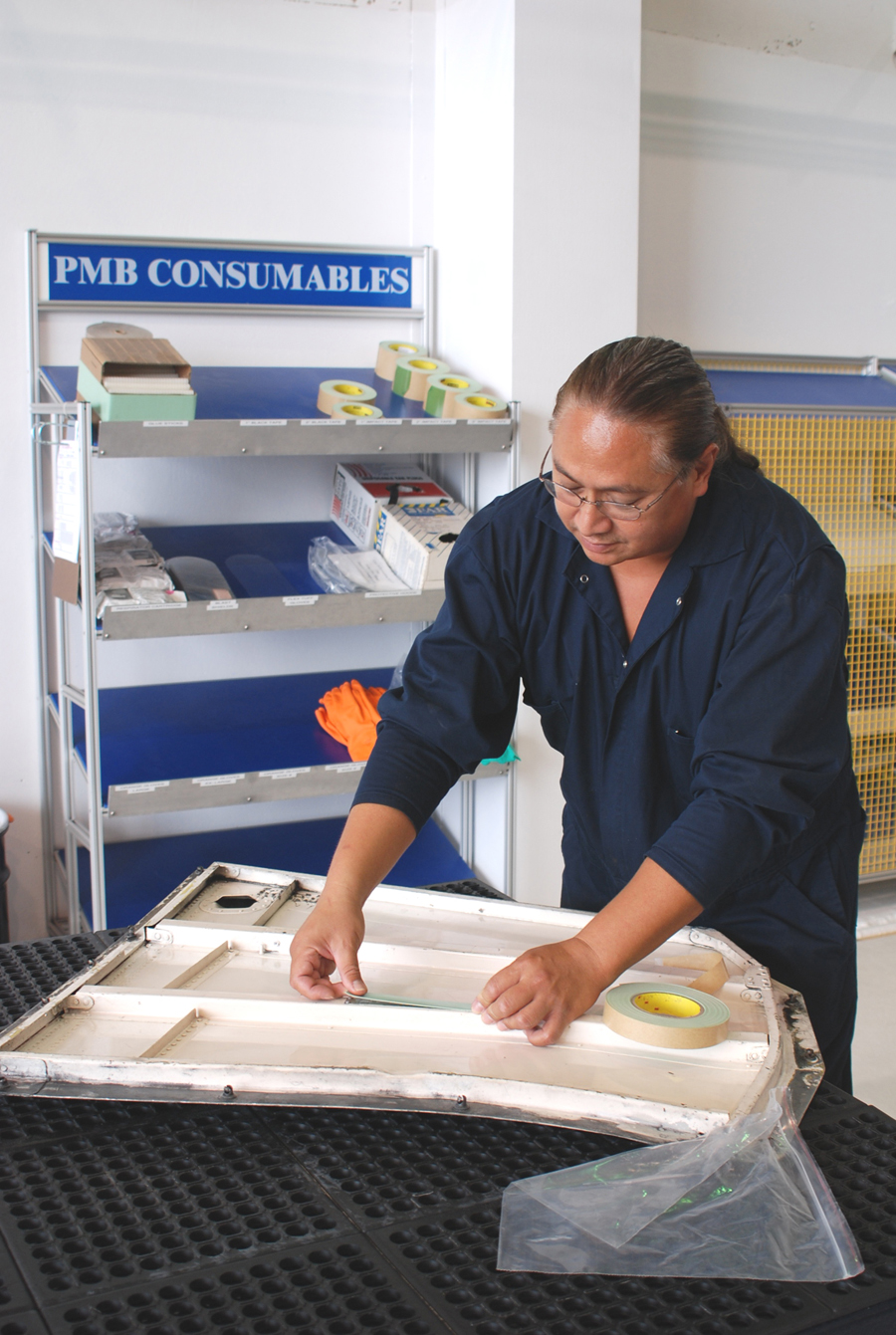
Patrick Orcales, Plastic Media Blast Shop crew leader, tapes an F/A-18 Hornet panel in preparation for painting. Joe Feliciano
Paint Shop Improving Business the AIRSpeed Way
By Jim Markle
NAS NORTH ISLAND – Using a common sense approach and focusing on the premise that eliminating waste leads to a better way of doing business, the Fleet Readiness Center Southwest (FRCSW) Paint Department is looking to AIRSpeed its operations.
The first step towards improvement is to identify the present “as-is” state, or steps involved and the completion time (cycle time or turn-around time) in tasks within the department. This way, any waste involved in completing a task may be identified, explained Walt Loftus, Paint Shop deputy program manager. He added that some procedures are required by regulations, such as environmental, and instructions which must be followed to comply with technical data.
After only seven weeks of analysis, the 16-member AIRSpeed team, which includes artisans, found areas to improve including utilizing time.
“Some of the things we have identified here are the ‘walk and wait’ time where the people are out of the area walking to get something (to accomplish a task). How do you improve your processes by removing the waste out of the system so you can recover that time back to productive time? That’s what we want to look at,” Loftus said.
Pai
Work area lighting was also identified and simultaneously stood as a safety improvement. Loftus said the artisans spent time looking for appropriate lighting to accommodate work inside of helicopters after the aircrafts floor boards were removed. Now resolved, the increased lighting significantly reduces potential mishaps.
New storage benches with electrical outlets have been placed in areas within the department providing artisans ready access to power for tools, lighting and supplies.
“AIRSpeed helps us to do our jobs. It increases our efficiency and because of the centralizing of tools, it helps our parts flow processes so we can increase the capacity of the workload,” said Patrick Orcales, crew leader of the Plastic Media Blast shop.
“It’s recovering the time back from nonproductive time, and by doing that we may eliminate 20 percent of the hours it takes us to complete the job and the turnaround time. So, we’re shortening the turnaround time and reducing the manhours it’s costing us. It will turn into cost-savings for the command,” Loftus said.
A Lean Black Belt, Loftus spent two years applying AIRSpeed tools to the FRCSW F/A-18 Program. He said the path to increasing efficiency and safety within processes may also lie in tooling. For example, he said the AIRSpeed team may review equipment currently used in stripping E-2 rotordomes to see if there’s a better stand for the domes, or a better and safer way to contain stripper as it is removed from aircraft.
Loftus said empowering workers is key to pinpointing areas of improvement. And providing employees with Lean and AIRSpeed training was “laying the foundation for the improvements.”
“We’re basically just there as facilitators for the employees as we try to guide them through the process. They are not our recommendations, but theirs. They come up with the ideas, we help them refine them, and bring them along through the process,” Loftus said.
“AIRSpeed is a continual process. It will never be completed. Initial improvements are usually the easiest ones to make, but as you progress through the AIRSpeed effort, it gets a little more difficult and savings are a little less. With us, even if it’s four hours, that’s half a shift. And here, where we have a five- and six-day turnaround time, for us to reduce that by half a day, that’s really something,” he said.
His ultimate goal is for the Paint Department to perform work faster and at a better cost. “Increasing volume and flow through the facility,” Loftus said, “improves capacity.”